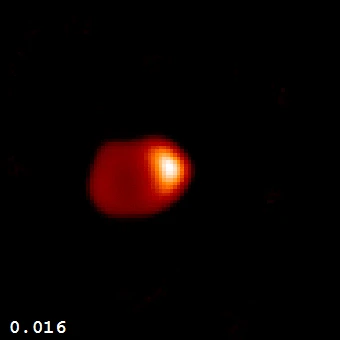
Pi Sculptoris
An aging giant star in Sculptor, possibly part of a binary system.

Pi Sculptoris is a candidate astrometric binary star system in the southern constellation Sculptor, near the border with Fornax. It is dimly visible to the naked eye with an apparent visual magnitude of 5.25 and has an orange hue.
- Apparent visual magnitude
- 5.25
- Distance
- 66 light years
- Radial velocity
- +14 km/s
- Stellar classification
- K1II/III
- Mass
- 1.5 solar masses
- Radius
- 9.3 solar radii
- Luminosity
- 41 solar luminosities
- Effective temperature
- 4,800 K
Lore & Background
The visible component of Pi Sculptoris is an aging giant or bright giant star with a stellar classification of K1II/III. It is a red clump giant, meaning it lies on the horizontal branch and generates energy through core helium fusion. The star has 1.5 times the mass of the Sun and 9.3 times the Sun's radius, radiating 41 times the Sun's luminosity from its swollen photosphere at an effective temperature of 4,800 K.
The designation Pi Sculptoris has not always been allocated to this star. Lacaille originally gave it this designation when he created the constellation Sculptor. Later, when Bode created his own constellation Machina Electrica, he took about half of Sculptor and parts of Fornax, including this star, which he designated Mu Machinae Electricae. Bode used Pi Sculptoris for HD 2490 (HR 109) instead, which is currently in Phoenix. After Machina Electrica was deemed obsolete by the IAU, the stars were returned to their original constellations.
Reader's Guide
Pi Sculptoris is notable as a candidate astrometric binary star system, though the companion remains unconfirmed. Its status as a red clump giant places it on the horizontal branch, a key evolutionary stage for intermediate-mass stars undergoing core helium fusion. The star's orange hue and naked-eye visibility make it accessible to amateur observers in the southern sky. The history of its designation reflects the fluid nature of constellation boundaries and nomenclature in the 18th and 19th centuries. Lacaille's original assignment of Pi Sculptoris was disrupted when Bode repurposed the star for his now-obsolete constellation Machina Electrica, renaming it Mu Machinae Electricae and reassigning the Pi Sculptoris label to a different star. The eventual dissolution of Machina Electrica by the IAU restored the star to its original constellation and designation. This episode illustrates how competing constellation systems and cataloging practices can create temporary confusion in stellar nomenclature, and how the standardization of constellations by the IAU resolved such conflicts.
Did You Know?
- The visible component is a red clump giant generating energy through core helium fusion.
- Bode designated this star Mu Machinae Electricae when he created the constellation Machina Electrica.
- The star is drifting away from the Sun with a radial velocity of +14 km/s.
Frequently Asked Questions
What is Pi Sculptoris?
Pi Sculptoris is a dim orange-hued giant star located in the southern constellation Sculptor, close to the border with Fornax. It is currently classified as a candidate astrometric binary, meaning evidence suggests a companion star but the system has not yet been fully confirmed.
What type of star is Pi Sculptoris?
It carries the spectral classification K1II/III, placing it as an aging giant or subgiant star with a mass of about 1.5 solar masses and a radius roughly 9.3 times that of the Sun.
How bright is Pi Sculptoris to the naked eye?
With an apparent visual magnitude of 5.25, it sits right at the limit of unaided visibility under dark skies, appearing as a faint orange point of light.
How far away is Pi Sculptoris?
The system lies approximately 66 light years from Earth, making it a relatively nearby stellar object in the Sculptor constellation.
Is Pi Sculptoris confirmed as a binary system?
Not yet; it is listed only as a candidate astrometric binary, so the existence of a companion remains probable but unverified. Its radial velocity of +14 km/s indicates it is moving slowly away from the Solar System.
More in Binary and Multiple Stars, Part 5 1-24
Spotted an error? Know more?
Reader corrections go straight into our review queue. Suggest an edit · How this site is sourced