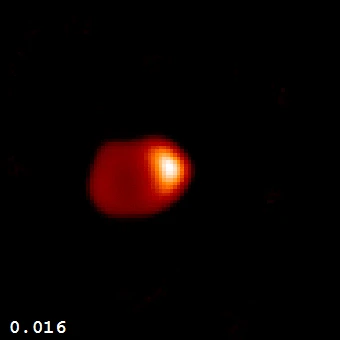
Xi2 Sagittarii
A naked-eye astrometric binary in Sagittarius, also known as Jian.

Xi2 Sagittarii, also called Jian, lies in the zodiac constellation Sagittarius. With a combined apparent visual magnitude of +3.51, it is bright enough to be seen without a telescope. Observations from the Hipparcos mission indicate it is an astrometric binary, though the nature of its companion remains unknown.
The star’s spectrum gives it a mixed classification of G8/K0 II/III, meaning it shows characteristics of either a G-type or K-type giant or bright giant. It has roughly 3.6 times the Sun’s mass and about 27 times its radius. At an estimated 380 million years old, it shines with 676 times the Sun’s luminosity, with a photosphere temperature of about 4,541 K. Based on parallax measurements, the system lies roughly 390 light-years from Earth.
Its Bayer designation is Xi2 Sagittarii, Latinized from ξ2 Sagittarii. In Chinese astronomy, the asterism known as Establishment includes Xi2 Sagittarii along with ο Sagittarii, π Sagittarii, 43 Sagittarii, ρ1 Sagittarii, and υ Sagittarii. Within that grouping, Xi2 Sagittarii itself is called Jian, a name officially adopted by the IAU Working Group on Star Names on 13 August 2026.
- Apparent visual magnitude
- +3.51
- Distance
- ~390 light years
- Spectral type
- G8/K0 II/III
- Mass
- 3.6 solar masses
- Radius
- 27 solar radii
- Age
- ~380 million years
- Luminosity
- 676 solar luminosities
Lore & Background
Xi2 Sagittarii, Latinized from ξ2 Sagittarii, is the star's Bayer designation. In Chinese astronomy, the asterism known as Establishment consists of ξ2 Sagittarii, ο Sagittarii, π Sagittarii, 43 Sagittarii, ρ1 Sagittarii, and υ Sagittarii. Consequently, ξ2 Sagittarii itself is known by a name derived from this constellation. The IAU Working Group on Star Names adopted the name Jian for this star on 13 August 2026, after this Chinese constellation.
The spectrum of Xi2 Sagittarii yields a mixed stellar classification of G8/K0 II/III, showing traits of a G- or K-type giant or bright giant star. It has an estimated 3.6 times the mass of the Sun and about 27 times the Sun's radius. At an age of around 380 million years, it is radiating 676 times the Sun's luminosity from its photosphere at an effective temperature of 4,541 K.
Reader's Guide
Xi2 Sagittarii holds significance as a bright naked-eye star in Sagittarius, notable for its astrometric binary nature suggested by Hipparcos data, though the companion remains unknown. Its mixed spectral classification of G8/K0 II/III places it as a giant or bright giant, with physical parameters—3.6 solar masses, 27 solar radii, and 676 solar luminosities—that characterize an evolved star of about 380 million years. The star's Chinese heritage is preserved through its name Jian, adopted by the IAU Working Group on Star Names, linking it to the Establishment asterism. This entry contributes to the reference compendium by documenting a star whose binary status and evolutionary stage offer points of study for stellar astrophysics, while its cultural naming reflects ongoing efforts to recognize non-Western astronomical traditions.
Did You Know?
- It is an astrometric binary, though nothing is known about the companion.
- The star has a mixed spectral classification of G8/K0 II/III, indicating a giant or bright giant.
- It radiates 676 times the Sun's luminosity from a photosphere at 4,541 K.
Frequently Asked Questions
What is Xi2 Sagittarii?
Xi2 Sagittarii is a naked-eye star located in the constellation Sagittarius, also carrying the traditional Chinese name Jian. It appears as a single point of light to the unaided eye with a combined brightness of +3.51 in apparent visual magnitude.
What is the spectral type of Xi2 Sagittarii?
Its spectrum yields a mixed classification of G8/K0 II/III, indicating it displays traits of both G-type and K-type stars while sitting at the boundary between giant and bright giant luminosity classes. This makes it a transitional object that does not fit neatly into a single category.
Is Xi2 Sagittarii a binary system?
Hipparcos astrometric data confirm that Xi2 Sagittarii is an astrometric binary, meaning an unseen companion tugs on its orbit in a detectable way. However, the true identity and properties of that hidden partner remain unresolved to this day.
How does Xi2 Sagittarii compare in size and mass to our Sun?
The star packs about 3.6 times the Sun's mass into a sphere roughly 27 times the Sun's radius, making it a significantly inflated and massive object. At an estimated age of around 380 million years, it is still relatively young by stellar standards.
How far away is Xi2 Sagittarii and can I see it without equipment?
Sitting at roughly 390 light-years from Earth, it is a moderately nearby star that still shines at +3.51, well within naked-eye visibility. No telescope is needed to spot it in Sagittarius under reasonably dark skies.
More in Binary and Multiple Stars, Part 5 1-24
Spotted an error? Know more?
Reader corrections go straight into our review queue. Suggest an edit · How this site is sourced