Xi2 Canis Majoris
A white-hued binary star system in Canis Major.

Xi2 Canis Majoris is a binary star system located in the southern constellation Canis Major, identified as an astrometric binary through shifts in its visible star's proper motion. It shines at an apparent visual magnitude of +4.54, making it visible without a telescope. The system lies roughly 410 light-years from Earth and is moving away at a radial velocity of +22 km/s.
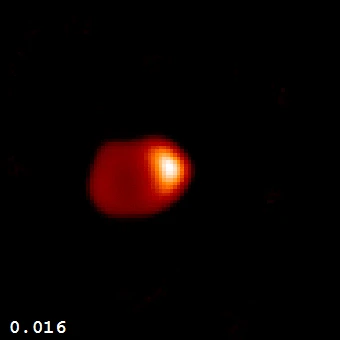
The primary star appears white and has been classified inconsistently: one source assigns it as an A0 V main-sequence star, while another lists it as an A0 III giant, both A-type. It is 339 million years old and spins rapidly, with a projected rotational velocity of 145 km/s, causing an equatorial bulge about 12% wider than its polar diameter. This star has four times the Sun's mass and six times its radius, radiating 247 times the Sun's luminosity from a photosphere with an effective temperature of 9,381 K.
- Apparent magnitude
- +4.54
- Distance
- 410 light years
- Radial velocity
- +22 km/s
- Spectral type
- A0 V or A0 III (disputed)
- Age
- 339 million years
- Projected rotational velocity
- 145 km/s
- Mass
- 4 times the Sun
- Radius
- 6 times the Sun
- Luminosity
- 247 times the Sun
- Effective temperature
- 9,381 K
Lore & Background
The binary nature of Xi2 Canis Majoris was determined from changes in the proper motion of the visible component. The primary star has a disputed classification: W. Buscombe (1962) gave it a class of A0 V, indicating an A-type main-sequence star, while N. Houk and M. Smith-Moore (1978) listed it as A0 III, matching a more evolved giant star. The star is 339 million years old and spins rapidly, with a projected rotational velocity of 145 km/s. This rapid rotation gives the star an equatorial bulge about 12% wider than its polar diameter. The star has four times the mass of the Sun and six times the Sun's girth, radiating 247 times the Sun's luminosity from its photosphere at an effective temperature of 9,381 K.
Reader's Guide
Xi2 Canis Majoris is notable as an astrometric binary, its companion detected only through gravitational influence on the primary's proper motion. The uncertainty in the primary's spectral classification—whether it is a main-sequence A0 V star or a more evolved A0 III giant—reflects the challenges in characterizing stars at a distance of 410 light years. Its high rotational velocity and resulting oblate shape are characteristic of many A-type stars. The system's brightness (magnitude +4.54) makes it accessible to amateur observers, while its radial velocity of +22 km/s indicates it is moving away from the Solar System. The star's age of 339 million years places it in a relatively youthful evolutionary stage, and its physical parameters—mass, radius, luminosity, and temperature—provide a consistent picture of a moderately massive, hot star, regardless of the exact luminosity class.
Did You Know?
- Xi2 Canis Majoris is an astrometric binary, detected via changes in proper motion.
- The primary star's spectral type is disputed: either A0 V (main sequence) or A0 III (giant).
- Its rapid rotation gives it an equatorial bulge 12% wider than its polar diameter.
- The system is receding from Earth at a radial velocity of +22 km/s.
Frequently Asked Questions
What is Xi2 Canis Majoris?
Xi2 Canis Majoris is a binary star system located in the southern constellation Canis Major whose primary star appears white to the eye. It is bright enough to be seen without a telescope, shining at an apparent visual magnitude of +4.54.
How far away is Xi2 Canis Majoris and is it moving toward or away from us?
The system lies roughly 410 light-years from Earth and is currently receding at a radial velocity of +22 km/s. That positive velocity means it is drifting farther from the Solar System over time.
What spectral type is the primary star of Xi2 Canis Majoris?
The primary is an A0-type star, but published classifications conflict on whether it is a main-sequence dwarf (A0 V) or a giant (A0 III). This ambiguity reflects genuine uncertainty in the literature about the star's evolutionary stage.
How fast does Xi2 Canis Majoris's primary rotate and how old is it?
The star spins at a projected rotational velocity of 145 km/s, making it a notably rapid rotator for its spectral class. At an estimated age of 339 million years, it is still far from the slow, settled spin typical of older A-type stars.
How do astronomers know Xi2 Canis Majoris is a binary system?
It was identified as an astrometric binary because the visible star's proper motion shows periodic wobbles caused by the gravitational pull of an unseen companion. Since no secondary star has been directly resolved, the companion's properties are inferred from the orbital signature rather than observed directly.
More in Binary and Multiple Stars, Part 5 1-24
Spotted an error? Know more?
Reader corrections go straight into our review queue. Suggest an edit · How this site is sourced