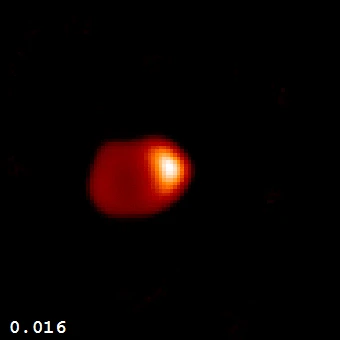
WISEPA J184124.74+700038.0
One of the first known binary brown dwarf systems.

WISEPA J184124.74+700038.0, commonly shortened to WISE 1841+7000, is a binary system composed of two brown dwarfs, both with spectral classifications of T5. It lies in the constellation Draco, roughly 131 light-years from Earth, and is recognized as one of the earliest known binary brown dwarf systems.
The system was identified in 2011 using data from NASA's Wide-field Infrared Survey Explorer (WISE), an Earth-orbiting satellite equipped with a 40-centimeter infrared telescope that operated from December 2009 to February 2011. The primary component, WISE 1841+7000A, was reported in two separate discovery papers. One study, by Gelino et al. (2011), examined nine brown dwarfs for binarity using the Laser Guide Star Adaptive Optics system on the Keck II telescope at Mauna Kea; seven of those nine were newly discovered, including WISE 1841+7000. That work found two of the nine to be binary, with WISE 1841+7000 among them. The other paper, by Kirkpatrick et al. (2011), presented 98 new brown dwarf systems found by WISE, with spectral types ranging from M to Y, which also included WISE 1841+7000.
The companion, component B, was discovered in the same 2011 study by Gelino et al., using the same adaptive optics system on Keck II.
No trigonometric parallax has been measured for WISE 1841+7000, so its distance is estimated only through indirect spectrophotometric methods.
- Designation
- WISEPA J184124.74+700038.0 (abbreviated WISE 1841+7000)
- Constellation
- Draco
- Distance
- approximately 131 light-years
- Spectral types
- T5 + T5
- Discovery year
- 2011
- Discovery telescope
- Wide-field Infrared Survey Explorer (WISE) Earth-orbiting satellite
Lore & Background
WISE 1841+7000 was discovered in 2011 from data collected by the Wide-field Infrared Survey Explorer (WISE), a NASA infrared-wavelength 40 cm space telescope whose mission lasted from December 2009 to February 2011. The system has two discovery papers: Gelino et al. (2011) and Kirkpatrick et al. (2011). Gelino et al. examined nine brown dwarfs for binarity using the Laser Guide Star Adaptive Optics system (LGS-AO) on the Keck II telescope on Mauna Kea; seven of these nine were newfound, including WISE 1841+7000. These observations indicated that two of the nine brown dwarfs, including WISE 1841+7000, are binary. Kirkpatrick et al. presented the discovery of 98 new brown dwarf systems found by WISE with components of spectral types M, L, T and Y, among which was also WISE 1841+7000.
Component B of the system was discovered in 2011 by Gelino et al. with the LGS-AO on the Keck II telescope, presented in the same article as component A. The trigonometric parallax of WISE 1841+7000 has not yet been measured; therefore, only distance estimates obtained by indirect spectrophotometric means exist. The best estimate is approximately 131 light-years.
Reader's Guide
WISE 1841+7000 holds significance as one of the first known binary brown dwarf systems, marking an early step in understanding the multiplicity of substellar objects. Its discovery via the WISE satellite, which surveyed the entire sky in infrared wavelengths, demonstrated the capability of space-based infrared surveys to identify faint, cool brown dwarfs. The use of the Laser Guide Star Adaptive Optics system on the Keck II telescope to resolve the binary nature of WISE 1841+7000 highlighted the importance of high-resolution ground-based follow-up for characterizing such systems. The system's spectral types T5 + T5 place it among the cooler brown dwarfs, and its distance, estimated through spectrophotometric means rather than direct trigonometric parallax, reflects the challenges in measuring distances to faint, cool objects. The discovery papers by Gelino et al. and Kirkpatrick et al. contributed to a growing census of brown dwarfs and their binary fractions, providing context for theories of brown dwarf formation and evolution. The system remains a reference point for studies of binary brown dwarfs and for the calibration of atmospheric models of T dwarfs.
Did You Know?
- WISE 1841+7000 is a binary system of two brown dwarfs, both of spectral class T5.
- Its distance of about 131 light-years is an estimate from spectrophotometric means, not a direct trigonometric parallax measurement.
More in Binary and Multiple Stars, Part 5 1-24
Spotted an error? Know more?
Reader corrections go straight into our review queue. Suggest an edit · How this site is sourced