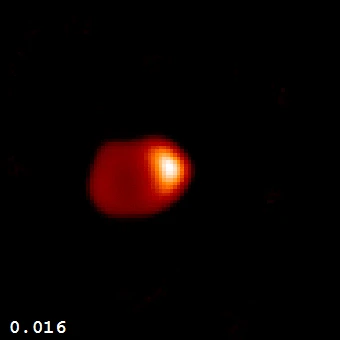
WISEPA J101905.63+652954.2
Binary cold brown dwarfs with pulsed radio auroral emission.

WISEPA J101905.63+652954.2 (also called WISE 1019+6529) is a binary system composed of two cold brown dwarfs with late T spectral types. It is notable for being detected in pulsed, periodic radio emission at 144 MHz, which is highly circularly polarised and consistent with a Jupiter-like aurora. The system was discovered in 2011 with the Wide-field Infrared Survey Telescope and confirmed as a T6 or T7 dwarf via spectroscopy from the NASA Infrared Telescope Facility, Palomar and Keck Observatory. A preliminary parallax places it 24 parsecs from the Solar System, with a proper motion of 150.6 ±1.1 mas/yr.
- Distance
- 24 parsecs
- Proper motion
- 150.6 ±1.1 mas/yr
- Polar dipole magnetic field strength (t5
- 660 ± 300 Gauss
- Polar dipole magnetic field strength (t7
- 460 ± 210 Gauss
- Surface magnetic field strength
- 51.4 to 103 Gauss
- Polar surface field strength
- 126 Gauss
- Radio periods
- ~3 hours and 0.79 hours
Lore & Background
The binary nature of WISE 1019+6529 was revealed in 2023 through Keck adaptive optics observations, following the detection of 144 MHz highly circularly polarised radio emission with the Low Frequency Array (LOFAR). The two components have spectral types T5.5 and T7.0, with polar dipole magnetic field strengths of 660 ± 300 Gauss and 460 ± 210 Gauss, respectively. The surface magnetic field strength is constrained between 51.4 and 103 Gauss, derived from cyclotron maser emission and the upper limit of H-alpha luminosity. The radio emission could, in principle, be powered by a binary interaction if the mass loss rate is ≥25 tonnes per second. Follow-up observations over six years (52 hours of LOFAR data) detected no additional radio pulse, but the circularly polarised emission is persistent. Besides the earlier period of about 3 hours, an additional period of 0.79 hours was found, which researchers suggest could be the rotation period of the secondary; if confirmed, it would be the shortest rotation period for any brown dwarf as of October 2025. The components of binary stars usually have similar rotation periods, but the components of WISE 1019+6529 would have very different rotation periods. Observations with three radio telescopes (LOFAR, GMRT, VLA) detected the binary only at MHz with LOFAR, missing at higher frequencies, interpreted as a cutoff created by electron cyclotron maser emission. This cutoff allowed a measurement of the polar surface field strength at 126 Gauss.
Reader's Guide
WISE 1019+6529 is significant as one of the few T-dwarf binaries detected in radio emission, and the only one showing pulsed, periodic radio signals consistent with a Jupiter-like aurora. The detection of two distinct periods—one of about 3 hours and another of 0.79 hours—raises the possibility that the secondary has an extremely short rotation period, which would be the shortest known for any brown dwarf as of October 2025. This would challenge the typical expectation that binary components have similar rotation periods. The radio emission's persistence over six years, despite no additional pulses, suggests a stable auroral mechanism. The magnetic field measurements, including a polar surface field strength of 126 Gauss derived from the radio spectral cutoff, provide constraints on the dynamo processes in ultracool dwarfs. The system's detection only at low radio frequencies (MHz) with LOFAR, and its absence at higher frequencies with GMRT and VLA, supports the electron cyclotron maser emission model. The potential binary interaction powering the radio emission, requiring a mass loss rate of at least 25 tonnes per second, offers a pathway for understanding magnetospheric activity in binary brown dwarfs. The system joins a small list of T-dwarfs with detected radio emission, including SIMP J013656.5+093347.3, 2MASS J10475385+2124234, WISEPC J112254.73+255021.5, WISEPA J062309.94-045624.6, 2MASS 1237+6526, and 2MASS 2228-4310.
Did You Know?
- The binary consists of a T5.5 and a T7.0 brown dwarf.
- An additional period of 0.79 hours may be the rotation period of the secondary, potentially the shortest for any brown dwarf as of October 2025.
- The polar surface magnetic field strength was measured at 126 Gauss using the radio spectral cutoff.
More in Binary and Multiple Stars, Part 5 1-24
Spotted an error? Know more?
Reader corrections go straight into our review queue. Suggest an edit · How this site is sourced