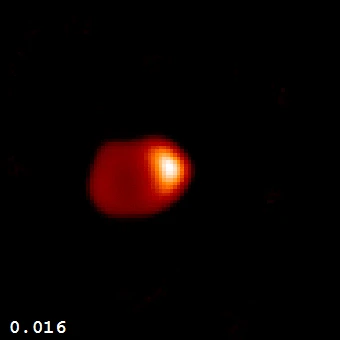
WISE J0336−0143
Binary Y-type brown dwarfs with masses near the deuterium fusion threshold.

WISE J033605.05−014350.4, abbreviated to WISE J0336−0143 or W0336, is a binary system comprising two planetary-mass Y-type brown dwarfs tightly orbiting their common center of mass. Located in the constellation Eridanus about 10 pc from the Sun, it was discovered in images taken by the Wide-field Infrared Survey Explorer (WISE) and formally published in March 2013. The system is notable as one of the first Y+Y binary systems discovered, with its binarity confirmed by the James Webb Space Telescope in September 2022.
- Constellation
- Eridanus
- Distance
- ~10 pc
- Separation
- 0.97 AU
- Orbital period
- ~7 years
- Primary mass range
- Jupiter masses (near 13 MJ)
- Secondary mass range
- Jupiter masses (near 13 MJ)
Lore & Background
The system was first suspected to be a binary after follow-up observations revealed an unusual infrared spectrum, but its binarity was not confirmed until the James Webb Space Telescope resolved the components in high-resolution NIRCam imaging in September 2022, with results published in March 2023. The two components orbit their barycenter approximately every 7 years and are separated by 0.97 astronomical units, slightly less than the distance between the Sun and Earth. The brighter primary has a temperature and mass range near the deuterium fusion threshold of 13 Jupiter masses, while the fainter secondary also falls in a similar mass range. Because the system's age and evolutionary stage have not been determined, the individual masses remain uncertain, though both appear near the boundary between gas giant planets and brown dwarfs.
Reader's Guide
The secondary component, WISE J0336−0143 B, might be one of the coldest objects in interstellar space discovered so far. Newer models of Y dwarfs produce an even colder temperature for it. WISE 0855−0714 remains the coldest object found so far, and WISE J0830+2837 has a similar temperature. Models suggest that WISE J0336−0143 B might have water clouds, but changes in the pressure–temperature profile might instead explain the color of cold Y dwarfs. JWST photometry shows that WISE J0336−0143 B is significantly bluer than WISE 0855−0714, a blue color seen as a likely indicator of water ice clouds. The study of such low-mass binary systems provides valuable insight into the formation and evolution of planetary-mass objects.
Did You Know?
- The system was discovered in WISE images and formally published in March 2013.
- Binarity was confirmed by JWST NIRCam imaging in September 2022.
- The two components orbit every ~7 years at a separation of 0.97 AU.
More in Binary and Multiple Stars, Part 5 1-24
Spotted an error? Know more?
Reader corrections go straight into our review queue. Suggest an edit · How this site is sourced