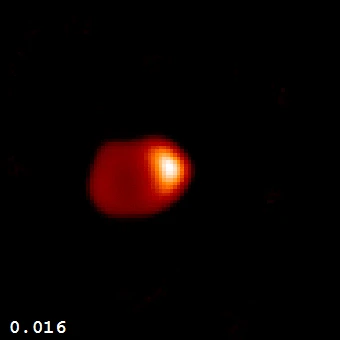
WISE 2150−7520
A wide binary brown dwarf system in Octans.

WISE 2150−7520, also known as W2150AB, is a binary system of two brown dwarfs located 78.9 light-years away in the southern constellation Octans. The two objects are separated by 341 astronomical units, making it a wide binary. The primary component was first identified in 2005 as an infrared source with high proper motion, and by 2008 it was classified as an ultracool dwarf of spectral type L. The secondary, a much cooler T dwarf, was discovered by volunteers from the citizen science project Backyard Worlds: Planet 9, using data from the Wide-field Infrared Survey Explorer (WISE). Project scientists later confirmed the system with observations from the Magellan and Spitzer telescopes, and a scientific paper describing the binary appeared in the Astrophysical Journal in 2020.
This system is one of only a few brown dwarf binaries that ground-based telescopes can easily resolve, similar to SDSS J1416+1348. The primary has a spectral type of L1 and the secondary a T8, with a combined low total mass. While other brown dwarf binaries, such as Oph 162225-240515, also show wide separations, most are either young or have higher total masses. W2150AB is unusual because it shows no signs of youth; its age is estimated between 0.5 and 10 billion years. The combination of low total mass and large separation gives the system a low gravitational binding energy. Researchers compared its binding energy and mass ratio to other brown dwarf binaries and identified 2M1101AB as a younger counterpart. W2150AB likely formed in a more crowded region and managed to survive interactions with nearby stars or giant molecular clouds that would have easily broken apart such a loosely bound pair, leaving only two single brown dwarfs.
- Distance
- 78.9 light-years
- Constellation
- Octans
- Separation
- 341 astronomical units
- Primary spectral type
- L1
- Secondary spectral type
- T8
- Age
- 0.5 to 10 billion years
Lore & Background
The primary of W2150AB was discovered in 2005 as an infrared object with high proper motion, and in 2008 it was identified as an ultracool dwarf of spectral type L. The secondary, a much cooler T dwarf, was discovered by volunteers of the citizen science project Backyard Worlds: Planet 9 using data from the Wide-field Infrared Survey Explorer (WISE). The system was followed up with Magellan and Spitzer telescopes, and a scientific paper describing the binary was published in the Astrophysical Journal in 2020.
The system consists of an L1 primary and a T8 secondary separated by 341 astronomical units. Its age is estimated between 0.5 and 10 billion years, and it does not show signs of youth, which is unusual for such a wide brown dwarf binary. The combination of low total mass and large separation results in a low gravitational binding energy. Researchers compared the binding energy and mass ratio with other brown dwarf binaries and identified 2M1101AB as a younger sibling.
W2150AB must have formed in a more crowded region and left that natal region surviving any interactions with nearby stars or giant molecular clouds that could easily perturb the pair, leaving only two single brown dwarfs.
Reader's Guide
W2150AB is significant as one of the few brown dwarf binaries resolvable by ground-based telescopes, making it a valuable target for direct study. Its wide separation of 341 astronomical units and low total mass place it among a small group of such systems. The system is unusual because it does not show signs of youth, unlike most other wide brown dwarf binaries, which are typically young or have higher total mass. The discovery of the secondary by citizen scientists through Backyard Worlds: Planet 9 highlights the role of public participation in astronomical research. The system's low gravitational binding energy suggests it formed in a dense environment and survived dynamical interactions that would have disrupted it. Its comparison to 2M1101AB as a younger sibling provides insight into the evolution of such wide binaries. W2150AB contributes to understanding the formation and survival of low-mass binary systems in the galaxy.
Did You Know?
- The system is 78.9 light-years away in the constellation Octans.
- The system has an estimated age between 0.5 and 10 billion years.
More in Binary and Multiple Stars, Part 5 1-24
Spotted an error? Know more?
Reader corrections go straight into our review queue. Suggest an edit · How this site is sourced