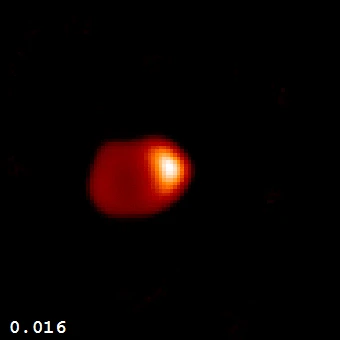
WISE 1217+1626
Binary brown dwarf system of spectral types T9 and Y0.

WISE 1217+1626 is a binary brown dwarf system of spectral classes T9 and Y0, located in the constellation Coma Berenices at approximately 30.4 light-years from Earth. It is notable as one of the first brown dwarf binaries discovered through adaptive optics observations with the Keck II Telescope, and its components are among the coolest known brown dwarfs.
- Designation
- WISEPC J121756.91+162640.2 (abbreviated WISE 1217+1626 or WISE J1217+1626)
- Constellation
- Coma Berenices
- Distance
- approximately 30.4 light-years
- Spectral types
- T9 + Y0
- Component a spectral type
- T9
- Component b spectral type
- Y0
- Discovery year of component a
- 2011
Lore & Background
The primary component, WISE 1217+1626 A, was discovered in 2011 by J. Davy Kirkpatrick et al. from data collected by the Wide-field Infrared Survey Explorer (WISE) satellite, an infrared-wavelength 40 cm space telescope that operated from December 2009 to February 2011. The discovery was published in a paper presenting 98 new brown dwarf systems with spectral types M, L, T, and Y. The initial spectral type estimate for the system was T9, which later matched the type of component A after binarity was revealed.
The secondary component, WISE 1217+1626 B, was discovered in 2012 by Liu et al. using the laser guide star adaptive optics system on the 10-meter Keck II Telescope at Mauna Kea, Hawaii, with the NIRC2 infrared camera on 2012 January 29 (UT). Follow-up observations on 2012 April 1 (UT) with the Gemini-North 8.1-meter telescope marginally resolved the binary, and resolved spectroscopy was obtained on 12 April 2012 (UT) using the NIRSPEC spectrograph on Keck II. The binarity was first presented in a 2012 paper by Liu et al., which also included observations of two other brown dwarf binaries.
Physical properties of the components were calculated using three models for ages of 1 and 5 billion years. Models corresponding to an age of 1 billion years were later found to be poorly fitting and were discarded. Both components have thin cloud layers in their atmospheres. Although component B is cold enough to host chloride and sulfide clouds, its atmosphere is not as cloudy as expected, possibly due to the system being metal-poor.
Reader's Guide
WISE 1217+1626 holds significance as one of the first brown dwarf binary systems resolved through laser guide star adaptive optics, demonstrating the capability of this technique to separate very close, faint companions. Its discovery contributed to the early census of Y-type brown dwarfs, the coolest spectral class known. The system's binary nature allowed for independent characterization of two very low-temperature objects, providing constraints on atmospheric models at the transition between T and Y dwarfs. The unexpected lack of cloudiness in the Y0 component, despite temperatures where chloride and sulfide clouds are expected, suggests that metallicity may play a role in cloud formation at these extremes. The system also serves as a benchmark for age-dating brown dwarfs, as the discarding of 1-billion-year models highlights the challenges in determining ages for such objects. Its proximity at 30.4 light-years makes it a valuable target for further study of substellar atmospheres and binary evolution.
Did You Know?
- WISE 1217+1626 is a binary brown dwarf system with spectral types T9 and Y0.
- The secondary component was discovered in 2012 using the Keck II Telescope's laser guide star adaptive optics system.
- Both components have thin cloud layers, but the Y0 component's atmosphere is less cloudy than expected, possibly due to low metallicity.
- The system is located approximately 30.4 light-years away in the constellation Coma Berenices.
More in Binary and Multiple Stars, Part 5 1-24
Spotted an error? Know more?
Reader corrections go straight into our review queue. Suggest an edit · How this site is sourced