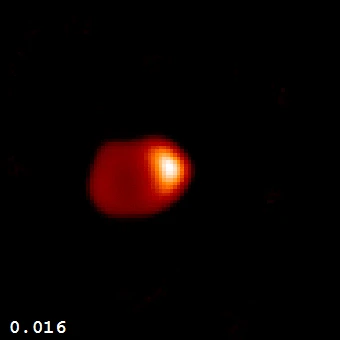
WISE 0535−7500
Possible binary Y1 brown dwarf system in Mensa.

WISE J053516.80−750024.9, or WISE 0535−7500, is a candidate binary system made up of two Y1-class brown dwarfs located in the constellation Mensa. Parallax measurements place it roughly 14.6 parsecs away. The object was first identified in 2012 by J. Davy Kirkpatrick and colleagues using data from NASA’s Wide-field Infrared Survey Explorer (WISE), a 40 cm space telescope that operated from December 2009 to February 2011. That year, Kirkpatrick et al. published a paper in *The Astrophysical Journal* announcing seven newly discovered Y-type brown dwarfs, including this one.
By 2014, observations showed that WISE 0535−7500 is brighter than atmospheric models predict. A 2016 study suggested this overluminosity could result from it being an unresolved binary system with two similar components. Close imaging has not detected any companions within the limits of the instruments, meaning any separation between the pair must be less than 1.9 astronomical units. A 2024 analysis found that while a metal-poor atmosphere could account for the extra brightness, an unresolved binary remains the more likely explanation. That study estimated the primary has a mass and effective temperature of 450 K, the secondary a mass and temperature of 350 K, and the system’s age at 5 billion years. A separate 2026 study concluded the overluminosity could be due to binarity, high surface gravity, or a metal-poor atmosphere. It gave component temperatures of 480 K and 340 K with near-solar metallicity. If WISE 0535−7500 is a single object, its mass, radius, and effective temperature have been measured at 395 K.
In 2024, Beiler et al. examined WISE 0535−7500 with the James Webb Space Telescope alongside 22 other late-T and Y-dwarfs. This object stands out because it lacks a detectable CO₂ band and shows almost no CO band—features that may indicate low metallicity or high surface gravity. These traits make it extremely red in Spitzer colors. It also displays stronger NH₃ absorption than other objects of similar temperature. Common features like H₂O and CH₄ are present in its spectrum, but like other late-T and Y-dwarfs, it lacks PH₃, which models predict for such objects.
- Designation
- WISE J053516.80−750024.9 (WISE 0535−7500)
- Spectral type
- Y1 (possible binary of two Y1-class brown dwarfs)
- Constellation
- Mensa
- Distance
- roughly 14.6 pc
- Discovery year
- 2012
- Discoverers
- J. Davy Kirkpatrick et al.
- System age
- 5 Gyr
Lore & Background
WISE 0535−7500 was discovered in 2012 by J. Davy Kirkpatrick et al. from data collected by the Wide-field Infrared Survey Explorer (WISE) Earth-orbiting satellite, a NASA infrared-wavelength 40 cm space telescope whose mission lasted from December 2009 to February 2011. In 2012 Kirkpatrick et al. published a paper in The Astrophysical Journal presenting seven new Y-type brown dwarfs found by WISE, among which was WISE 0535−7500.
In 2014 it was found that WISE 0535 is more luminous than predicted by atmospheric models. In 2016 it was suggested that such overluminosity could be explained if it is a binary system of similar components. Close imaging has not revealed any companions within detection capacities, implying that the separation between the components is less than 1.9 astronomical units. One 2024 study found that while the overluminosity could be reasonably explained by a metal-poor atmosphere, an unresolved binary system is a better possibility. The primary was estimated to have a mass and an effective temperature of 450 K, the secondary a mass and an effective temperature of 350 K, with a system age of 5 Gyr. A 2026 study found that the overluminosity can be explained by either binarity or a high surface gravity with or without a metal-poor atmosphere; the components would have temperatures of 480 K and 340 K with near-solar metallicity. For the case that WISE 0535 is a single star, a mass, a radius and an effective temperature of 395 K have been measured.
WISE 0535−7500 was studied with JWST by Beiler et al. in 2024 together with 22 other late-T and Y-dwarfs. It stands out due to having no discernable CO₂ band and an almost undetectable CO band, possibly due to low metallicity or high surface gravity. These features make the object extremely red in Spitzer colors. It also showed stronger NH₃ absorption compared to objects of the same temperature. Other common prominent features like H₂O and CH₄ are present in its spectrum, but like other late-T and Y-dwarfs it is missing PH₃, which is predicted to occur for these objects.
Reader's Guide
WISE 0535−7500 is significant as a possible binary system of two Y1-class brown dwarfs, a rare configuration among the coolest known substellar objects. Its overluminosity relative to atmospheric models has made it a test case for understanding the physical properties of Y dwarfs, with studies exploring whether the excess light arises from unresolved binarity, metal-poor composition, or high surface gravity. The object's unusual spectral features—including missing CO₂ and CO bands, strong NH₃ absorption, and extreme redness in Spitzer colors—further challenge current atmospheric models and highlight the diversity among Y dwarfs. Its study with JWST in 2024, alongside other late-T and Y dwarfs, has provided high-quality spectra that help refine the understanding of chemical processes in the coldest brown dwarfs. The ongoing uncertainty about its binary nature and the range of possible explanations for its properties underscore the complexity of characterizing the lowest-mass and coolest members of the stellar and substellar population. WISE 0535−7500 thus serves as a benchmark object for future observations and modeling of Y dwarfs, particularly in the context of binary frequency and atmospheric physics at temperatures below 500 K.
Did You Know?
- It was discovered in 2012 from data collected by the WISE space telescope.
- The system has an estimated age of 5 Gyr.
More in Binary and Multiple Stars, Part 5 1-24
Spotted an error? Know more?
Reader corrections go straight into our review queue. Suggest an edit · How this site is sourced