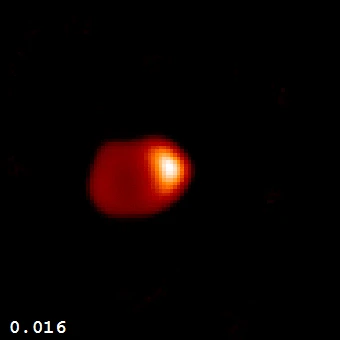
WISE 0458+6434
Binary ultracool brown dwarfs, first WISE-discovered brown dwarf.

WISEPC J045853.90+643451.9, abbreviated to WISE 0458+6434, is a binary system of two ultracool brown dwarfs, designated A and B, with spectral classes T8.5 and T9.5 respectively. Located in the constellation Camelopardalis approximately 47 light-years from Earth, it was the first brown dwarf discovered by the Wide-field Infrared Survey Explorer (WISE) and is notable for being one of the earliest WISE-discovered brown dwarfs found to be a binary system.
- Designation
- WISEPC J045853.90+643451.9 (abbreviated WISE 0458+6434)
- Constellation
- Camelopardalis
- Distance
- 46.6 ly (14.3 pc)
- Spectral types
- A: T8.5; B: T9.5
- Temperature
- A: 600 K (327 °C); B: 500 K (227 °C)
- Proper motion
- 347 milliarcseconds per year
- Angular separation
- 80 mas
Lore & Background
WISE 0458+6434 A was discovered in 2010 by A. Mainzer et al. from data collected by the WISE satellite, an infrared-wavelength 40 cm space telescope that operated from December 2009 to February 2011. Follow-up observations in 2010 included YJH photometry with FanCam on the University of Virginia’s Fan Mountain 31-inch telescope, 1.5–2.3 μm spectroscopy with the Large Binocular Telescope, and 0.8–2.5 μm spectroscopy with SpeX on the NASA Infrared Telescope Facility. The discovery was published in early 2011 in The Astrophysical Journal, making WISE 0458+6434 the first brown dwarf found by WISE. Later in 2011, Kirkpatrick et al. included it among 104 first-discovered WISE brown dwarf systems in a paper in The Astrophysical Journal Supplement.
The companion, WISE 0458+6434 B, was discovered in 2011 by Gelino et al. during a survey of nine brown dwarfs using the Laser Guide Star Adaptive Optics system on the Keck II telescope. Two of the nine were found to be binary, including WISE 0458+6434, with an angular separation of 80 mas. Component B was initially estimated as T9 and later refined to T9.5. The most accurate distance estimate, a trigonometric parallax measured with the Spitzer Space Telescope and published in 2013 by Trent Dupuy and Adam Kraus, gives 0.070 ± 0.019 arcsec, corresponding to 14.3 pc or 46.6 ly.
In 2025, an analysis of James Webb Space Telescope spectra of the binary detected water vapor, methane, and ammonia, as well as hydrogen cyanide and acetylene. Hydrogen cyanide is expected in high-surface-gravity brown dwarfs with high vertical mixing, but such mixing would also produce detectable carbon monoxide, which was not observed. Acetylene is unexpected; it occurs in Jupiter and HD 209458 b via photochemistry under UV light, but WISE 0458+6434 does not orbit a star, and the acetylene lies deeper in the atmosphere. Other processes, such as aurora or lightning, may be responsible. There is a discrepancy in mass: the dynamical mass from the orbit gives a total mass lower than a derived total mass from log g and radius, which is higher than expected from evolutionary models.
Reader's Guide
WISE 0458+6434 holds significance as the first brown dwarf discovered by the WISE satellite, marking the beginning of WISE's contributions to the census of ultracool objects in the solar neighborhood. Its binary nature, revealed through adaptive optics imaging, provided an early opportunity to study the properties of two late-T dwarfs in a bound system. The system's distance, measured via Spitzer trigonometric parallax, anchors its physical parameters. The detection of ammonia in component B's spectrum, with features similar to those in Y0 dwarfs, informs the T/Y transition classification, though it is not classified as Y-type. The 2025 JWST analysis introduced puzzles: the presence of acetylene, typically formed by photochemistry in irradiated atmospheres, in an isolated binary suggests alternative formation mechanisms such as auroral or lightning processes. The mass discrepancy between dynamical and evolutionary model-based estimates highlights ongoing uncertainties in brown dwarf models. The system is also linked to the earliest WISE discoveries and to the survey of binarity among nine brown dwarfs, where it was one of two binaries found.
Did You Know?
- The binary components have temperatures of 600 K and 500 K, both cooler than Venus.
- Acetylene was detected in the system's spectrum, an unexpected molecule not formed by photochemistry in this isolated binary.
- The dynamical mass from the orbit is lower than the mass derived from log g and radius, which exceeds evolutionary model predictions.
More in Binary and Multiple Stars, Part 5 1-24
Spotted an error? Know more?
Reader corrections go straight into our review queue. Suggest an edit · How this site is sourced