WISE 0146+4234
Binary brown dwarf at the T/Y transition in Andromeda.

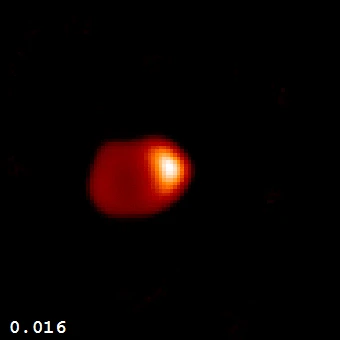
WISE J014656.66+423410.0 (abbreviated WISE 0146+4234) is a binary brown dwarf system in the constellation Andromeda, approximately 60 light-years from Earth. Its components are of spectral classes T9 and Y0, making it a key object for studying the transition between T and Y dwarfs. The system is notable for its uncertain age and mass, with interpretations ranging from an old binary of substellar objects to a young pair of planetary-mass bodies.
- Designation
- WISE J014656.66+423410.0 (WISE 0146+4234)
- Constellation
- Andromeda
- Distance
- 60 light-years
- Spectral types
- T9 and Y0
- Discovery year
- 2012
- Discoverer
- J. Davy Kirkpatrick et al.
- Discovery telescope
- Wide-field Infrared Survey Explorer (WISE)
Lore & Background
WISE 0146+4234 was discovered in 2012 by J. Davy Kirkpatrick et al. from data collected by the Wide-field Infrared Survey Explorer (WISE), a NASA infrared-wavelength 40 cm space telescope that operated from December 2009 to February 2011. It was one of seven new Y-type brown dwarfs presented in a 2012 paper in The Astrophysical Journal. The system's distance was initially estimated at 20 light-years, but later parallax measurements revised it to 60 light-years.
The unresolved spectrum, observed with JWST NIRSpec and MIRI, shows strong absorption from ammonia and methane, with weak carbon monoxide and carbon dioxide absorption. Researchers found the spectrum resembles a combination of the brown dwarfs W0751 (484 K) and W1405 (392 K), but model comparisons yield different temperatures of 550 K and 325 K. The components exhibit a large difference in Spitzer color despite a small temperature difference, possibly indicating atmospheric changes at the T/Y transition.
Age and mass estimates are uncertain. For an age of 10 billion years, the total mass is given as a specific value (not fully stated in notes), with an orbital period predicted to be ≤10 years. Another work estimated an age of a few billion years, yielding component masses of 7–15 Jupiter masses and 6–14 Jupiter masses. If the system is young (about 1 billion years), it would be a pair of planetary-mass objects with a total mass also specified in the notes.
Reader's Guide
WISE 0146+4234 holds significance as a benchmark binary for understanding the T/Y spectral transition, a regime where brown dwarf atmospheres shift from methane-dominated to ammonia-dominated chemistry. The large color difference between components despite similar temperatures suggests that subtle atmospheric changes—such as cloud thickness or chemical disequilibrium—can produce dramatic photometric variations at the T/Y boundary. This makes the system a natural laboratory for testing atmospheric models of ultracool dwarfs.
The system's uncertain age and mass highlight the degeneracy between age and mass in brown dwarf evolution: an old, massive binary and a young, low-mass binary can produce similar spectra. The predicted short orbital period (≤10 years for an old system) offers a path to dynamical mass measurement, which would break this degeneracy. JWST observations have provided detailed spectroscopic coverage, revealing strong ammonia and methane absorption alongside weak carbon monoxide and carbon dioxide features, further constraining atmospheric composition.
As one of the first Y-type binaries discovered by WISE, WISE 0146+4234 remains a reference object for studies of the coldest brown dwarfs and the transition to planetary-mass objects. Its discovery alongside six other Y dwarfs in 2012 expanded the known population of the coldest substellar objects.
Did You Know?
- WISE 0146+4234 is a binary brown dwarf with spectral types T9 and Y0.
- Its distance was initially estimated at 20 light-years but later revised to 60 light-years.
- The unresolved spectrum shows strong ammonia and methane absorption, with weak carbon monoxide and carbon dioxide.
- The system was discovered in 2012 by J. Davy Kirkpatrick et al. using data from the WISE satellite.
More in Binary and Multiple Stars, Part 5 1-24
Spotted an error? Know more?
Reader corrections go straight into our review queue. Suggest an edit · How this site is sourced