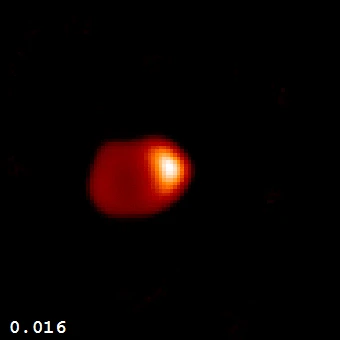
VHS J1256−1257
A triple brown dwarf system with a highly variable planetary-mass companion.

VHS J1256−1257 is a young triple brown dwarf system in the constellation Corvus, approximately 69.0 light-years from the Sun. It consists of the equal-mass binary VHS J1256−1257AB and the distant planetary-mass companion VHS 1256−1257 b. The system is notable for the detection of continuous radio emission from radiation belts surrounding the primary binary, and for its companion's extreme atmospheric variability and unusual rotation.
- Distance
- 69.0 ly
- Constellation
- Corvus
- Companion mass
- ~4 Jupiter masses
- Companion temperature
- 1380 K
- Companion rotation period
- 22.04 ± 0.05 hours
- Companion c/o molar ratio
- >0.63
- Companion discovery year
- 2015
Lore & Background
VHS J1256−1257 b was first identified by the 2MASS survey in 2015. It orbits at a distance of 102 AU from the binary and has an estimated mass of approximately 4 Jupiter masses. The companion is carbon-rich, with a C/O molar ratio exceeding 0.63, and its temperature has been measured at 1380 K. Its rotation period of 22.04 ± 0.05 hours is unusually long for substellar objects, and it possesses a high axial tilt similar to that of Uranus.
Observations with the Hubble Space Telescope's Wide-Field Camera 3 revealed extreme near-infrared variability: 19.3% at 1.1 and 1.7 μm over 8.5 hours, and 24.7% with the 1.27 μm filter—the largest amplitude for any substellar object as of 2022. Later Hubble studies yielded even higher brightness variability of 33–37% without a definite period, indicating the presence of both spots and waves. One study using variability and spectra from the James Webb Space Telescope concluded that planetary-scale dust storms, persisting for tens of days and consisting of iron and silicate particles, are the main cause of the variability, with large patchy clouds propagating with equatorial waves.
The atmosphere of VHS 1256 b is in chemical disequilibrium. The presence of carbon monoxide and depleted methane compared to equilibrium models suggests vertical atmospheric mixing, which forces the upper atmosphere out of equilibrium. JWST observations in 2022 with NIRSpec and MIRI detected water vapor, methane, carbon monoxide, carbon dioxide, sodium, potassium, and silicate clouds—the first direct detection of silicate clouds for a planetary-mass object. The silicate feature closely matches that of the L4.5 brown dwarf 2M2224-0158. NIRSpec also measured several carbon and oxygen isotopes: the carbon-12 to carbon-13 ratio is 62±2, intermediate between isolated brown dwarfs (about 100) and exoplanets (about 30). Oxygen-17 and oxygen-18 abundances are higher than in the Solar System and the local interstellar medium, possibly explained by isotope fractionation processes in protoplanetary disks.
Reader's Guide
VHS J1256−1257 is significant as a benchmark system for understanding brown dwarf and planetary-mass companion atmospheres, dynamics, and formation. The detection of continuous radio emission from radiation belts around the primary binary adds a rare observational constraint on magnetic activity in substellar objects. The companion VHS 1256 b exhibits the largest near-infrared variability amplitude of any substellar object as of 2022, with variations attributed to planetary-scale dust storms—a phenomenon not seen on Jupiter. Its unusually long rotation period and high axial tilt further distinguish it from typical brown dwarfs and giant planets. The direct detection of silicate clouds via JWST marks the first such detection for a planetary-mass object, and the measured isotope ratios (carbon-12/carbon-13 of 62±2, elevated oxygen-17 and oxygen-18) provide unique tracers of planet formation processes, suggesting isotope fractionation in protoplanetary disks. The system's triple nature and the companion's wide separation (102 AU) make it a valuable laboratory for studying the formation and evolution of low-mass objects in hierarchical systems.
Did You Know?
- VHS 1256 b has the largest near-infrared variability amplitude of any substellar object as of 2022, reaching 24.7% at 1.27 μm.
- The atmosphere contains silicate clouds, the first direct detection of such clouds for a planetary-mass object.
- The carbon-12 to carbon-13 ratio in its atmosphere is 62±2, intermediate between isolated brown dwarfs and exoplanets.
More in Binary and Multiple Stars, Part 5 1-24
Spotted an error? Know more?
Reader corrections go straight into our review queue. Suggest an edit · How this site is sourced