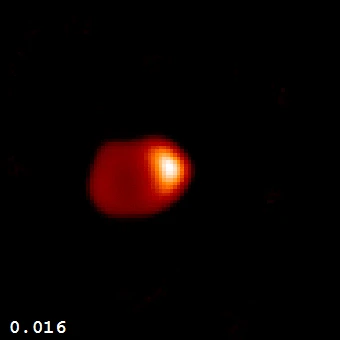
UScoCTIO 108
A wide binary of two brown dwarfs in Upper Scorpius.

UScoCTIO 108 is a binary system about 470 light-years away, located in the Upper Scorpius OB association. The primary component, UScoCTIO 108A, has a mass of roughly 0.06 solar masses, placing it at the boundary between a brown dwarf and a low-mass red dwarf. The secondary, UScoCTIO 108B, has a mass near the deuterium-burning limit—about 13 Jupiter masses—making it either a brown dwarf or an extrasolar planet.
The primary was first identified in 2000 as a possible member of the Upper Scorpius association based on its position on an HR diagram, during a survey at the Cerro Tololo Inter-American Observatory (CTIO). It was designated UScoCTIO 108. Follow-up spectroscopic and photometric observations confirmed its membership, revealing signs of low gravity and youth. Its mass was estimated at 60 Jupiter masses, with an effective temperature of 2,800 K and a spectral type of M7. This mass is too low to sustain hydrogen fusion, classifying it as a brown dwarf.
The secondary was discovered in 2008, separated by 4.6 arcseconds, which corresponds to a physical separation of more than 670 AU. It is also a confirmed member of the association. Its spectrum indicates a cold substellar object with an effective temperature of 2,300 K and a spectral type of M9.5. Its mass was initially estimated at 14 Jupiter masses, near the planet-brown dwarf boundary. A later revision of the association’s age to 11 million years raised this estimate to 16 Jupiter masses, suggesting it is likely a low-mass brown dwarf. Although common proper motion has not been observed, the proximity of the two objects makes physical association very likely.
The minimum separation of 670 AU is much larger than the average for similar-mass systems, indicating a very weakly bound pair. The escape velocity for the secondary is just 0.4 km/s. Given the average stellar density in Upper Scorpius, perturbations from passing stars are expected to break up the system within a few million years.
Observations by the infrared telescope WISE detected excess emission at 12 and 22 micrometers, indicating a debris disk around the brown dwarf.
- Distance
- 470 light-years
- Primary mass
- 0.06 solar masses (60 Jupiter masses)
- Primary effective temperature
- 2,800 K
- Primary spectral type
- M7
- Secondary mass
- 16 Jupiter masses (revised)
- Secondary effective temperature
- 2,300 K
- Secondary spectral type
- M9.5
Lore & Background
The primary component, UScoCTIO 108A, was identified in 2000 as a possible member of the Upper Scorpius association based on its position in an HR diagram, during a search at the Cerro Tololo Inter-American Observatory. Subsequent spectroscopic and photometric observations confirmed its membership, revealing low gravity and youth, with a mass of 60 Jupiter masses, an effective temperature of 2,800 K, and a spectral type of M7. Its low mass precludes hydrogen fusion, classifying it as a brown dwarf.
The secondary component, UScoCTIO 108B, was discovered in 2008 at a separation of 4.6 arcseconds, corresponding to a physical separation of more than 670 AU. Its spectrum indicates a cold substellar object with an effective temperature of 2,300 K and spectral type M9.5. Originally estimated at 14 Jupiter masses, a revision of the association's age to 11 million years raised the mass to 16 Jupiter masses, placing it near the deuterium-burning limit and likely making it a low-mass brown dwarf rather than a planet. The physical association between the two has not been confirmed by common proper motion, but is considered very likely given their proximity.
The minimum separation of 670 AU is much larger than the mean for similar-mass systems, indicating a very weakly bound pair with an escape velocity of 0.4 km/s for the secondary. Given the stellar density in Upper Scorpius, perturbations by passing stars are expected to disrupt the system within a few million years. Observations by the infrared telescope WISE revealed excess emission at 12 and 22 μm, suggesting the presence of a debris disk around the primary brown dwarf.
Reader's Guide
UScoCTIO 108 is significant as a rare example of a very wide binary system composed of two substellar objects, with a separation exceeding 670 AU. This extreme width makes it one of the most weakly bound brown dwarf binaries known, with an escape velocity of only 0.4 km/s for the secondary. The system's location in the young Upper Scorpius association (age about 11 million years) provides a snapshot of a binary that is likely to be disrupted by stellar encounters within a few million years, offering insight into the dynamical evolution of low-mass binaries. The primary's mass of 0.06 solar masses places it near the hydrogen-burning limit, while the secondary's mass of 16 Jupiter masses straddles the deuterium-burning boundary, illustrating the continuum between brown dwarfs and planets. The detection of a debris disk around the primary via WISE excess emission adds further interest, as such disks are uncommon around brown dwarfs. The system's uncertain physical association—lacking common proper motion confirmation—highlights the challenges in verifying wide binaries in crowded stellar associations. Its legacy lies in informing models of binary formation and disruption in low-mass regimes, as well as the classification of objects near the planet–brown dwarf boundary.
Did You Know?
- The primary component has a mass of 0.06 solar masses, making it a brown dwarf unable to sustain hydrogen fusion.
- The secondary's mass was revised from 14 to 16 Jupiter masses after an update to the association's age of 11 million years.
- The two components are separated by at least 670 AU, much wider than typical brown dwarf binaries.
- Infrared observations by WISE detected excess emission at 12 and 22 μm, indicating a debris disk around the primary.
More in Binary and Multiple Stars, Part 5 1-24
Spotted an error? Know more?
Reader corrections go straight into our review queue. Suggest an edit · How this site is sourced