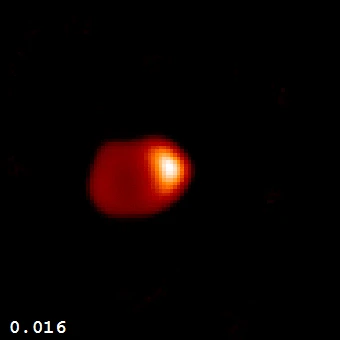
SDSS J141624.08+134826.7
A nearby wide binary of two brown dwarfs in Boötes.

SDSS J141624.08+134826.7, shortened to SDSS J1416+1348, is a binary system of two brown dwarfs located in the constellation Boötes. The system is a wide binary, with a primary component of spectral type L and a secondary of spectral type T.
The primary component was identified in late 2009 from data in the Sloan Digital Sky Survey (SDSS) Data Release 7, taken at Apache Point Observatory in New Mexico. Two discovery papers, by Bowler et al. (2009) and Schmidt et al. (2009), announced it. The secondary component was found in early 2010 using the UKIDSS Large Area Survey (ULAS) Data Releases 5 and 6, conducted at the United Kingdom Infrared Telescope (UKIRT) on Mauna Kea in Hawaii. Two papers also cover its discovery: Burningham et al. (2010) and Scholz (2010). Burningham et al. independently discovered the whole system by cross-matching ULAS DR5 with SDSS DR7, while Scholz found component B by inspecting UKIDSS finding charts around the already known component A.
A precise parallax of 109.9 ± 1.8 milliarcseconds was published in 2012 from the Canada-France-Hawaii Telescope under The Hawaii Infrared Parallax Program, placing the system at a distance of 9.10 ± 0.15 parsecs (29.7 ± 0.5 light-years). Earlier parallax measurements by Bowler et al. and Scholz had large errors.
The system moves with a proper motion of 165 milliarcseconds per year at a position angle of 32 degrees, toward the northeast. The proper motion components are 88.0 ± 2.8 milliarcseconds per year in right ascension and 139.9 ± 1.3 milliarcseconds per year in declination. At the assumed distance of 29.7 light-years, the tangential velocity is 7.1 kilometers per second. The radial velocity is -42.2 ± 5.1 kilometers per second, meaning the system is approaching the Solar System. The total velocity relative to the Solar System is 42.8 kilometers per second. These space motions indicate SDSS J1416+1348 belongs to the Galactic thin disk population.
Because the radial velocity is much larger than the tangential velocity and is negative, the system will pass much closer to the Solar System in the future. Using proper motion and radial velocity from Schmidt et al. (2009) and the parallax from Dupuy & Liu (2012), and assuming constant straight-line motion, the minimum distance is 4.9 light-years, reached around the year 207100.
- Distance
- 9.10 ± 0.15 pc (29.7 ± 0.5 ly)
- Parallax
- 109.9 ± 1.8 mas
- Proper motion
- 165 mas·yr⁻¹ at position angle 32°
- Radial velocity
- -42.2 ± 5.1 km/s
- Total velocity relative to solar system
- 42.8 km/s
- Projected separation
- 89.3 ± 1.5 AU
- Spectral types
- Component A: sdL7 / L6 / L5 / d/sdL7; Component B: T7.5 / T7.5p
Lore & Background
Component A was discovered in late 2009 from a search of Sloan Digital Sky Survey Data Release 7, conducted at Apache Point Observatory in New Mexico. Component B was discovered in early 2010 from the UKIDSS Large Area Survey Data Releases 5 and 6, conducted on the United Kingdom Infrared Telescope on Mauna Kea in Hawaii. The system was independently discovered by cross-matching the two surveys. The first relatively precise parallax was measured in 2012 at the Canada-France-Hawaii Telescope under The Hawaii Infrared Parallax Program, yielding a distance of 9.10 parsecs.
The system is old, with age estimates ranging from >0.8 Gyr to ~10 Gyr, and probably possesses low metallicity. Component A has an unusually blue near-infrared J−Kₛ color; its peculiar spectrum is primarily attributed to thin condensate clouds and vertical mixing in its atmosphere, though alternative explanations invoke age or metallicity. Component B has an extremely blue near-infrared H−K color, very red optical-to-near-infrared colors, and an extremely red H−[4.5] color that may indicate a cooler unresolved companion. Its spectrum suggests high surface gravity and/or subsolar metallicity.
Space motion indicates membership in the Galactic thin disk population. The system's radial velocity is negative, meaning it is approaching the Solar System. Assuming constant velocity along a straight line, it will pass at a minimal distance of 4.9 light-years around the year 207100.
Reader's Guide
SDSS J1416+1348 is significant as a benchmark binary brown dwarf system whose components share common peculiarities, offering a laboratory for studying the effects of age, metallicity, and cloud properties on substellar atmospheres. The system's unusually blue near-infrared colors challenge standard atmospheric models, prompting debate over whether thin condensate clouds, vertical mixing, or intrinsic properties like low metallicity dominate. Its wide separation (projected 89.3 AU) allows individual characterization of each component, while the common space motion and age link their peculiarities to shared evolutionary history. The predicted future close approach to the Solar System (4.9 ly in ~207100 CE) makes it a rare case of a brown dwarf binary that will become a near neighbor, potentially enabling detailed future study. The system also highlights the value of cross-matching large-area surveys (SDSS and UKIDSS) for discovering faint, nearby substellar objects. Its legacy includes informing models of brown dwarf atmospheres, binary formation, and the dynamics of low-mass objects in the solar neighborhood.
Did You Know?
- The system will pass within 4.9 light-years of the Solar System around the year 207100.
- Component B has an extremely red H−[4.5] color of 4.86 ± 0.04, possibly indicating a cooler unresolved companion.
- The two components are separated by 9.81 arcseconds, corresponding to a projected separation of 89.3 AU.
- Component A was discovered in late 2009 from SDSS Data Release 7, while Component B was found in early 2010 from UKIDSS Data Releases 5 and 6.
More in Binary and Multiple Stars, Part 5 1-24
Spotted an error? Know more?
Reader corrections go straight into our review queue. Suggest an edit · How this site is sourced