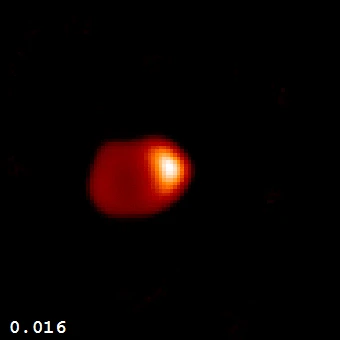
Oph 162225-240515
Wide brown dwarf binary in Scorpius, first of its kind reported.

Oph 162225-240515, shortened to Oph 1622 or Oph 11, is a binary system of two brown dwarfs that appear to orbit each other. It lies in the constellation Scorpius, roughly 430 light-years away. Their masses are uncertain but are likely above the 13-Jupiter-mass boundary separating brown dwarfs from planets. The two components, Oph1622A and Oph1622B, are separated by 1.94 arcseconds at a position angle of 182°, equivalent to about 240 astronomical units. This wide separation is so tenuous that a passing star or brown dwarf could permanently split them apart.
The pair was discovered using the European Southern Observatory's New Technology Telescope in La Silla, Chile, and announced in a 2006 *Science* article by Ray Jayawardhana and Valentin D. Ivanov. Initial mass estimates were lower—14 and 7 Jupiter masses—which would have made the smaller object a planetary-mass object, or planemo, and the system the first reported binary of such small bodies. However, later observations revised the masses upward. Close et al. estimate the primary, Oph1622A, at 12–21 Jupiter masses and the secondary, Oph1622B, at 9–20 Jupiter masses. Luhman et al. assign values of 57 and 20 Jupiter masses. Despite its name suggesting a link to the young Ophiuchus molecular cloud, Oph1622 is likely older than the originally assumed 1 million years. It probably belongs to the Upper Scorpius subgroup of the Scorpius–Centaurus association, which has an age of 11 million years. At that age, the system’s inferred masses are 53 and 21 Jupiter masses, similar to Luhman et al.'s results.
Because the objects are so widely separated and relatively massive, the system is best considered a wide brown dwarf binary rather than a binary planetary system. The discovery cast doubt on the idea that such free-floating planet-like objects are ejected from stellar systems, as that process would likely be too violent to leave them in such a wide orbit.
- Designations
- Oph 162225-240515, Oph 1622, Oph 11
- Constellation
- Scorpius
- Distance
- ~430 light years
- Separation
- 1.94 arcseconds (≈240 AU)
- Position angle
- 182°
- Discovery year
- 2006
- Discoverers
- Ray Jayawardhana, Valentin D. Ivanov
Lore & Background
The pair was discovered using telescopes of the European Southern Observatory's New Technology Telescope at La Silla, Chile. Initial mass estimates were 14 and 7 Jupiter masses, which would have made the smaller object a planetary-mass object, or planemo. However, later calculations revised the masses upward: Close et al. estimate the primary (Oph1622A) at 12–21 Jupiter masses and the secondary (Oph1622B) at 9–20 Jupiter masses, while Luhman et al. assign 57 and 20 Jupiter masses. For an adopted age of 11 million years, the system has inferred masses of 53 and 21 Jupiter masses, similar to Luhman et al.'s values.
Despite the acronym 'Oph' in its name, implying possible membership in the young Ophiuchus molecular cloud, Oph1622 is likely older than its originally adopted age of 1 million years. It is more likely a member of the Upper Scorpius subgroup of the Scorpius–Centaurus association, which has an age of 11 million years. The distance between the two components is about 240 AU, so wide that a passing star or brown dwarf could permanently separate them. This wide separation cast doubt on the theory that such free-floating planet-like objects are ejected from a stellar system, as such an event would be too violent to leave them in such a wide orbit.
Reader's Guide
Oph 162225-240515 is significant as the first reported binary system of objects with masses near the brown-dwarf/planet boundary. Its discovery challenged prevailing ideas about the formation of free-floating planetary-mass objects, because the wide separation of the pair (≈240 AU) made it unlikely that they were ejected from a stellar system—ejection would typically disrupt such a tenuous gravitational bond. Instead, the system is best thought of as a wide brown dwarf binary rather than a binary planetary system. The initial report of masses as low as 14 and 7 Jupiter masses generated considerable interest, but subsequent observations and calculations revised the masses upward, placing both components above the 13-Jupiter-mass brown-dwarf/planet dividing line. The uncertainty in mass estimates persists, with different studies yielding ranges from 12–21 and 9–20 Jupiter masses (Close et al.) to 57 and 20 Jupiter masses (Luhman et al.). The system's age was also revised from 1 million to 11 million years, aligning it with the Upper Scorpius subgroup. Its legacy lies in demonstrating that very low-mass objects can form as binaries, and in prompting re-evaluation of how such objects originate.
Did You Know?
- The two components are separated by about 240 AU, a distance so wide that a passing star could permanently separate them.
- Initial mass estimates of 14 and 7 Jupiter masses would have made the smaller object a planetary-mass object, but later revisions placed both above 13 Jupiter masses.
- The system is likely a member of the Upper Scorpius subgroup, with an age of 11 million years, not the younger Ophiuchus cloud.
More in Binary and Multiple Stars, Part 5 1-24
Spotted an error? Know more?
Reader corrections go straight into our review queue. Suggest an edit · How this site is sourced