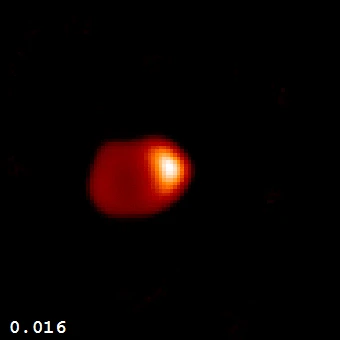
Nu Ophiuchi
A K-type giant with two brown dwarfs in resonance.

Nu Ophiuchi (ν Ophiuchi) is a K-type giant star in the equatorial constellation Ophiuchus, with an apparent visual magnitude of +3.3. Located about 150 light-years from Earth, it is notable for hosting two brown dwarf companions locked in a 6:1 orbital resonance, suggesting a planetary-like formation from a circumstellar disk.
- Bayer designation
- ν Ophiuchi
- Apparent magnitude
- +3.3
- Distance
- ~150 ly
- Spectral type
- K0 IIIa
- Mass
- ~3 M☉
- Radius
- ~14 R☉
- Luminosity
- 108 L☉
- Age
- ~450 million years
- Effective temperature
- 5,000 K
Lore & Background
Nu Ophiuchi is a giant star that has exhausted its core hydrogen and evolved off the main sequence, with an expanded envelope about 14 times the Sun's radius. Its spectrum is classified as K0 IIIa, and it exhibits an anomalously low abundance of cyanogen for its type. The star is roughly 450 million years old and has about three times the Sun's mass, radiating 108 times the Sun's luminosity at an effective temperature of 5,000 K, giving it an orange hue. It follows an orbit through the Milky Way between 23.4 and 29.2 kly from the Galactic Center, likely as a member of the thin disk population, staying within about 100 ly of the galactic plane.
In Chinese astronomy, Nu Ophiuchi is part of the Left Wall of the Heavenly Market Enclosure asterism, representing the state Yan (燕) together with ζ Capricorni. The star is sometimes called Sinistra (Latin for 'left side') in astrological contexts, though astronomer Jim Kaler recommended against using this name, preferring the Bayer designation alone.
Reader's Guide
Nu Ophiuchi is significant as a giant star that hosts a system of two brown dwarf companions, discovered via radial velocity in 2003 and 2010, and confirmed in 2012. The inner companion, Nu Ophiuchi b, has at least 21.9 Jupiter masses and orbits in 536 days, while the outer brown dwarf takes 3,169 days. Their 6:1 orbital resonance implies they likely formed like planets from a circumstellar disk, rather than through gravitational collapse. In 2026, astrometric measurements determined the inclinations and true masses of both bodies, revealing somewhat misaligned orbits. This system provides a rare example of brown dwarfs in a resonant configuration, offering insights into substellar formation and dynamics. The star itself, a K0 IIIa giant with an anomalously low cyanogen abundance, adds to the diversity of evolved stars with planetary-mass companions. Its legacy lies in challenging the boundary between planet and brown dwarf formation, and in demonstrating that substellar objects can form in a disk around a post-main-sequence star.
Did You Know?
- Nu Ophiuchi has an anomalously low abundance of cyanogen for a K0 IIIa giant.
- The two brown dwarf companions are locked in a 6:1 orbital resonance.
- The star is sometimes called Sinistra, meaning 'left side' in Latin, in astrological contexts.
- In Chinese astronomy, Nu Ophiuchi represents the state Yan (燕).
More in Binary and Multiple Stars, Part 5 1-24
Spotted an error? Know more?
Reader corrections go straight into our review queue. Suggest an edit · How this site is sourced