Luhman 16
Closest-known brown dwarf binary, third-nearest system to the Sun.

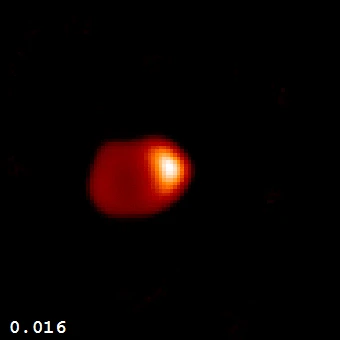
Luhman 16 (also designated WISE 1049−5319 or WISE J104915.57−531906.1) is a binary system of two brown dwarfs located in the southern constellation Vela at a distance of 6.51 light-years from the Sun. It is the closest-known brown dwarf system and the third-closest-known system to the Sun, after the Alpha Centauri system and Barnard's Star. The primary is of spectral type L7.5 and the secondary is near the L–T transition, with masses of 35.4 and 29.4 Jupiter masses, respectively, and an estimated age of 400–800 million years.
- Distance
- 6.51 ly
- Spectral types
- Primary L7.5; secondary near L–T transition
- Masses
- 35.4 and 29.4 Jupiter masses
- Age
- 400–800 million years
- Orbital separation
- 3.5 AU
- Orbital period
- 26.6 years
- Constellation
- Vela
Lore & Background
The system was discovered by Kevin Luhman from Pennsylvania State University using images from the Wide-field Infrared Survey Explorer (WISE) satellite, taken between January 2010 and January 2011, with the discovery announced in 2013. The system was found by comparing WISE images at different epochs to reveal objects with high proper motion. Its proximity to the galactic plane, densely populated by stars, had previously hindered detection despite its nearness to the Sun. The second component was also discovered by Luhman in 2013, resolved with the Gemini Multi-Object Spectrograph at Gemini South on 23 February 2013, showing an angular separation of 1.5 arcseconds and a magnitude difference of 0.45 mag.
Precovery images were later identified from surveys spanning 1978 to 2007, including the Digitized Sky Survey, IRAS, ESO Schmidt telescope, Guide Star Catalog, DENIS, 2MASS, and AKARI. An ESO Schmidt image from 1984 showed the source elongated at a position angle of 138°, similar to the resolved pair in 2013, suggesting the time between those epochs may be close to the orbital period. The name Luhman 16 was proposed by Eric E. Mamajek, originating from the Washington Double Star Catalog where the system is listed with discoverer designation LUH 16; the rationale was that it is easier to remember than the 24-character WISE designation.
Reader's Guide
Luhman 16 holds several records: it is the nearest brown dwarf, the nearest L-type dwarf, and possibly the nearest T-type dwarf if component B is of T-type. It is the closest system found since the measurement of Barnard's Star's proper motion in 1916. The system's proper motion is about 2.79 arcseconds per year, relatively large due to its proximity. Radial velocities of 23.1 km/s for component A and 19.5 km/s for component B indicate the system is moving away from the Solar System; it passed closest about 36,000 years ago at a minimal distance of roughly 5.05 light-years. The orbit has been refined over time: Garcia et al. (2017) found a period of 27.4 years with semi-major axis 3.54 AU and eccentricity 0.35; Gaia DR2 data in 2018 refined the period to about 26.6 years; a 2024 refinement gave a semi-major axis of 3.52 AU. Both brown dwarfs appear to be viewed roughly equator-on and aligned with their orbital plane. In 2022, Luhman 16 was identified as a member of the Oceanus moving group, with an age of 400–800 million years consistent with that membership. A 2013 search for planets reported perturbations suggesting a possible third body below the brown-dwarf mass limit, with estimated odds of a false positive at 0.002%.
Did You Know?
- Luhman 16 is the closest-known brown dwarf system, at 6.51 light-years from the Sun.
- The system was discovered by comparing WISE images taken at different epochs to reveal high proper motion.
- The components orbit each other at about 3.5 AU with a period of roughly 26.6 years.
More in Binary and Multiple Stars, Part 5 1-24
Spotted an error? Know more?
Reader corrections go straight into our review queue. Suggest an edit · How this site is sourced