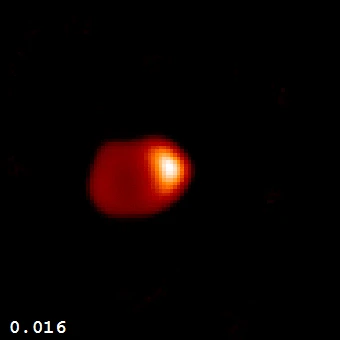
LP 261-75
Triple system with a red dwarf and two brown dwarfs.

LP 261-75 (also known as TOI 1779) is a triple star system in the constellation Leo Minor, consisting of a young red dwarf primary star, a close-in transiting brown dwarf companion, and a wide-orbit brown dwarf. The inner pair is one of the first red dwarf–brown dwarf systems to have its obliquity measured via the Rossiter–McLaughlin effect, and the system is thought to be a member of the AB Doradus Moving Group.
- Constellation
- Leo Minor
- Primary star type
- Young red dwarf (mid-M spectral type)
- Primary rotation period
- ~2.2 days
- Inner companion orbital period
- ~1.88 days
- Inner companion mass
- Brown dwarf (mass consistent with brown dwarf identification)
- Wide companion projected separation
- Larger than typical maximum for low-mass systems
- Wide companion spectral type
- L6
Lore & Background
The wide brown dwarf LP26175B was discovered during the 2MASS survey and announced in a 2000 discovery paper. Its association with the primary was noted five years later after proper motion measurements confirmed co-movement, though confirmation with parallax was not yet available. The wide binary nature was confirmed by 2006 via the spectroscopic method, establishing a common distance and young age. Observations by the Hawaii Infrared Parallax Program at the Canada–France–Hawaii Telescope confirmed common parallax, and the infrared spectrum showed relatively strong FeH and alkali features, indicating higher gravity typical of old field brown dwarfs.
The inner transiting companion LP26175C was discovered by the MEarth transit survey and confirmed spectroscopically, revealing its mass is consistent with a brown dwarf. Observations at Gemini North with the MAROON-X instrument during a transit characterized the Rossiter–McLaughlin effect to determine the obliquity of the primary star relative to the inner companion's orbital plane.
The primary star is a young red dwarf with strong Hα emission, indicating strong chromospheric activity typical of young mid-M stars. It is a suspected X-ray source and rotates rapidly with a ~2.2-day period, consistent with a young age from gyrochronology. The wide brown dwarf has a rotation period with variability across the infrared, likely due to heterogeneous clouds or hazes, and a secondary period near one-third of the main period suggests a persistent symmetric cloud pattern.
Reader's Guide
LP 261-75 is notable as one of the first red dwarf–brown dwarf systems to have its obliquity measured via the Rossiter–McLaughlin effect, providing insight into the alignment of such low-mass binaries. The measured projected obliquity, combined with orbital and rotational inclinations, yields a true obliquity indicating the system is aligned. Because the system is younger than the timescale thought necessary for tidal interactions to align the orbit, this alignment is likely primordial, offering a window into the initial conditions of brown dwarf formation.
The inner companion's orbital period is shorter than the primary's rotation period, and tidal interactions are expected to lead to spin–orbit synchronization, though the young age suggests the final state has not been reached. The system's membership in the AB Doradus Moving Group supports its young age. The wide brown dwarf's separation is larger than typical for such low-mass systems but common for brown dwarfs around higher-mass stars, with the young age explaining the survival of the weakly bound system.
The mass and radius of the inner brown dwarf are well-known from radial velocity and transit photometry. Its radius is smaller than expected for a brown dwarf of the system's age, corresponding more closely to a value expected for a different age, implying a gap in current evolutionary models for brown dwarfs.
More in Binary and Multiple Stars, Part 5 1-24
Spotted an error? Know more?
Reader corrections go straight into our review queue. Suggest an edit · How this site is sourced