Kelu-1
A binary brown dwarf system and prototype L dwarf.

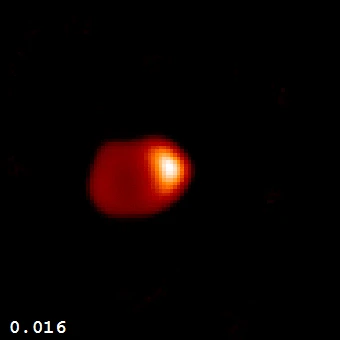
Kelu-1 is a binary system of two brown dwarfs, with spectral types L2 and L4, located in the constellation Hydra about 60.6 light-years from Earth. It is one of the first free-floating brown dwarfs discovered with a spectral type later than M, and is sometimes regarded as the prototype for L-type brown dwarfs.
The object was found through the Calán-ESO proper-motion survey, which María Teresa Ruiz initiated in 1987. The survey used red plates taken from the 1970s with the 1-meter ESO Schmidt Camera at La Silla Observatory in Chile. It was not designed to find brown dwarfs but primarily to search for white dwarfs. Pairs of plates taken years apart were compared with a blink comparator to identify objects with high proper motion. Candidates were then selected for follow-up spectroscopy with the 3.6-meter telescope and EFOSC1 at the same observatory.
In March 1997, spectroscopy was carried out on an object discovered from a pair of plates taken 14 years apart (1979–1993). Its apparent magnitude in the R band was about 19.5, near the survey’s sensitivity limit. The spectrum was very red, peculiar, and odd-looking. Its extremely low luminosity led to the conclusion that it was probably a brown dwarf. Ruiz and colleagues named it Kelu-1: "kelu" means "red" in the Mapuche language, while the origin of the number "1" in the name was not explained in the discovery paper.
Follow-up observations included optical spectroscopy with the ESO 3.6-meter telescope in March 1997, infrared spectroscopy with IRCAM3 and CGS4 on UKIRT at Mauna Kea Observatory in April 1997, and a finding chart taken by R. Covarrubias with the CTIO 0.9-meter telescope. The discovery paper was received on September 5, 1997, accepted on October 16, 1997, and published on November 6, 1997, in The Astrophysical Journal Letters.
In 2001, Ruiz et al. published the Calán-ESO Proper-Motion Catalog (CE Catalog), which contained 542 high proper-motion stars detected from ESO 1-meter Schmidt Camera plates with time intervals between 6.4 and 16 years. Kelu-1 was included as object number 298, giving it the identifier CE 298.
No spectral class was assigned in the 1997 discovery paper, as the latest spectral class then in use was M, and Kelu-1 was later than M. In 1999, J. Davy Kirkpatrick et al. introduced two new spectral classes later than M—L and T—for recently discovered cool brown dwarfs.
- Distance
- 60.6 ± 0.8 ly
- Spectral types
- L2 V (primary), L4 (secondary)
- Constellation
- Hydra
- Discovery year
- 1997
- Discoverers
- María Teresa Ruiz et al.
- Mass
- 177 MJup (system total)
- X-ray luminosity
- 2.9 × 10²⁵ erg·s⁻¹
Lore & Background
Kelu-1 was discovered as part of the Calán-ESO proper-motion survey, which used red plates from the 1-m ESO Schmidt Camera at La Silla Observatory, Chile. The survey, initiated in 1987 by María Teresa Ruiz, was primarily designed to find white dwarfs, not brown dwarfs. In March 1997, spectroscopy of an object with high proper motion—detected from plates separated by 14 years (1979–1993)—revealed an extremely red, peculiar spectrum. Its low luminosity led to the conclusion that it was a brown dwarf, and it was named Kelu-1, 'kelu' meaning 'red' in the Mapuche language.
No spectral class was assigned in the discovery paper, as the latest class then in use was M. In 1999, Kirkpatrick et al. introduced the L and T classes and assigned Kelu-1 the spectral class L2 V. In 2005, adaptive optics on the Keck II Telescope revealed a second component, Kelu-1 B, with a separation of about 290 mas. Earlier HST observations in 1998 had not detected the companion because its separation was much smaller at that time (45 ± 18 mas).
Subsequent observations by Stumpf et al. using HST, VLT, and Spitzer yielded a total system mass of 177 MJup, which exceeds the maximum expected for two brown dwarfs (about 150 MJup). This may indicate a third component, or it may reflect an under-prediction of brown dwarf masses. A peculiarity in the spectrum of Kelu-1 A suggested it might itself be an unresolved binary (L0.5 and T7.5), but later analysis did not confirm this.
Reader's Guide
Kelu-1 holds a significant place in the history of brown dwarf astronomy as one of the first free-floating L dwarfs discovered, and it is sometimes regarded as the prototype of the L spectral class. Its discovery demonstrated that large proper-motion surveys could uncover substellar objects beyond the M class, and it helped spur the formal introduction of the L and T spectral classes in 1999. The system's binarity, confirmed in 2005, provided an opportunity to study the orbital dynamics and mass of brown dwarfs, though the derived total mass of 177 MJup raised questions about the maximum mass limit for brown dwarfs and the possibility of a third component. Kelu-1 was also the first L dwarf detected in X-rays, observed by the Chandra X-ray Observatory in 2007, with an X-ray luminosity of 2.9 × 10²⁵ erg·s⁻¹. Its precise distance, measured by Gaia in 2018 at 60.6 light-years, has made it a benchmark object for calibrating the properties of L dwarfs. The system continues to be a subject of study for understanding the mass, age, and multiplicity of brown dwarfs.
Did You Know?
- Kelu-1 was discovered in 1997 by María Teresa Ruiz et al. as part of the Calán-ESO proper-motion survey.
- Its name comes from the Mapuche word 'kelu', meaning 'red'.
- Kelu-1 was the first L dwarf detected in X-rays, observed by Chandra in 2007.
- The system's total mass of 177 MJup exceeds the expected maximum for two brown dwarfs, suggesting a possible third component.
More in Binary and Multiple Stars, Part 5 1-24
Spotted an error? Know more?
Reader corrections go straight into our review queue. Suggest an edit · How this site is sourced