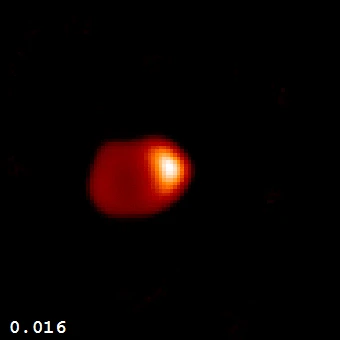
HD 130948
A Sun-like star with two co-orbiting brown dwarfs.

HD 130948, also designated HP Boötis, is a G1V main-sequence star in the constellation Boötes. It is notable for hosting a pair of co-orbiting brown dwarfs, making it a rare multiple system with substellar companions. With an apparent magnitude of 6.0, it is faintly visible to the naked eye under very good observing conditions.
- Apparent magnitude
- 6.0
- Spectral type
- G1V
- Age
- 4.7 billion years (Gyr) (disputed; a 2009 study gave a much younger age)
- Metallicity
- 63% of solar (disputed; a 2009 study gave metallicity very similar to the Sun)
- Variable star designation
- HP Boötis
- Brown dwarf companions
- HD 130948 B and HD 130948 C
- Orbital period of brown dwarf pair
- 3656 days
Lore & Background
HD 130948 was observed by Eric J. Gaidos et al. in 1998 and 1999, leading to its identification as a variable star. It received the variable star designation HP Boötis in 2006. The star has a stellar classification of G1V, indicating a mass and surface temperature similar to the Sun. Its estimated age is 4.7 billion years, comparable to the Sun, but it has a lower proportion of elements other than hydrogen or helium (63% of solar). However, a separate study in 2009 gave a much younger age and a higher metallicity very similar to the Sun. A 2019 study favored the younger age, based on coevality with the brown dwarf companions. Evolutionary models suggest the star is just reaching the end of its main sequence life.
Reader's Guide
The discovery of two brown dwarfs orbiting HD 130948 in 2002, using an adaptive optics instrument on the Gemini North 8m telescope in Hawaii, marked a significant step in understanding substellar companions around Sun-like stars. The brown dwarfs, HD 130948 B and HD 130948 C, are similar to each other in mass, radius, and temperature. They orbit each other with a period of 3656 days, while their orbit around the primary star is poorly constrained, with a period on the order of centuries to tens of thousands of years. The system's age uncertainty—whether it is roughly solar-aged or much younger—affects models of brown dwarf evolution and the star's own evolutionary stage. The star's space velocity components through the Milky Way have been measured, providing context for its galactic motion. HD 130948 remains a key object for studying binary brown dwarf dynamics and the late main-sequence evolution of solar-type stars.
Did You Know?
- HD 130948 is also known as HP Boötis, a variable star designation given in 2006.
- The two brown dwarfs were discovered in 2002 using the Gemini North telescope in Hawaii.
- The star's age is disputed, with estimates ranging from 4.7 billion years to much younger.
More in Binary and Multiple Stars, Part 5 1-24
Spotted an error? Know more?
Reader corrections go straight into our review queue. Suggest an edit · How this site is sourced