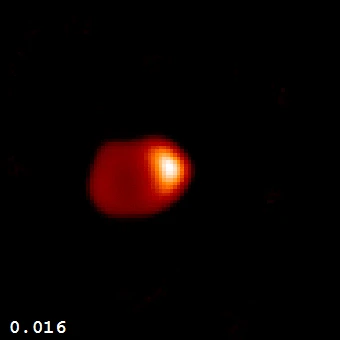
Epsilon Indi
A nearby K-dwarf system with brown dwarfs and a Jovian planet.

Epsilon Indi (ε Indi) is a star system approximately 12 light-years from Earth in the southern constellation Indus. It consists of a K-type main-sequence star, ε Indi A, orbited by a binary pair of brown dwarfs (ε Indi Ba and ε Indi Bb) and one known planet, ε Indi Ab. The system is notable as a benchmark for studying the formation of gas giants and brown dwarfs, and its planet is the second-closest Jovian exoplanet after ε Eridani b.
- Distance
- ~12 light-years
- Apparent visual magnitude
- 4.674
- Spectral type (ε indi a)
- K5V
- Mass (ε indi a)
- ~0.75 solar masses
- Radius (ε indi a)
- 71% solar radius
- Metallicity (ε indi a)
- ~87% solar iron abundance
- Planet mass (ε indi ab)
- 6.31 Jupiter masses
Lore & Background
The constellation Indus first appeared in Johann Bayer's 1603 atlas Uranometria. In 1847, Heinrich Louis d'Arrest discovered ε Indi's proper motion by comparing catalog positions dating to 1750. David Gill and William L. Elkin measured its parallax in 1882–83 at the Cape of Good Hope, and Harlow Shapley derived a parallax of 0.45 arcseconds in 1923. In 1972, the Copernicus satellite searched for ultraviolet laser signals from the star, with negative results. The star appears on a list of 17,129 nearby stars most likely to host planets supporting complex life, compiled by Margaret Turnbull and Jill Tarter. It is also among five nearby K-type stars considered a 'sweet spot' for evolved life between Sun-analog and M stars, per analysis by Giada Arney.
ε Indi A is a main-sequence star of spectral type K5V with about three-fourths the Sun's mass and 71% of its radius. Its corona has an X-ray luminosity of 2 × 10²⁷ erg s⁻¹ and an estimated temperature of 2 × 10⁶ K. The stellar wind produces a bow shock at 63 AU and a termination shock reaching 140 AU. The star has the third highest proper motion of any star visible to the unaided eye and will move into Tucana around 2640 AD. It belongs to the ε Indi moving group of at least sixteen population I stars. In about 17,500 years it will make perihelion passage at roughly 3.245 pc.
In January 2003, a brown dwarf was announced in orbit around ε Indi A; later that year it was resolved as a binary brown dwarf with a separation of 2.1 AU and an orbital period of about 15 years. The components are ε Indi Ba (spectral type T1–T1.5) and ε Indi Bb (T6). Gaia parallax measurements place the binary about 11,600 AU from the primary along the line of sight. The brown dwarfs have estimated masses, radii, effective temperatures (1300–1340 K and 880–940 K), surface gravities, and luminosities; they are variable and designated CI Indi.
Reader's Guide
The ε Indi system serves as a benchmark for understanding the formation of gas giants and brown dwarfs. Its planet, ε Indi Ab, was suspected from radial velocity observations in 2002, confirmed in 2018, and formally published in 2019 with astrometric detection. A direct image taken by the James Webb Space Telescope in 2023 and released in 2024 revealed a mass of 6.31 Jupiter masses and an elliptical orbit with a period of about 171.3 years, though later observations suggested a shorter, more circular orbit. The discrepancy is attributed to more careful data treatment. No debris disk has been detected around ε Indi. The system's proximity and composition make it a key object for comparative studies of substellar companions and planetary system architecture.
Did You Know?
- The brown dwarf pair was discovered in 2003 and later found to be a binary with a separation of 2.1 AU.
- As seen from ε Indi, the Sun is a 2.6-magnitude star in Ursa Major near the Big Dipper's bowl.
More in Binary and Multiple Stars, Part 5 1-24
Spotted an error? Know more?
Reader corrections go straight into our review queue. Suggest an edit · How this site is sourced