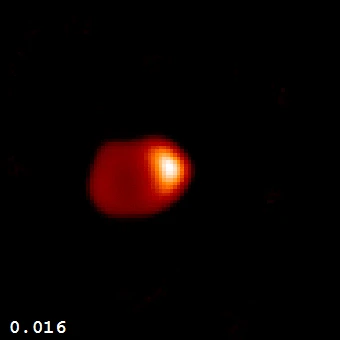
CWISEP J1935−1546
Cold Y-dwarf binary with auroral methane emission.

CWISEP J1935−1546 is a cold brown dwarf binary or planetary-mass binary system located at a distance of 14.4 parsecs (47 light-years). It is notable as only the second discovered binary system of Y-dwarfs, after WISE J0336−0143, and for exhibiting methane emission attributed to an aurora.
- Distance
- 14.4 parsecs (47 light-years)
- Mass range
- 2–20 or 6–35 Jupiter masses
- Temperature range
- 270–360 K (initial estimate); later 367 K
- Spectral type
- Later than Y1
- Mass ratio
- 0.55–0.62
- Orbital period (assumed circular)
- 16–28 years
Lore & Background
CWISEP J1935−1546 was discovered in 2019 by Marocco et al. as an extremely cold brown dwarf with a temperature range of 270–360 K and a distance of 5.6–10.9 parsecs. The discovery utilized the Python package XGBoost, machine-learning algorithms, the CatWISE catalog, and the WiseView tool. A NASA press release attributed the discovery to security engineer and citizen scientist Dan Caselden. Follow-up observations with Spitzer revealed a very red object with a ch1-ch2 color of 3.24±0.31 mag. Later, Kirkpatrick et al. 2021 reported a temperature of 367 K and a parallax measurement. The spectral type was estimated to be later than Y1.
Observations with JWST found strong signatures of methane, carbon monoxide, carbon dioxide, water vapor, and ammonia in the atmosphere. The abundance of hydrogen sulfide was measured, but detection was not mentioned; phosphine was undetected, with only upper limits provided. Using JWST MIRI imaging, the object was discovered to be a binary of two Y-dwarfs. PSF-subtraction revealed that two sources were required to successfully subtract the object in F1000W and F1280W filter images. The two components are separated by an unspecified distance, and assuming a circular orbit, the orbital period would be 16–28 years. The mass ratio is low, at q=0.55–0.62.
At the 243rd meeting of the AAS, it was announced that W1935 shows emission of methane, attributed to heating of the upper atmosphere by an aurora. Impacts of electrons with molecular hydrogen create trihydrogen cation (H₃⁺) in gas giants with aurorae, but emission from H₃⁺ was not detected in W1935, likely due to the higher density of the brown dwarf leading to a shorter lifetime of H₃⁺. Aurorae were previously discovered around hotter brown dwarfs with radio telescopes. The researchers proposed that the aurora around W1935 is caused by either unaccounted internal processes or external interactions with interstellar plasma or a nearby active moon. They also announced that W1935 has a temperature inversion, either caused by the aurora or related to internal energy transport. These results were later published in April 2024.
Reader's Guide
CWISEP J1935−1546 holds significance as only the second discovered Y-dwarf binary, providing a rare opportunity to study binary dynamics and atmospheric properties of the coldest brown dwarfs. Its methane emission, attributed to an aurora, challenges existing models of brown dwarf atmospheres and energy transport. The discovery of the companion W1935B allows for alternative scenarios: the companion rather than the primary may produce the methane emission, or mechanisms in the presence of the companion may drive plasma formation. Observations with NIRSpec could detect periodicity of the methane emission, helping identify which component produces it. Possible stable orbital configurations of an exomoon could be identified by tracing the orbit of the Y-dwarf binary.
An analysis showed that the thermal inversion requires substantially more energy deposition than predicted by aurora heating. One proposed source is Joule heating, which would require a strong magnetic field and large electron densities. The large electron densities support external ionization from an unidentified source, such as electron precipitation. The binary companions cannot provide meaningful external ionization to each other. An alternative source of the heating is comet impacts. The system thus serves as a laboratory for understanding atmospheric heating mechanisms, magnetic activity, and potential exomoon interactions in ultracool dwarfs.
Did You Know?
- CWISEP J1935−1546 is only the second discovered Y-dwarf binary, after WISE J0336−0143.
- Its methane emission is attributed to an aurora, possibly caused by internal processes or external interactions with interstellar plasma or a nearby active moon.
- The mass ratio of the binary is low, at q=0.55–0.62.
- Phosphine was undetected in its atmosphere, with only upper limits provided.
More in Binary and Multiple Stars, Part 5 1-24
Spotted an error? Know more?
Reader corrections go straight into our review queue. Suggest an edit · How this site is sourced