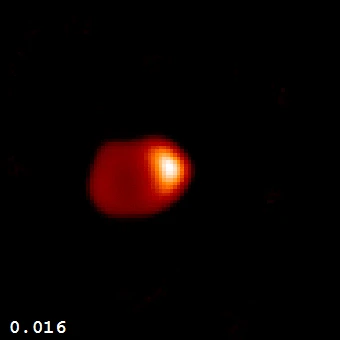
CFBDSIR J145829+101343
Binary brown dwarf system with a Y0 companion among the coolest known.

CFBDSIR J145829+101343 (abbreviated CFBDSIR 1458+10 or CFBDSIR J1458+1013) is a binary system of two brown dwarfs of spectral classes T9 and Y0 orbiting each other. Located in the constellation Boötes about 104 light-years from Earth, it is notable for containing one of the coolest known brown dwarfs at the time of its discovery.
- Spectral types
- T9 + Y0
- Distance
- 104.2 ly (31.9 pc)
- Parallax
- 31.3 ± 2.5 mas
- Proper motion
- ≈420 mas/yr
- Surface temperature of b
- 370 ± 40 K (≈100 °C)
- Mass of b
- 6–15 MJup
- Constellation
- Boötes
Lore & Background
The primary component, CFBDSIR 1458+10 A, was discovered in 2010 from the Canada-France Brown Dwarf Survey using MegaCam and WIRCam on the 3.6 m Canada-France-Hawaii Telescope on Mauna Kea. Follow-up photometry in 2009 used the SOFI near-infrared camera at the ESO 3.5 m New Technology Telescope at La Silla Observatory. The discovery paper reported 55 T-dwarf candidates, six photometrically confirmed as T-dwarfs, including three ultracool brown dwarfs later than T7, among them CFBDSIR 1458+10.
The companion, CFBDSIR 1458+10 B, was discovered in 2011 with the laser guide star adaptive optics system of the 10 m Keck II Telescope on Mauna Kea, using the NIRC2 infrared camera. Observations were made on 2010 May 22 and 2010 July 8. The discovery paper also presented a near-infrared trigonometric parallax measured with WIRCam on the Canada-France-Hawaii Telescope over seven epochs in 2009–2010, and spectroscopy with the X-Shooter spectrograph at the Very Large Telescope's Unit Telescope 2 in Chile, which allowed calculation of the temperature and other physical parameters of both brown dwarfs.
In 2012 the system was observed again with Keck II LGS-AO and NIRC2 on 2012 April 13, as part of a study of three brown dwarf binary systems. The binarity of CFBDSIR 1458+10 had been known before that study.
Reader's Guide
CFBDSIR 1458+10 B was the least luminous brown dwarf known at the time of its discovery, and its surface temperature of about 370 K (roughly 100 °C) made it the coolest known brown dwarf until the discovery of WISE 1828+2650 in August 2011. In the 2011 discovery paper it was assigned a spectral class >T10 and proposed as a possible member of the Y spectral class; in 2012 it was assigned spectral class Y0. Because of its low temperature, CFBDSIR 1458+10 B may be able to form water clouds in its upper atmosphere. The system's trigonometric parallax, measured under The Hawaii Infrared Parallax Program in 2012, is 31.3 ± 2.5 mas, corresponding to a distance of 31.9 pc (104.2 ly). Its proper motion is about 420 milliarcseconds per year. Physical properties of the components were calculated using three models: Lyon/COND models and Lbol, Burrows et al. (1997) models and Lbol, and Burrows et al. (2003) models and M(J). The adopted surface temperature of B is 370 ± 40 K, and its adopted mass is 6–15 Jupiter masses.
Did You Know?
- CFBDSIR 1458+10 B has a surface temperature of about 370 K, roughly 100 °C.
- The system is located about 104 light-years away in the constellation Boötes.
More in Binary and Multiple Stars, Part 5 1-24
Spotted an error? Know more?
Reader corrections go straight into our review queue. Suggest an edit · How this site is sourced