BV Centauri
A dwarf nova with an unusually long period and anomalous outbursts.

BV Centauri is a binary star system in Centaurus, classified as a cataclysmic variable of the dwarf nova type. Its brightness regularly surges, with outbursts recurring on average every 150 days, though this interval appears to have lengthened in recent decades. In its quiet state, the system shines at an apparent visual magnitude of about 13, varying by a few tenths of a magnitude over each orbit due to ellipsoidal changes in the visible surface area. During outbursts, it brightens to a maximum magnitude of 10.7. Based on its luminosity, the system is estimated to lie roughly 500 parsecs from Earth; a Gaia parallax measurement of 2.81 milliarcseconds gives a distance of about 360 parsecs. The star's variability was first noted by William Francis Herschel Waterfield in 1929.
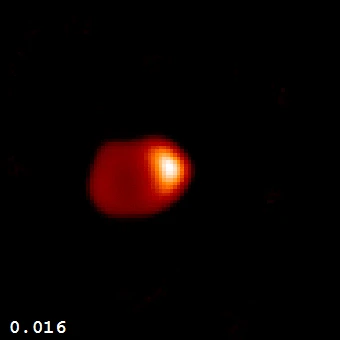
Cataclysmic variables are close binary systems where a white dwarf primary pulls matter from a companion star. In BV Centauri, the white dwarf and its companion have estimated masses of 1.18 and 1.05 solar masses, respectively, though conflicting mass measurements have also been reported. The secondary star is a conventional G5-G8IV-V type star, thought to contribute about half the system's visual light. It appears significantly evolved away from the zero-age main sequence. Doppler imaging of its surface reveals high magnetic activity, with roughly 25% of the surface covered in starspots, which are far more abundant on the hemisphere facing the white dwarf. A prominence was also detected on that same side of the secondary. The white dwarf is most clearly observed at ultraviolet wavelengths, where it dominates the light; any accretion disk in the system is relatively faint.
The system's orbital period is 0.611179 days (16.7 hours), one of the longest known for a dwarf nova. Its orbital inclination is 53 ± 4° relative to the plane of the sky. BV Centauri's outburst light curve is unusual for a dwarf nova: it takes up to 15 days to reach peak brightness and shows no plateau at maximum. This behavior has been compared to the classic nova GK Persei, leading to the suggestion that BV Centauri may have produced an unobserved nova outburst in the 19th century, missed by astronomers at the time.
- Constellation
- Centaurus
- Apparent magnitude (quiescence)
- about 13
- Apparent magnitude (outburst)
- 10.7
- Orbital period
- 0.611179 days (16.7 hours)
- Inclination
- 53 ± 4°
- Distance (gaia parallax)
- about 360 pc
- Discovery year
- 1929
Lore & Background
BV Centauri was discovered as a variable star by William Francis Herschel Waterfield in 1929. It is a cataclysmic variable binary in which a white dwarf primary accretes matter from a secondary star. The white dwarf has an estimated mass of 1.18 solar masses, and the secondary has an estimated mass of 1.05 solar masses, though conflicting mass measurements have also been reported. The secondary is a G5-G8IV-V star, assumed to contribute half of the system's visual luminosity, and is significantly evolved away from the zero-age main sequence. Doppler imaging has revealed it to be highly magnetically active, with about 25% of its surface covered in starspots, which are more abundant on the hemisphere facing the white dwarf. A prominence was also detected on the secondary's side facing the white dwarf. The white dwarf is the strongest source at ultraviolet wavelengths, while any accretion disk appears relatively faint.
Reader's Guide
BV Centauri undergoes recurrent rapid increases in brightness with a mean period of 150 days, a period that appears to have increased in recent decades. During quiescence its visual magnitude is about 13, varying by a few tenths due to ellipsoidal variability, and it brightens to magnitude 10.7 during outbursts. Its outburst light curve is anomalous for a dwarf nova: it takes up to 15 days to reach peak brightness and lacks a plateau at maximum. This behavior has been compared to GK Persei, leading to the proposal that BV Centauri may have produced an unobserved nova outburst in the 19th century. The system's orbital period of 0.611179 days (16.7 hours) is one of the longest known for a dwarf nova. Its distance is estimated at about 500 pc from luminosity, while a Gaia parallax of 2.81 mas gives about 360 pc. The system is inclined by 53 ± 4° relative to the plane of the sky.
Did You Know?
- BV Centauri's orbital period of 16.7 hours is one of the longest for a dwarf nova.
- The secondary star has about 25% of its surface covered in starspots, concentrated on the hemisphere facing the white dwarf.
- A prominence was detected above the secondary star's surface on the side facing the white dwarf.
More in Binary and Multiple Stars, Part 5 1-24
Spotted an error? Know more?
Reader corrections go straight into our review queue. Suggest an edit · How this site is sourced