81 Cancri
A multiple system with a close binary and a brown dwarf binary.

81 Cancri, also designated Pi¹ Cancri, is a stellar system located in the constellation Cancer. Its primary component is a close binary pair, while a widely separated binary brown dwarf orbits them. The system’s main star has an apparent visual magnitude of 6.49, making it just barely visible without a telescope. Because it lies near the ecliptic, the star can be occulted by the Moon.
Parallax measurements place the system about 66 light-years from the Sun. It moves across the sky at a high proper motion and is receding from Earth at a line-of-sight velocity of 49.8 km/s.
The close binary was first identified as a visual pair by W. S. Finsen in 1959. The two stars orbit each other every 988.058 days on an eccentric path (eccentricity 0.433). The primary is a G-type main-sequence star (class G8V) with 89% of the Sun’s mass and 82% of its radius. It shines with roughly the same luminosity as the Sun and has an effective temperature of 5,430 K. The secondary is a K-type main-sequence star (class K1V), slightly less massive than the primary and a few hundred kelvin cooler.
A brown dwarf companion was detected in 2001. The object 2MASSW J0912145+145940 (2M0912+14) was found to share the system’s proper motion, confirming it as a member. Designated 81 Cancri C, it has a spectral type of L8, near the boundary between L and T dwarfs. It lies about 43 arcseconds from the primary pair, corresponding to a minimum physical separation of roughly 880 AU at the system’s distance of 20.4 parsecs.
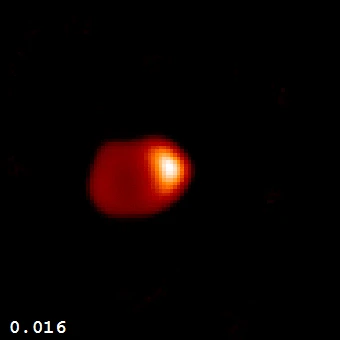
This brown dwarf appeared about half a magnitude brighter in the JHK bands than expected for its spectral type and distance. The system showed no signs of being unusually young, suggesting that component C might itself be an unresolved binary. In 2006, follow-up observations revealed it to be slightly oblong, confirming two brown dwarfs of similar spectral type. These two components, C and D, are separated by about 11 AU, and their mutual orbit is estimated to take on the order of 150 years due to their low masses.
- Bayer designation
- Pi1 Cancri
- Flamsteed designation
- 81 Cancri
- Apparent visual magnitude
- 6.49
- Distance from sun
- 66 ly
- Radial velocity
- 49.8 km/s (receding)
- Orbital period (ab)
- 988.058 days
- Orbital eccentricity (ab)
- 0.433
Lore & Background
81 Cancri was found to be a close visual binary by W. S. Finsen in 1959. The primary is a G-type main-sequence star with a stellar classification of G8V, having 89% of the mass of the Sun and 82% of its radius, radiating a similar luminosity with an effective temperature of 5,430 K. The secondary is a K-type main-sequence star with a class of K1V, similar in mass and temperature to the primary, being only lower in mass and a few hundred kelvin cooler. Their orbit has a period of 988.058 days with an eccentricity of 0.433.
A brown dwarf component was detected in 2001. The source 2MASSW J0912145+145940 (2M0912+14) was identified as having a common proper motion with the AB binary, and subsequent observations confirmed its brown dwarf nature. This component, 81 Cancri C, has a spectral type of L8, near the L-T transition. Separated from the primary components by 43 arcseconds and at a distance of 20.4 parsecs, the brown dwarf has a minimum physical separation of approximately 880 AU.
The brown dwarf was found to be about half a magnitude brighter in the JHK bands than expected, compared to others of similar spectral type and known distance. The system was not found to be particularly young to some confidence, so it was possible that component C could itself be a close binary not resolved by 2MASS. This was confirmed in 2006 as the source was found to be slightly oblong, caused by two components of similar spectral types. These two brown dwarfs, components C and D, have a separation of approximately 11 AU, and their mutual orbit likely takes on order of 150 years due to the small masses involved.
Reader's Guide
81 Cancri is notable as a hierarchical multiple system containing both a close stellar binary and a widely separated brown dwarf binary. The detection of the brown dwarf component in 2001 and its subsequent resolution into a binary in 2006 illustrate the progression of observational capabilities in identifying substellar companions. The system's proximity at 66 light-years and its location near the ecliptic make it accessible for both photometric and astrometric study, including lunar occultations. The brown dwarf binary's unexpected brightness in the near-infrared, about half a magnitude brighter than typical for its spectral type and distance, raised questions about its nature, ultimately leading to the discovery that it is itself a close binary. The orbital parameters of the stellar binary—a period of 988.058 days and eccentricity of 0.433—provide a well-characterized dynamical framework. The system's large proper motion and radial velocity of 49.8 km/s away from the Sun contribute to its kinematic profile. As a multiple system spanning from G- and K-type stars to L-type brown dwarfs, 81 Cancri offers a case study in the formation and evolution of low-mass companions across a wide range of separations.
Did You Know?
- 81 Cancri is also designated Pi1 Cancri and is located in the zodiac constellation of Cancer.
- The primary star is just bright enough to be visible to the naked eye at magnitude 6.49.
More in Binary and Multiple Stars, Part 5 1-24
Spotted an error? Know more?
Reader corrections go straight into our review queue. Suggest an edit · How this site is sourced