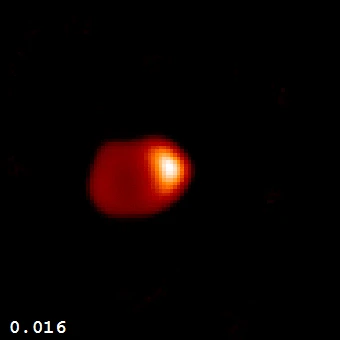
2MASSW J0920122+351742
Triple brown dwarf system with a highly inclined orbit.

2MASSW J0920122+351742 is a triple brown dwarf system, alternatively described as a low-mass star orbiting a pair of brown dwarfs. It is notable for its complex multiplicity, highly inclined orbit, and the presence of silicate-rich clouds in its primary component.
- Discovery
- 2000 by J. Davy Kirkpatrick et al. using 2MASS photometry and Keck spectroscopy
- Spectral type
- L6.5 (optical); infrared classified as T0pec
- Distance
- 21 parsec
- Separation
- 70 milliarcseconds (1.6 astronomical units at discovery distance)
- Orbital period
- about 6.7 years
- Orbital inclination
- 88.6 ± 1.2°
- System age
- estimated around 2 billion years
Lore & Background
2MASSW J0920122+351742 was first discovered in 2000 using 2MASS photometry and Keck spectroscopy, with an optical spectral type of L6.5 and a distance of 21 parsecs. Shortly after, Hubble WFPC2 imaging revealed it was extended in the F814W filter but not in F606W, indicating a red companion at a separation of 70 milliarcseconds (1.6 astronomical units at the then-known distance).
In 2017, dynamical mass measurements showed the binary was overly massive, with component B being more massive than expected. This led to the interpretation that component B is itself a pair of equal-mass brown dwarfs, making the system a triple. The primary (component A) could be either a low-mass star or a high-mass brown dwarf. The system's orbit is highly inclined at 88.6 ± 1.2°, giving a 6.8% chance of being an eclipsing binary, and the orbital period is about 6.7 years.
Spectral deconvolution estimated the primary's spectral type as L5.5±1 and the secondary as L9±1.5. The secondary's mass was too large for an L9 dwarf, supporting the triple interpretation. The system was observed with the Spitzer Infrared Spectrograph, which identified silicate-rich clouds in the primary, composed of small (≤0.1 μm) grains of amorphous enstatite or silicon monoxide. Another study found the top cloud layer of the primary to be 48% iron and 52% silicates (enstatite, fosterite, periclase, and quartz).
Reader's Guide
2MASSW J0920122+351742 is significant as one of the few known triple brown dwarf systems, demonstrating that brown dwarfs can form in hierarchical multiples. Its discovery and subsequent analysis highlight the challenges of resolving close, highly inclined binaries, as VLT and Hubble observations failed to resolve the pair at certain orbital phases, while Keck adaptive optics succeeded. The system's dynamical mass measurements were crucial in revealing the triple nature, as the secondary's mass exceeded expectations for its spectral type. The presence of methane in the H- and K-band spectrum of an L6.5 dwarf was unusual, leading to its infrared classification as T0pec and suggesting a composite spectrum from an L and T dwarf pair. The silicate-rich clouds in the primary, studied with Spitzer, provide insights into atmospheric chemistry and cloud formation in cool substellar objects. The system's age of about 2 billion years places it among older brown dwarf populations, and its highly inclined orbit offers a potential opportunity for future eclipsing binary studies, which could further refine component masses and orbital parameters.
Did You Know?
- The system has a 6.8% chance of being an eclipsing binary due to its orbital inclination of 88.6°.
- The primary's top cloud layer is composed of 48% iron and 52% silicates.
- Methane was detected in the H- and K-band spectrum, unusual for an L6.5 dwarf.
- The secondary component is unresolved and interpreted as two equal-mass brown dwarfs.
More in Binary and Multiple Stars, Part 5 1-24
Spotted an error? Know more?
Reader corrections go straight into our review queue. Suggest an edit · How this site is sourced