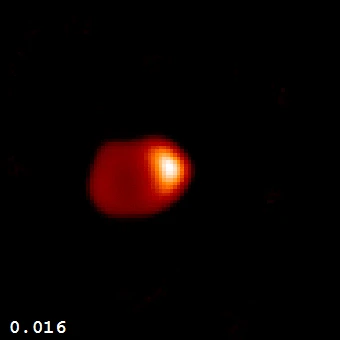
2MASS J11011926−7732383
First brown dwarf binary found with separation over 20 au.

2MASS J11011926–7732383 AB (abbreviated 2M1101AB; LUH 1) is a brown dwarf binary system located about 600 light-years away in the constellation Chamaeleon. The pair is separated by approximately 240 astronomical units, making it the first brown dwarf binary discovered with a separation greater than 20 au. Its existence challenged the ejection hypothesis of brown dwarf formation, which had predicted a maximum separation of 10 au for such binaries.
- Distance
- about 600 light-years
- Constellation
- Chamaeleon
- Separation
- about 240 astronomical units
- Primary spectral type
- M7.25 ± 0.25
- Primary mass
- about 52 Jupiter masses
- Primary temperature
- 2838 K (2565 °C; 4649 °F)
- Secondary spectral type
- M8.25 ± 0.25
- Secondary mass
- about 26 Jupiter masses
- Secondary temperature
- 2632 K (2359 °C; 4279 °F)
- Age
- about 1 million years
Lore & Background
The system was discovered by Kevin Luhman in 2004 during observations of candidate young brown dwarfs in Chamaeleon I, using the Magellan I telescope. The primary, 2M1101A, has a spectral type of M7.25 ± 0.25, a mass of about 52 Jupiter masses, and a temperature of 2838 K. The secondary, 2M1101B, has a spectral type of M8.25 ± 0.25, a mass of about 26 Jupiter masses, and a temperature of 2632 K. Based on spectral features such as sodium and potassium absorption lines, both brown dwarfs are young and belong to Chamaeleon I, with an approximate age of 1 million years, making them among the youngest substellar members of that association. Measurements by ESA's Gaia satellite show a similar parallax and proper motion for both components, confirming their physical association. The system has a relatively low binding energy.
Reader's Guide
The discovery of 2M1101AB provided fundamental insights into the formation of brown dwarfs. Previously, it was thought that wide binary brown dwarfs either do not form or are disrupted at ages of 1–10 million years. The existence of this system, together with other wide binaries such as Oph 162225-240515 and UScoCTIO 108, was inconsistent with the ejection hypothesis, which proposed that brown dwarfs form in multiple systems but are ejected before they gain enough mass to burn hydrogen. That hypothesis had predicted a maximum separation of 10 au for brown dwarf binaries. The system was detected in X-rays with Chandra and XMM-Newton. While XMM-Newton could not resolve the binary and detected only the primary, Chandra resolved the binary and detected the secondary. These apparently contradictory results were interpreted as strong variability of the X-ray emissions by this system.
Did You Know?
- The system has a low binding energy and an age of about 1 million years.
- Chandra and XMM-Newton gave contradictory X-ray results, interpreted as strong variability.
More in Binary and Multiple Stars, Part 5 1-24
Spotted an error? Know more?
Reader corrections go straight into our review queue. Suggest an edit · How this site is sourced