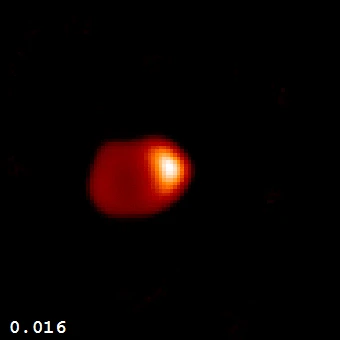
2MASS J05352184−0546085
First eclipsing binary brown dwarf system discovered.

2MASS J05352184−0546085, also known as V2384 Orionis, is a young eclipsing binary brown dwarf system located in the Orion Nebula at a distance of about 1200 light-years. It was the first eclipsing brown dwarf system ever discovered, preceding the detection of the transiting brown dwarf CoRoT-3b.
- Designations
- 2MASS J05352184−0546085, V2384 Orionis
- Distance
- about 1200 ly
- Orbital period
- 9.8 days
- Masses
- about 60 and 38 times the mass of Jupiter
- Age
- about 1 million years
- Rotation periods
- primary 3.3 days, secondary 14 days
- Spectral type
- M-type
Lore & Background
The system consists of two brown dwarfs orbiting each other every 9.8 days. With an age of roughly one million years, the objects have not yet cooled and remain inflated to over half the radius of the Sun, with temperatures comparable to red dwarf stars. The primary rotates every 3.3 days, while the secondary rotates every 14 days, indicating they are not yet tidally locked.
Unexpectedly, the less massive secondary brown dwarf is hotter than the primary. Several explanations have been proposed for this temperature reversal: a slight age difference between the two brown dwarfs; strong magnetic fields on the primary inhibiting convection, supported by its fast rotation and strong hydrogen-alpha emission; large starspots on the primary, though evidence does not support this; and tidal heating, which is unlikely to be solely responsible.
No infrared excess that would indicate a circumstellar disk has been detected. The system is a source of X-ray emission.
Reader's Guide
The discovery of 2M0535-05 as the first eclipsing binary brown dwarf system marked a milestone in the study of substellar objects. Eclipsing binaries provide direct measurements of mass and radius, making this system a crucial benchmark for testing models of brown dwarf structure and evolution at very young ages. The unexpected temperature reversal—where the less massive brown dwarf is hotter—challenges standard evolutionary models and has spurred investigation into mechanisms such as magnetic activity, starspots, and tidal heating. The system's youth (about one million years) means the brown dwarfs are still contracting and cooling, offering a snapshot of early substellar evolution. The lack of a detected circumstellar disk suggests that disk dissipation has already occurred. The X-ray emission indicates ongoing magnetic activity, consistent with the primary's rapid rotation and strong hydrogen-alpha emission. As the first of its kind, 2M0535-05 remains a reference object for subsequent discoveries of eclipsing brown dwarf binaries, such as 2M1510.
Did You Know?
- 2M0535-05 was the first eclipsing brown dwarf system discovered, in 2006.
- The less massive brown dwarf is unexpectedly hotter than the more massive one.
- The system is about 1 million years old and located about 1200 light-years away in the Orion Nebula.
- No circumstellar disk has been detected around the system.
More in Binary and Multiple Stars, Part 5 1-24
Spotted an error? Know more?
Reader corrections go straight into our review queue. Suggest an edit · How this site is sourced