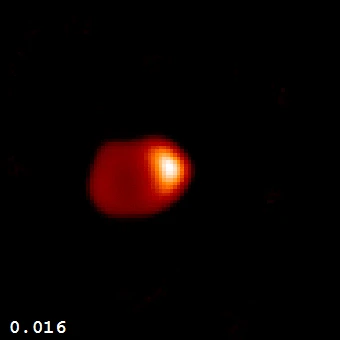
2M1510
A triple brown dwarf system with an eclipsing binary and a planet candidate.

2M1510 (2MASS J15104761–2818234) is a triple or possibly quadruple system of gravitationally bound brown dwarfs located 120 light-years away in the constellation Libra. It consists of the eclipsing binary 2M1510AB and the wide companion 2M1510C, and is only the second eclipsing binary brown dwarf system found (as of March 2020), the other being 2M0535-05. The system verified theoretical models for how brown dwarfs cool.
- Distance
- 120 light-years
- Constellation
- Libra
- Separation (2m1510ab–c)
- 250 astronomical units
- Orbital period (2m1510ab)
- 20.9 days
- Mass (2m1510a)
- about 0.04 solar masses (implied by near equal-mass binary)
- Mass (2m1510b)
- about 0.04 solar masses (implied by near equal-mass binary)
- Age indicator
- Member of the Argus moving group (million-year-old)
Lore & Background
The inner eclipsing binary, 2M1510AB, was discovered in the first light data of the SPECULOOS telescopes. It is also a double-lined spectroscopic binary, revealed by follow-up observations with Keck II. The two components, 2M1510A and 2M1510B, have very similar masses and orbit each other every 20.9 days. The wide companion 2M1510C is separated by 250 astronomical units and was resolved in 2MASS data. Additionally, VLT/SINFONI data showed an elongated point spread function for 2M1510AB, suggesting a possible fourth component, 2M1510D, with a mass of about 0.02 solar masses and a separation of about 4.4 au, orbiting the eclipsing binary every 30 years. This result was not considered in some later work and could represent a contamination of the eclipsing binary, making tests of cooling models more challenging.
Reader's Guide
2M1510 is significant as only the second eclipsing binary brown dwarf system discovered, providing a rare direct test of brown dwarf cooling models. The system's youth is indicated by hydrogen-alpha emission lines, membership in the million-year-old Argus moving group, and low surface gravity. The orbital period was improved with TESS, enabling further follow-up. In April 2025, strong evidence was announced for a circumbinary planet, 2M1510(AB)b, in a polar orbit around the brown dwarf pair—the first such polar circumbinary planet discovered. The discovery relied on radial velocity measurements showing retrograde apsidal precession unexplained by the outer companion. However, a dependency exists between orbital period and planet mass: a ≈100-day period corresponds to a ≈10 Jupiter-mass planet, while a ≈400-day period corresponds to a ≈100 Jupiter-mass planet. A 2025 study suggested that a timing offset in the Doppler data may have produced a spurious signal, with radial velocity uncertainties underestimated, leaving the planet candidate possibly a false positive. Follow-up observations such as eclipse timing variation or astrometry could confirm the planet and break the period–mass degeneracy.
Did You Know?
- 2M1510 is only the second eclipsing binary brown dwarf system ever found (as of March 2020).
- The inner binary 2M1510AB has an orbital period of 20.9 days and consists of two near-equal-mass brown dwarfs.
- A planet candidate, 2M1510(AB)b, was announced in 2025 in a polar orbit around the brown dwarf binary—the first such polar circumbinary planet.
- A 2025 study suggested the planet candidate may be a false positive due to underestimated radial velocity uncertainties.
More in Binary and Multiple Stars, Part 5 1-24
Spotted an error? Know more?
Reader corrections go straight into our review queue. Suggest an edit · How this site is sourced