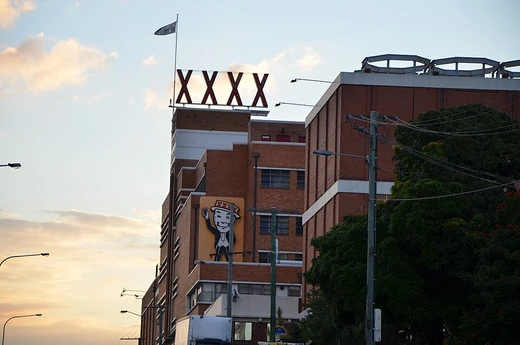
Rheingold Brewery
Rheingold was the leading beer in New York State for decades.

Rheingold Beer was produced from 1883 until 1987 by a company known variously as Rheingold Brewery, Rheingold Breweries, or Liebmann Breweries. The brand itself has been sold intermittently by other companies since the original brewery shut down, with two gaps in production: one in the mid-1990s and another from 2013 to 2023.
The business began when Samuel Liebmann, a brewer, immigrated from Germany to America in 1854 to escape government oppression. His oldest son, Joseph, had gone ahead to scout a location. Upon the family’s arrival in Philadelphia on November 7, 1854, Joseph met them at the wharf and took them to Brooklyn. Within a week, Samuel leased a small brewery on Meserole Street and started brewing with his three sons. A year later, the company purchased a 6.4-acre site at the corner of Forrest Street and Bremen Street in the Bushwick section of Brooklyn, where they built a new plant. Samuel retired in 1868, and in 1870 the company was renamed S. Liebmann’s Sons Brewery.
The Rheingold brand name debuted in 1883. Several family stories explain its origin. One holds that “Rheingold” simply alluded to the great Rhine River in Germany. Another claims that after an opera performance, a conductor held up a glass of beer and declared it the color of “Rheingold”—a reference to the legendary gold ring from the Rhine River in Richard Wagner’s Ring cycle, whose first opera is *Das Rheingold*. A third version says a special beer was brewed for a dinner honoring the head of the Metropolitan Opera after the season finale of *Das Rheingold*; it was named “Rheingold,” became a hit, and was made a permanent product.
Production grew from 1,200 barrels in the first year to 39,000 barrels in 1877, 165,000 in 1894, 200,000 per year in the early 1900s, and 700,000 in 1914. The brewery expanded onto adjacent properties, absorbing the John Schoenwald Brewery in 1878 and the Claus-Lipsius Brewery in 1902. By 1907, it was the largest and most complete brewing facility in the eastern United States, covering 18 acres and four city blocks. The plant pioneered new refrigeration methods and was the first to have its own laboratory.
During Prohibition (1920–1933), the brewery survived by selling “near beer,” lemonade, and “Teutonic,” a concentrated liquid extract of malt and hops marketed for nutrition and good health.
- Founded
- 1883 (brand); 1854 (brewery)
- Founder
- Samuel Liebmann and his three sons
- Peak market share
- 35% in New York State (1940s–early 1960s)
- Peak production
- 4,236,000 barrels (1965)
- Number of plants at peak
- 5
- Final sale of original brewery
- 1987 (to G. Heileman Brewing Company)
- Notable innovation
- Introduced Gablinger's Beer, an early reduced-calorie beer (1966)
Lore & Background
The Rheingold brand name was first used in 1883. Several family-lore explanations exist for its origin: an allusion to the great Rhein River in Germany; a conductor at a banquet after an opera performance declaring the beer the color of 'Rheingold'; or a special beer brewed for a dinner honoring the head of the Metropolitan Opera after a performance of Das Rheingold. The brewery's production grew from 1,200 barrels in its first year to 700,000 barrels in 1914, and by 1907 it was the largest and most complete brewing facility in the eastern United States, occupying 18 acres and four city blocks. During Prohibition (1920–1933), the brewery survived by selling near beer, lemonade, and a malt and hops extract called 'Teutonic'.
After Prohibition, Rheingold was promoted as the 'Dry Beer', and the annual Miss Rheingold contest, launched in 1940, became the centerpiece of its marketing campaign. Between 1947 and 1954, the company acquired four new plants, giving it more production facilities than any other brewing company in the country except Falstaff Brewing Corporation. Expansion into California was unsuccessful; the San Francisco plant closed in 1955 and the Los Angeles facility was sold in 1957. Rheingold prospered until the early 1960s when profits were squeezed by rising costs and competition.
In 1964, the fourth generation of the Liebmann family sold the company to Pepsi-Cola United Bottlers for $26 million. Beer sales peaked in 1965 at 4,236,000 barrels but declined thereafter. In 1966, Rheingold introduced Gablinger's Beer, one of the first reduced-calorie beers, which failed in the marketplace. The formula was later tweaked and made available to Meister Brau Inc., which marketed it as Meister Brau Lite; that brand was sold to Miller Brewing Company in 1972 and relaunched as Miller Lite. Rheingold Breweries was purchased by Chock full o'Nuts in 1974, then by Christian Schmidt Brewing Company in 1977, and finally by G. Heileman Brewing Company in 1987, which continued to sell the beer but stopped using Rheingold Brewery as a company name on the label.
Reader's Guide
Rheingold Brewery's significance lies in its long history as a dominant regional brewer and its role in the development of light beer. For decades, Rheingold was the leading beer brand in New York State, capturing as much as 35% of the market during the 1940s through early 1960s. The brewery's marketing campaign centered on the Miss Rheingold contest, launched in 1940, which became a cultural fixture. The company's legacy also includes the introduction of Gablinger's Beer in 1966, one of the first reduced-calorie beers. Although that product failed, its formula was adapted and eventually led to Miller Lite, a major national brand. Rheingold's ownership changed hands multiple times after the Liebmann family sold it in 1964, passing through Pepsi-Cola United Bottlers, Chock full o'Nuts, Christian Schmidt Brewing Company, and G. Heileman Brewing Company. The brand has been sold intermittently by subsequent owners, with gaps in the mid-1990s and from 2013 through 2023. The name 'Rheingold' alludes to the legendary ring made of gold from the Rhine River, central to Richard Wagner's opera Das Rheingold.
Did You Know?
- Rheingold was the leading beer brand in New York State with a market share as high as 35% during the 1940s, 1950s, and early 1960s.
- The brewery introduced Gablinger's Beer in 1966, one of the first reduced-calorie beers, which later contributed to the development of Miller Lite.
- In 1974, PepsiCo poured 100,000 gallons of Rheingold beer into the East River rather than pack it.
- The Rheingold name is an allusion to the legendary ring made of gold from the Rhine River, subject of Richard Wagner's opera Das Rheingold.
More in Beer Brands, Part 3 1-24
Spotted an error? Know more?
Reader corrections go straight into our review queue. Suggest an edit · How this site is sourced