
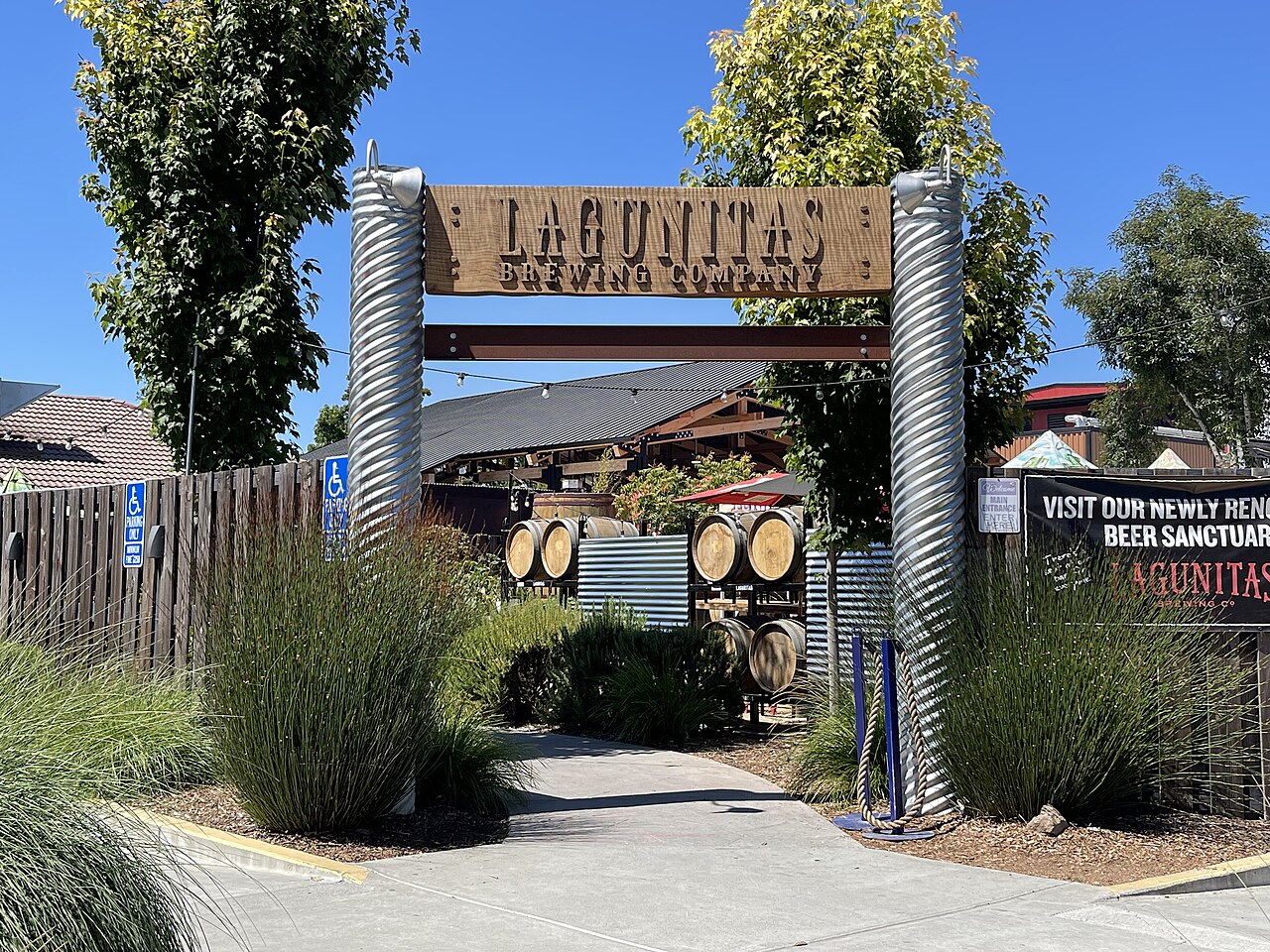
Lagunitas Brewing Company
A former craft brewery now owned by Heineken International.

Missvain · CC BY 4.0
Lagunitas Brewing Company is a brewery founded in 1993 in Petaluma, California, and is a subsidiary of Heineken International. It was originally a craft brewery before Heineken acquired a 50% stake in 2015, and later the remainder in 2017. The brewery is known for its rapid growth, legal disputes over cannabis associations, and a notable lawsuit against Sierra Nevada over IPA labeling.
Quick Facts
- Location City
- Petaluma
- Location State
- California
- Location Country
- United States
- Opened
- 1993
- Key People
- Tony Magee (Founder)
- Production
- 916420 USbeerbbl
- Owner
- Heineken International
Facts from the source article.
Lore & Background
The brewery was founded by Tony Magee in Lagunitas, California, in 1993, but moved to Petaluma a year later after outgrowing its original rural West Marin location. Lagunitas became one of the fastest-growing craft breweries in the United States, with production increasing from 27,000 US beer barrels in 2004 to 106,000 in 2010. By March 2011, it had 92 employees and distribution in 32 states. In 2012, a $9.5 million expansion increased brewing capacity to 600,000 US beer barrels, and construction began on a satellite brewery in Chicago's North Lawndale neighborhood, which started production on April 18, 2014, and closed in 2024. A planned third brewery in Azusa, California, did not open due to a slowdown in growth.
The brewery has long-standing associations with cannabis, which have caused legal problems. In 2005, the California Department of Alcoholic Beverage Control raided a weekly tasting party at the brewery, investigating alleged cannabis dealing. No charges were filed, but Lagunitas was found in violation of California's 'disorderly house' law and served a twenty-day suspension, commemorated with Undercover Investigation Shut-down Ale. In 2013, Lagunitas dropped '420' from its labels after a trademark claim by Sweetwater Brewing Company. In 2018, it released Hi-Fi Hops, an IPA-inspired sparkling water infused with THC and CBD, in collaboration with AbsoluteXtracts, available only in California.
Reader's Guide
Lagunitas Brewing Company's significance lies in its trajectory from a small craft brewery to a global brand under Heineken International. Its rapid growth in the 2000s and early 2010s made it a notable player in the American craft beer scene, ranking as the fifth top-selling craft brewery in the US in 2013. The brewery's expansion into Chicago and planned expansion into Azusa reflect its ambition, though the latter was halted by slowing growth. The 2015 acquisition by Heineken, which exceeded the 25% ownership threshold, caused Lagunitas to lose its craft brewery designation by the Brewers Association, marking a shift in its identity. The brewery's legal entanglements, including a 2014 lawsuit against Sierra Nevada over IPA labeling (dropped after public outcry) and cannabis-related incidents, highlight its confrontational and countercultural brand. The 2018 release of Hi-Fi Hops, a THC- and CBD-infused beverage, further underscores its ongoing association with cannabis culture. The closure of the Chicago brewery in 2024 marks a contraction in its physical footprint, while founder Tony Magee continued as CEO after Heineken's full ownership in 2017, aiming for global expansion.
Did You Know?
- Lagunitas was founded in 1993 in Lagunitas, California, and moved to Petaluma a year later.
- In 2005, a raid over alleged cannabis dealing led to a twenty-day suspension, commemorated with Undercover Investigation Shut-down Ale.
- Heineken acquired a 50% stake in Lagunitas in 2015, and the remainder in 2017.
- The Chicago satellite brewery opened in 2014 and closed in 2024.
Petaluma Roots & the Craft Label
Lagunitas Brewing Company was rooted in Petaluma, California, where it operated as a craft brewery. Its identity as a craft brewer was a defining characteristic of the business, one that placed it in a distinct category separate from the massive multinational brewing corporations. That status, however, was not permanent or invulnerable. The very definition of what qualified as a craft brewer hinged on a specific ownership threshold: if a larger entity held more than twenty-five percent of the company, the craft designation was lost. For years, Lagunitas operated comfortably within that boundary, building its reputation as an independent, California-based producer. The Petaluma location anchored the brand in a specific regional identity, and the craft label served as both a marketing distinction and a philosophical statement about how the beer was made and who controlled the process. All of that would change within a matter of years, as the brewing industry's consolidation pushed even beloved regional names into the orbit of global giants.
The 2015 Heineken Partnership
On September 10, 2015, Heineken International publicly announced its intention to acquire a fifty-percent stake in Lagunitas Brewing Company of Petaluma, California. The stated rationale behind the transaction was to equip Lagunitas with the means to expand its operations on a global scale, a reach that a regional craft brewery could not easily achieve on its own. At the time, Heineken was the third-largest brewer in the world by revenues, positioned behind Anheuser-Busch InBev and SABMiller, and it had been steadily growing its international footprint through a series of high-profile acquisitions including the FEMSA brewery division in Mexico and the Scottish and Newcastle brands. The partnership gave the Petaluma-based brewery access to the distribution and production infrastructure of a multinational giant while preserving a degree of operational independence through the fifty-fifty ownership structure. For Heineken, the move fit a clear pattern of absorbing well-known regional and craft names to broaden its portfolio and strengthen its presence in the American market.
The End of a Craft Identity
One of the most consequential and immediate effects of the Heineken deal was the loss of Lagunitas's craft brewer status. Because the Heineken stake exceeded the twenty-five-percent threshold that defined craft eligibility, the Petaluma brewery could no longer claim the designation that had been central to its brand identity. This was not merely a technicality or a matter of industry jargon; the craft label had been a core part of how Lagunitas positioned itself in the marketplace, distinguishing its products from those of the large multinational brewers. The moment Heineken's ownership crossed that line, the philosophical distinction between an independent regional producer and a subsidiary of a global brewing corporation became the defining reality. For consumers and industry observers alike, the deal symbolized a broader trend in the American beer landscape: the steady absorption of beloved craft brands into the portfolios of the world's largest brewing companies. Lagunitas's story became a case study in how the boundaries of the craft beer movement could be redrawn by a single ownership transaction.
Full Absorption in 2017
Less than two years after the initial partnership, the relationship between Heineken and Lagunitas moved from a joint arrangement to full corporate ownership. On May 4, 2017, Heineken announced that it would purchase the remaining fifty percent of Lagunitas Brewing Company, making it the sole owner of the Petaluma-based brewery. This completed a transition that had begun in September 2015, when the fifty-fifty stake was first established. With full ownership, the operational independence that the initial deal had preserved was effectively dissolved, and Lagunitas became wholly integrated into Heineken's global brewing structure. The original mission of the 2015 deal, to enable Lagunitas to expand its operations globally, was now to be carried out under the complete control of a company that, by that point, had become the second-largest brewer in the world following the 2016 merger of Anheuser-Busch InBev and SABMiller. For the Petaluma brewery, the 2017 acquisition marked the final chapter of its existence as an independently governed entity and the beginning of its life as a fully owned subsidiary of a Dutch multinational.
Gallery

Frequently Asked Questions
Who started Lagunitas Brewing Company and when?
Tony Magee launched the brewery in 1993 in the small coastal town of Lagunitas, California. It later relocated its operations to Petaluma, California, where it is based today.
What is the relationship between Lagunitas and Heineken?
Heineken International first bought a 50 percent stake in the brewery in 2015 and then acquired the remaining shares in 2017. That two-step purchase turned what had been an independent craft operation into a subsidiary of the global beer conglomerate.
How quickly did Lagunitas scale in its early years?
Output jumped from roughly 27,000 US beer barrels in 2004 to about 106,000 barrels by 2010. That fourfold increase in just six years made it one of the fastest-growing craft breweries in the country at the time.
What legal disputes is Lagunitas known for?
The company was embroiled in a high-profile lawsuit against Sierra Nevada over whether the term "IPA" could be trademarked, arguing it was a generic style descriptor. It also faced separate legal friction tied to its branding and association with cannabis culture.
Why does Lagunitas matter in the broader craft-beer story?
Its trajectory from a small coastal brewpub to a Heineken-owned brand became a flashpoint in debates over corporate ownership and the meaning of the "craft" label. The rapid expansion, trademark battles, and eventual absorption made it a frequently cited case study in industry consolidation.
More in Beer Brands, Part 3 1-24
Spotted an error? Know more?
Reader corrections go straight into our review queue. Suggest an edit · How this site is sourced