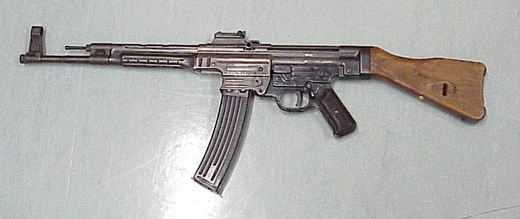
ČZ 2000
A Czech prototype weapon system never adopted for service.

The ČZ 2000 is a prototype Czech weapon system chambered in 5.56 mm, designed as a family of three firearms: a standard rifle, a carbine, and a light machine gun. It grew out of the earlier Lada S project, which began in 1977 at the Brno General Machine-Building Plants R&D Center. The chief designer for both systems was J. Denel of the Prototypa-ZM company in Brno. By 1984, a design was approved that used the smaller 5.45×39 mm cartridge and covered three roles: a subcarbine with a 185 mm barrel, a rifle with a 382 mm barrel, and a light support weapon with a 577 mm barrel. These weapons closely followed the AK-74 family, differing mainly in the receiver cover, sights, and safety selector. Prototypes were built by late 1985, tested from 1986, and approved for production in November 1989.
Shortly after, the Cold War ended and Czechoslovakia’s communist government fell during the Velvet Revolution. Although 300,000 Lada systems were planned, the army had no funds by the time production was declared viable in February 1990. The country itself began splitting apart, and on 1 January 1993, it separated into the Czech Republic and Slovakia, ending 74 years of unified Czechoslovakia. The smaller army was unlikely to buy the Lada in large numbers. By then, Česká zbrojovka Uherský Brod had taken over the design and been privatized, shelving the weapon for several years.
In the late 1990s, the project was revived as the Czech Republic moved toward full NATO membership. Before being shelved, the Lada had been converted to fire .223 Remington, mainly because the program did not involve producing 5.45×39 mm ammunition and Sellier & Bellot already made .223 cartridges. The restarted program rechambered the rifle to NATO-standard 5.56×45 mm, but kept a magazine well that accepted AK-74-type magazines; switching to STANAG magazines would have required a receiver redesign and been too costly. The Army of the Czech Republic showed interest but never awarded a contract. The weapon was then offered for export as the CZ 2000.
The ČZ 2000 family consists of selective-fire, gas-operated automatic weapons with a rotating bolt. Cartridge casings are extracted by a spring-loaded claw extractor and ejected by a protrusion in the receiver. It uses a hammer-type striker and a trigger assembly with a manual fire selector on the left side of the receiver above the pistol grip.
Quick Facts
- Origin
- Czechoslovakia
- Is Ranged
- Yes
- Designer
- Bohuslav Novotný
- Design Date
- 1986-1990 (LADA) / 1990-1991 (ČZ 2000)
- Manufacturer
- Česká Zbrojovka Uherský Brod
- Variants
- Carbine / Light machine gun
- Weight
- 2.60 kg (carbine) / 3.00 kg (standard rifle) / 4.10 kg (LMG)
- Length
- 675 mm stock extended/435 mm stock folded (carbine) / 850 mm stock extended/615 mm stock folded (standard rifle) / 1226 mm stock extended/1050 mm stock folded (LMG)
- Part Length
- 185 mm (carbine) / 382 mm (standard rifle) / 577 mm (LMG)
- Height
- 270 mm
- Cartridge
- 5.45×39mm (LADA) / 5.56×45mm NATO (ČZ 2000)
- Action
- Gas-operated, rotating bolt
Facts from the source article.
Lore & Background
The ČZ 2000 originated from a program begun in 1977 at the Brno General Machine-Building Plants R&D Center under the name Lada S. Chief designer J. Denel from Prototypa-ZM led development. A design approved in 1984 fired the 5.45×39mm cartridge and could fill three roles: subcarbine, rifle, and light support weapon. The weapons were built by late 1985, tested from 1986, and approved for production in November 1989. However, the end of the Cold War and the Velvet Revolution left the Czechoslovak Army without funds; 300,000 Lada systems were planned but none were produced. After Czechoslovakia split in 1993, the project was shelved by Česká zbrojovka Uherský Brod.
In the late 1990s, the Lada project was restarted as the Czech Republic sought NATO membership. It was rechambered to 5.56×45mm NATO ammunition, retaining AK-74-type magazines to avoid costly receiver redesign. The Army of the Czech Republic expressed interest but awarded no contracts. The weapon was then offered for export as the ČZ 2000. The system features a side-folding metal wire stock, adjustable iron sights with self-luminous aiming dots, and a high degree of parts commonality among variants. The light machine gun variant includes a side rail for optics. As of 2007, the project has been discontinued.
Reader's Guide
The ČZ 2000 represents a late Cold War attempt by Czechoslovakia to develop a modular infantry weapon system in a smaller caliber, initially following the AK-74 pattern. Its history reflects the political and economic upheavals of the region: the project was approved just as the communist government fell, and the subsequent dissolution of Czechoslovakia left the weapon without a buyer. The conversion to NATO caliber in the late 1990s was a pragmatic response to the Czech Republic's prospective NATO membership, but the army's lack of funding and the cost of further redesign prevented adoption. The weapon's significance lies in its demonstration of how geopolitical shifts can derail even well-developed military projects. Though never fielded, the ČZ 2000 remains a notable example of a post-Soviet attempt to bridge Eastern and Western small arms standards. Its discontinuation in 2007 marked the end of a three-decade development effort.
Did You Know?
- The ČZ 2000 was originally designed to fire the 5.45×39mm cartridge before being rechambered to 5.56×45mm NATO.
- The weapon system was intended to replace the vz. 58 assault rifle, vz. 61 Škorpion submachine gun, and vz. 59 machine gun.
- The magazine well was designed to accept AK-74-type magazines rather than STANAG magazines to avoid costly receiver redesign.
- The light machine gun variant has a barrel length of 577 mm and a sight range of up to 1000 m.
More in Assault Rifles 1-24
Spotted an error? Know more?
Reader corrections go straight into our review queue. Suggest an edit · How this site is sourced