Comparison of the AK-47 and M16
Cold War rivals that defined modern infantry combat.

Auge=mit · CC BY-SA 4.0
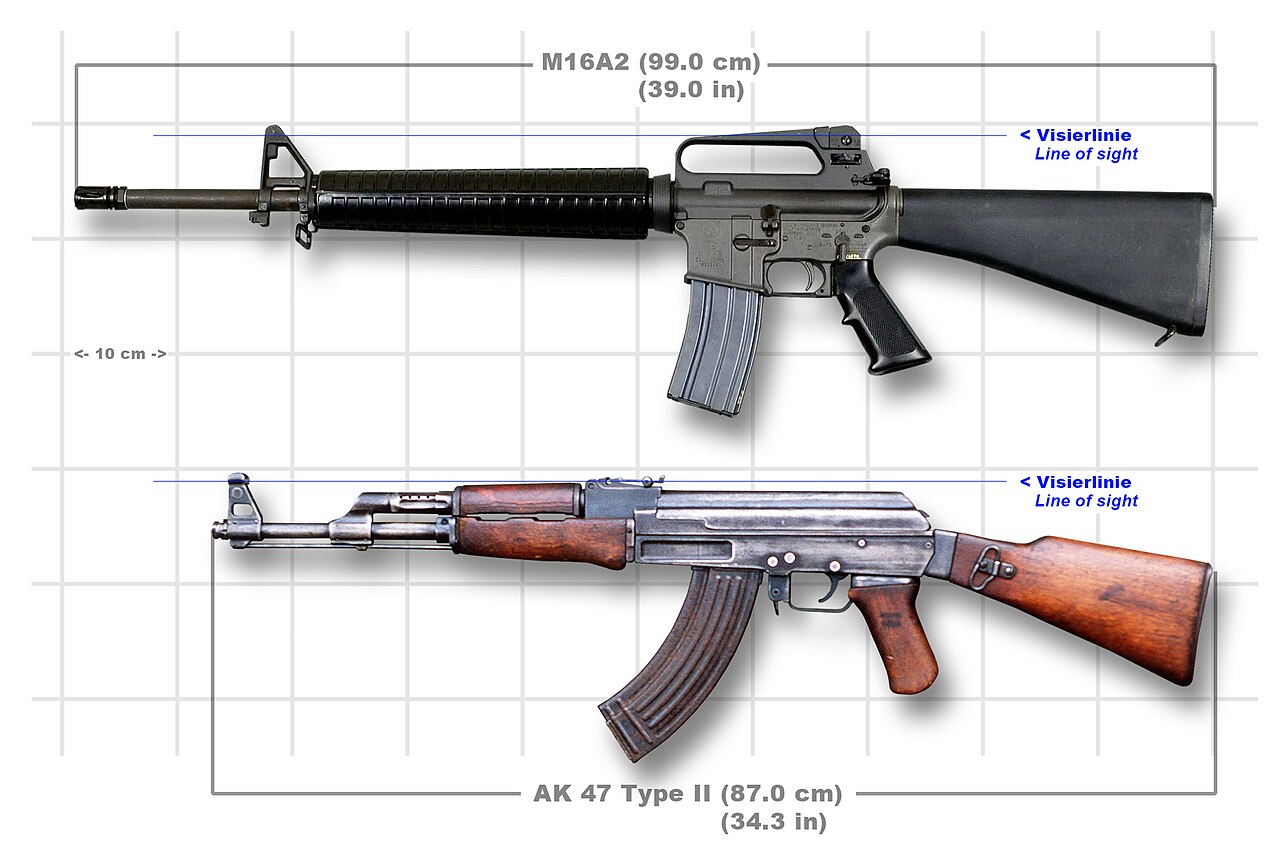
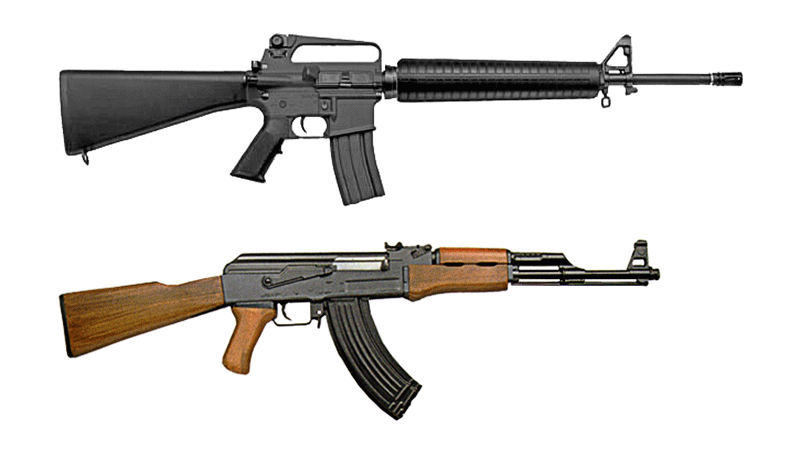
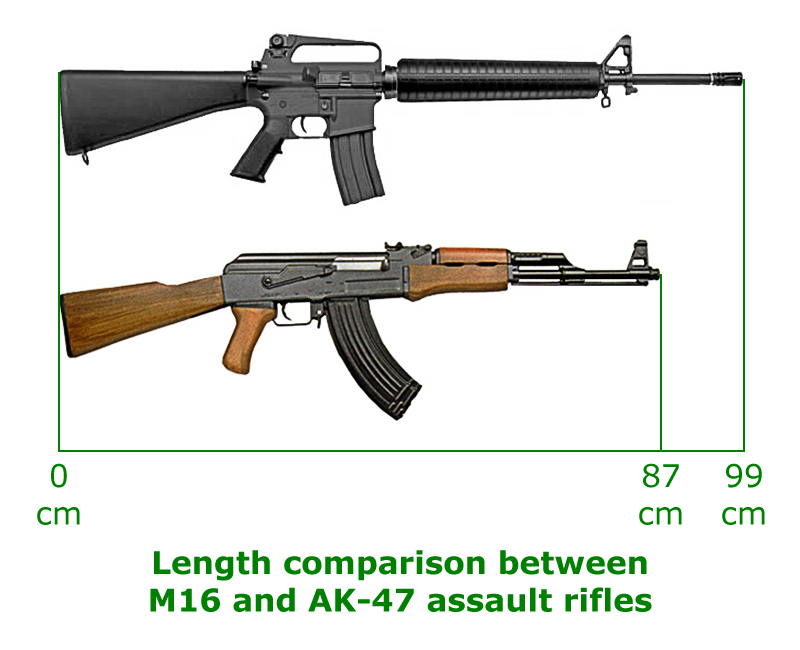
The AK-47 and M16 are the world’s two most widespread assault rifles. Born from the Cold War, both have seen action in conflicts of every scale since the 1960s. Their users span militaries, police, security forces, revolutionaries, terrorists, criminals, and civilians, and they will likely remain in service for decades. This has made them the focus of endless comparisons and debates.
The AK-47’s design drew from the German StG 44. It was finalized, adopted, and issued widely to the Soviet Army in the early 1950s. Its firepower, simple handling, low production cost, and ruggedness fit perfectly with the Soviet military’s new mobile warfare tactics. More AK-type weapons have been built than all other assault rifles combined. In 1974, the Soviets began replacing their AK-47 and AKM models with the newer AK-74, which fires the 5.45×39mm cartridge.
The M16 was adapted from the ArmaLite AR-15 and entered U.S. military service in the mid-1960s. Despite early problems, it proved a revolutionary design and holds the record as the longest continuously serving rifle in American military history. The U.S. military has largely replaced the M16 in combat units with the shorter, lighter M4 carbine.
**History**
**Sturmgewehr 44**
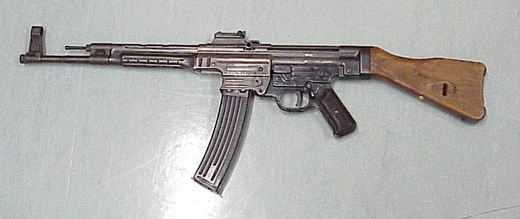
The Germans pioneered the assault rifle concept during World War II. Their research showed most firefights occur within 400 meters and that standard rifles were too powerful for typical small-arms combat. They developed a select-fire, intermediate-powered rifle that combined a submachine gun’s rate of fire with a rifle’s range and accuracy. The result was the Sturmgewehr 44, produced in large numbers—about half a million units. It fired a new intermediate cartridge, the 7.92×33mm Kurz, made by shortening the standard 7.92×57mm Mauser round and using a lighter 125-grain bullet. This limited range but made automatic fire more controllable. The smaller, lighter cartridge also let soldiers carry more ammunition to support the higher consumption of automatic fire. The Sturmgewehr 44 used an inexpensive stamped steel design and a 30-round detachable box magazine. It featured a straight stock with the barrel under the gas cylinder to reduce the turning moment of recoil, helping prevent the muzzle from climbing during automatic fire. Its barrel and overall length were shorter than traditional rifles, and it had a pistol grip for better control.
- Ak-47 adopted
- early 1950s
- M16 adopted
- mid-1960s
- Ak-47 cartridge
- 7.62×39mm M43
- M16 cartridge
- .223 caliber (5.56 mm)
- Ak-type weapons produced
- more than all other assault rifles combined
- M16 service length
- longest-continuously serving rifle in American military history
Lore & Background
The AK-47 was influenced by the design of the German StG 44. It was finalized, adopted, and entered widespread service in the Soviet Army in the early 1950s. Its firepower, ease of use, low production costs, and reliability were perfectly suited for the Soviet Army's new mobile warfare doctrines. More AK-type weapons have been produced than all other assault rifles combined. In 1974, the Soviets began replacing their AK-47 and AKM rifles with a newer design, the AK-74, which uses 5.45×39mm ammunition.
The M16 was adapted from the ArmaLite AR-15, and entered United States military service in the mid-1960s. Despite its early failures, the M16 proved to be a revolutionary design and stands as the longest-continuously serving rifle in American military history. The U.S. military has largely replaced the M16 in combat units with a shorter and lighter version called the M4 carbine.
The first confrontations between the AK-47 and the M14 came in the early part of the Vietnam War. Battlefield reports indicated that the M14 was uncontrollable in full-auto and that soldiers could not carry enough ammo to maintain fire superiority over the AK-47. The M2 Carbine was underpowered and ultimately outclassed by the AK-47. A replacement was needed, leading to the adoption of the M16.
Reader's Guide
The AK-47 and M16 represent two competing design philosophies that emerged from Cold War rivalries. The AK-47, influenced by the German StG 44, emphasized reliability, low production costs, and ease of use, making it ideal for mass conscript armies and irregular forces. Its widespread supply to allied nations and shared blueprints—notably with the People's Republic of China's Type 56—resulted in more AK-type weapons being produced than all other assault rifles combined. Of the estimated 500 million firearms worldwide, approximately 100 million belong to the Kalashnikov family, three-quarters of which are AK-47s.
The M16, adapted from the ArmaLite AR-15, introduced a lightweight design with a small-caliber, high-velocity cartridge. Its adoption followed the failure of the M14 to match the AK-47 in Vietnam, where the M14 was uncontrollable in full-auto and soldiers could not carry enough ammunition. Despite early failures, the M16 became the longest-continuously serving rifle in American military history, though it has largely been replaced in combat units by the shorter M4 carbine. Both rifles continue to be used worldwide by military, police, security forces, revolutionaries, terrorists, criminals, and civilians.
The German Blueprint That Shaped Two Rivals
The assault rifle concept was born in Germany during World War II, when research revealed that the vast majority of firefights occurred within 400 meters, making traditional full-power rifles overkill for most engagements. The Sturmgewehr 44 embodied this insight, pairing the rapid-fire capability of a submachine gun with the range and precision of a conventional rifle, all while firing a revolutionary 7.92×33mm Kurz intermediate cartridge. Its stamped steel construction, 30-round box magazine, straight stock, and pistol grip set a template that would echo through decades of small-arms design. Both the Soviet and American arsenals ultimately drew from this well. The Soviets, having witnessed a Sturmgewehr demonstration in 1943, moved quickly to develop their own intermediate-caliber weapons, culminating in the AK-47. The Americans, by contrast, initially dismissed the StG 44 as merely a carbine equivalent of little importance, a misjudgment that delayed their embrace of the concept until the M16 arrived in the mid-1960s.
Soviet Success and a Global Footprint
The AK-47 was finalized and adopted into widespread Soviet Army service in the early 1950s, and its combination of dependable firepower, straightforward operation, minimal manufacturing expense, and rugged reliability aligned perfectly with the Red Army's emerging mobile warfare doctrines. The weapon's influence spread far beyond Soviet borders. Blueprints were shared with allied nations, with China's Type 56 production line standing out as a particularly massive contributor. The result is staggering: of an estimated 500 million firearms in existence worldwide, roughly 100 million belong to the Kalashnikov family, and three-quarters of those are AK-47s. More AK-type weapons have been manufactured than every other assault rifle combined. By 1974, the Soviets began phasing out the AK-47 and its AKM variant in favor of the AK-74, which chambered the smaller 5.45×39mm round, yet the original design's global footprint continued to expand well into the 1960s and beyond.
American Hesitation and the M16's Hard-Won Entry
While the Soviets and Germans embraced the intermediate-cartridge assault rifle, the U.S. Army clung to its preference for high-powered semi-automatic weapons. American studies of World War II combat yielded conclusions nearly identical to those of their European counterparts, yet senior commanders, scarred by the logistical nightmares of two wars, resisted the shift. The Sturmgewehr 44 was officially characterized as serving the same role as the U.S. carbine and deemed of little importance. Even during the Korean War, when the select-fire M2 Carbine largely supplanted submachine guns, combat experience revealed the .30 Carbine round was underpowered. It was not until the mid-1960s that the M16, adapted from the ArmaLite AR-15, entered United States military service. Despite early field failures, the M16 proved to be a genuinely revolutionary design and went on to claim the distinction of being the longest-continuously serving rifle in American military history.
Decades of Service and an Unending Debate
Since the 1960s, the AK-47 and M16 have appeared in conflicts of every scale, wielded by regular armies, police units, security forces, revolutionary groups, terrorists, criminals, and ordinary civilians. This extraordinary breadth of users has made the two rifles the subject of countless comparisons and an endless cycle of debate that shows no sign of slowing. The M16, despite its early rough patches, has remained a cornerstone of American infantry armament for decades, though combat units have largely transitioned to the shorter, lighter M4 carbine. The AK-47, meanwhile, continues to circulate globally in enormous numbers, and both weapons are expected to remain in active use for decades to come. Their shared Cold War origins, their divergent design philosophies, and their persistent presence on battlefields around the world ensure that the AK-47-versus-M16 conversation remains one of the most enduring topics in modern small-arms history.
Gallery
Frequently Asked Questions
Who is Comparison of the AK-47 and M16?
This entry covers the two most widely deployed assault rifles on the planet, born as Cold War rivals and still in active service today. The AK-47 entered Soviet service in the early 1950s, while the M16 was adopted by the U.S. military in the mid-1960s. Together they form the dominant infantry-weapon pairing of the modern era.
What are Comparison of the AK-47 and M16's powers/role?
The AK-47 fires the 7.62×39 mm M43 round and is prized for its ruggedness, low production cost, and simple handling, whereas the M16 chambers the 5.56 mm (.223 caliber) cartridge and holds the record as the longest-continuously serving rifle in American military history. AK-type weapons have been manufactured in greater total numbers than every other assault rifle combined.
Why is Comparison of the AK-47 and M16 important?
These two rifles defined modern infantry combat during the Cold War and have seen action in conflicts of every scale since the 1960s. Their users span national armies, revolutionaries, criminals, and civilians, making them the most consequential small-arms rivalry in firearms history.
What is the origin of Comparison of the AK-47 and M16?
The AK-47's design was inspired by Germany's StG 44 and was finalized for wide Soviet Army issue in the early 1950s. The M16 followed a decade later in the mid-1960s, cementing the East-versus-West rivalry that still drives fan discussions today.
More in Assault Rifles 1-24
Spotted an error? Know more?
Reader corrections go straight into our review queue. Suggest an edit · How this site is sourced