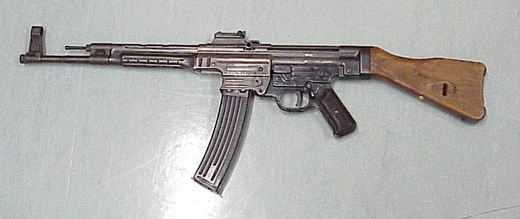
Kalashnikov rifle
The most widely produced assault rifle family in history.

Vitaly V. Kuzmin · CC BY-SA 4.0
The Kalashnikov is a series of assault rifles that grew out of Mikhail Kalashnikov’s original blueprint. In Russian, it is formally called *avtomat Kalashnikova* (автомат Калашникова, meaning “Kalashnikov’s automatic [rifle]”) and is often shortened to *kalash*. It ranks among the world’s most common firearms, with roughly 72 million units in use globally.
The Soviet Union’s Kalashnikov Concern (formerly Izhmash) first produced these rifles. Because the design is straightforward and inexpensive to manufacture, the USSR lent the plans to allied nations, enabling local production—both licensed and unlicensed—in many countries. Over time, rifles based on the Kalashnikov, such as the Galil ACE and the INSAS, also appeared.
Numerous countries have manufactured their own versions. Albania produced the ASH-78 and ASH-82, along with short-barreled AKMS variants for special forces, vehicle crews, and police, plus modified ASh-82 rifles with SOPMOD accessories for its RENEA unit and for export. Azerbaijan makes the Khazri, a licensed AK-74M. Cuba produces the AKM under license. Ethiopia’s state-run Gafat Armament Engineering Complex turns out the Et-97/1, an AK-103 variant. Nigeria’s Defence Industries Corporation manufactures the OBJ-006. North Korea uses AK rifles as standard issue. Pakistan produces the PK-10, in addition to unlicensed Khyber Pass copies. Sudan’s Military Industry Corporation makes the MAZ, a licensed copy of China’s Type 56. Turkey’s Sarsilmaz defense contractor builds the SAR 15T/308(V2), a modernized AK platform. Venezuela locally manufactures the AK-103. Vietnam fields the AKM-1, AKM-VN, and TUL-1 light machine gun. Other producing nations include Armenia, Bulgaria, China, Croatia, East Germany, Egypt, Finland, Hungary, Iraq, Poland, Romania, Ukraine, the United States, and Yugoslavia/Serbia.
Several other rifles are either based on the Kalashnikov design or look similar but are different internally. These come from Argentina, Bulgaria, China, Czechoslovakia, India, Israel, and South Africa.
Accessories for the Kalashnikov include the PSO-1 sight, the PBS-1 silencer, a series of bayonets (6KH2, 6KH3, 6KH4, 6KH5, 6KH9), and the GP-25 grenade launcher.
In the United States, the Kalashnikov design has grown popular in the firearms industry. Competitive shooting matches like the Red Oktober event near St.
- Designer
- Mikhail Kalashnikov
- Estimated global circulation
- 72 million rifles
- Original manufacturer
- Kalashnikov Concern (formerly Izhmash) in the Soviet Union
- Caliber variants
- 7.62×39mm (original AK), 5.45×39mm (AK-74 family), 7.62×51mm (SAR 15T/308(V2))
Lore & Background
The Kalashnikov rifle's simple design makes it easy to produce, and the Soviet Union readily leased plans of the firearm to friendly countries, where it could be produced locally at a low cost. As a result, the Kalashnikov rifles and their variants have been manufactured in many countries, with and without licenses. Manufacturing countries include Albania, Armenia, Azerbaijan, Bulgaria, China, Croatia, Cuba, East Germany, Egypt, Ethiopia, Finland, Hungary, Iraq, Nigeria, North Korea, Pakistan, Poland, Romania, Sudan, Turkey, Ukraine, the United States, Vietnam, Venezuela, and Yugoslavia/Serbia.
Rifles similar to the Kalashnikov and its Soviet variants were later produced in many countries friendly to the Soviet Bloc, with rifles based on its design such as the Galil ACE and the INSAS also being produced. The original Kalashnikov rifles and their derivatives were produced in the Soviet Union and later the Russian Federation. Specific variants include the Albanian ASH-78 and ASH-82, the Azerbaijani Khazri (AK-74M), the Ethiopian Et-97/1 (AK-103 variant), the Nigerian OBJ-006, the Sudanese MAZ (licensed copy of the Chinese Type 56), the Turkish SAR 15T/308(V2), and the Venezuelan AK-103.
Accessories for the Kalashnikov include the PSO-1 sight, the PBS-1 silencer, bayonets (6KH2, 6KH3, 6KH4, 6KH5, 6KH9), and the GP-25 grenade launcher. The rifle's design has also influenced similar rifles produced in Argentina, Bulgaria, China, Czechoslovakia, India, Israel, and South Africa.
Reader's Guide
The Kalashnikov rifle's significance lies in its widespread adoption and influence. With an estimated 72 million rifles in global circulation, it is one of the most widely used firearms in the world. Its simple design facilitated production in numerous countries, both with and without licenses, making it a standard-issue weapon for many nations, including North Korea. The design's adaptability is evident in the many variants produced, from the original AK to the AK-74M, AK-103, and modernized versions like the Turkish SAR 15T/308(V2).
In the United States, the Kalashnikov weapon design has become increasingly popular in the American firearms industry. There are specific competitive shooting matches that require the use of its weapon variants, such as the Red Oktober match held just outside of St. George, Utah. Due to sanctions preventing the import of arms from Russia, a number of companies started producing clones of the Kalashnikov family of weapons, including Kalashnikov USA, Palmetto State Armory, and Century Arms. The legacy of the Kalashnikov extends beyond its military use to influence civilian markets and competitive shooting sports.
Did You Know?
- The Kalashnikov is officially known in Russian as avtomat Kalashnikova, meaning 'Kalashnikov's automatic [rifle]'.
- An estimated 72 million Kalashnikov rifles are in global circulation.
- The AK-74M is locally produced under license in Azerbaijan as the Khazri.
- The PBS-1 silencer is an accessory for the Kalashnikov rifle.
Origins & Design Philosophy
The Kalashnikov rifle traces its lineage to a single designer: Mikhail Kalashnikov, whose original concept gave birth to an entire family of assault rifles. In Russian military parlance the weapon carries the formal designation "avtomat Kalashnikova," translating roughly to "Kalashnikov's automatic rifle," while everyday speakers worldwide shorten it to the familiar nickname "kalash." The rifle was first manufactured within the Soviet Union by what is now known as Kalashnikov Concern, an entity that carried the earlier name Izhmash. One of the design's most celebrated qualities is its mechanical simplicity, a trait that proved decisive for mass production. Rather than demanding precision machining or exotic materials, the platform can be assembled from relatively straightforward components, making it accessible to manufacturers with limited industrial infrastructure. This ease of fabrication became a cornerstone of the rifle's extraordinary global reach, as the same design could be replicated in workshops ranging from state arsenals to smaller national defense plants. The result is a weapon whose engineering philosophy prioritizes reliability and manufacturability over refinement, a choice that shaped the trajectory of modern small-arms development for decades to come.
Global Proliferation & Manufacturing
The sheer scale of Kalashnikov production worldwide is difficult to overstate. An estimated seventy-two million rifles of the AK family are in circulation across the globe, placing the platform among the most numerous firearms ever manufactured. The Soviet Union actively facilitated this spread by leasing production plans to allied and friendly nations, enabling local manufacturing at relatively low cost. The resulting footprint spans the entire alphabet: from Albania's ASH-78 and ASH-82 variants to Azerbaijan's licensed Khazri (an AK-74M), from Cuba's AKM production to Ethiopia's Et-97/1 built at the state-run Gafat Armament Engineering Complex. Nigeria's Defence Industries Corporation produces the OBJ-006, Pakistan fields the PK-10 alongside Khyber Pass copies, Sudan's Military Industry Corporation builds the MAZ from Chinese Type 56 blueprints, and Turkey's Sarsilmaz defense contractor offers the modernized SAR 15T/308(V2). North Korea has adopted AK rifles as standard military issue, while Venezuela manufactures the AK-103 domestically. Whether produced under formal license or independently, the pattern is consistent: a design so straightforward it can be replicated in virtually any industrial setting.
Variants & the Accessories Ecosystem
The Kalashnikov is not a single rifle but a sprawling family of weapons, and its ecosystem of accessories reflects decades of tactical evolution. Among the most recognized attachments is the PSO-1 telescopic sight, long associated with Soviet and Russian configurations. For suppressed operations the PBS-1 silencer has served as a standard option. The bayonet tradition is particularly rich, with at least six distinct models documented: the 6KH2, 6KH3, 6KH4, 6KH5, and 6KH9, each representing incremental refinements in blade geometry and mounting. The GP-25 under-barrel grenade launcher further extends the platform's role beyond direct fire. Beyond the core AK lineage, several nations developed rifles that either drew directly on Kalashnikov's architecture or merely resembled it in silhouette. Israel's Galil ACE and South Africa's INSAS are frequently cited as design-adjacent weapons, while Argentina, Bulgaria, China, Czechoslovakia, and India all produced rifles occupying the same conceptual space. This web of derivatives and look-alikes underscores how deeply the original design permeated global small-arms thinking, inspiring both faithful copies and independent reinterpretations that nonetheless echo its fundamental layout.
Western Competitive & Commercial Legacy
In the United States the Kalashnikov family has carved out a distinctive niche extending well beyond military or law-enforcement use. Competitive shooting communities have embraced the platform with particular enthusiasm, and events like the Red Oktober match, staged just outside St. George, Utah, are specifically designed around ComBloc-style weapons. Within those competitions AK-pattern rifles dominate participants' arsenals, a testament to the design's handling characteristics and the deep bench of aftermarket parts available to shooters. Geopolitical friction has also reshaped the American market. Sanctions restricting the import of Russian arms prompted a wave of domestic manufacturers to produce functional clones of the Kalashnikov family. Kalashnikov USA was founded with that precise purpose, while established companies such as Palmetto State Armory and Century Arms added AK-pattern products to their catalogs. The outcome is a paradox: a weapon born in Soviet arsenals now thrives in American gun shops and competition ranges, sustained by a commercial ecosystem that mirrors the original design's core virtue—its accessibility and adaptability.
Gallery
Frequently Asked Questions
Who is Kalashnikov rifle?
The Kalashnikov is an assault rifle family designed by Mikhail Kalashnikov, formally known in Russian as *avtomat Kalashnikova* and colloquially shortened to *kalash*. It originated from his original blueprint and has since become the most widely produced assault rifle family in history.
What are the Kalashnikov rifle's core strengths and role?
Its defining trait is a rugged, straightforward mechanism that keeps manufacturing costs low, which is why the Soviet Union shared the plans with allied nations for local production. That simplicity has helped it reach an estimated 72 million units in global circulation, making it the go-to workhorse in countless arsenals.
What caliber variants does the Kalashnikov rifle family include?
The original AK fires the 7.62×39mm round, the later AK-74 family switched to the smaller 5.45×39mm cartridge, and the SAR 15T / 308(V2) variant chambers the 7.62×51mm NATO round. Together these three calibers cover the family's main operational niches.
Who originally manufactured the Kalashnikov rifle?
Production began at the Kalashnikov Concern, which was formerly called Izhmash, located in the Soviet Union. The factory remains the lineage's original manufacturer, though licensed partners in allied countries have also built the rifle locally since the USSR shared the blueprints.
Why is the Kalashnikov rifle so important to firearms history?
With roughly 72 million units in service worldwide, it holds the record as the most widely produced assault rifle family ever made. Its combination of reliability, low cost, and easy maintainability set a benchmark that shaped how subsequent military small arms are designed and distributed.
More in Assault Rifles 1-24
Spotted an error? Know more?
Reader corrections go straight into our review queue. Suggest an edit · How this site is sourced