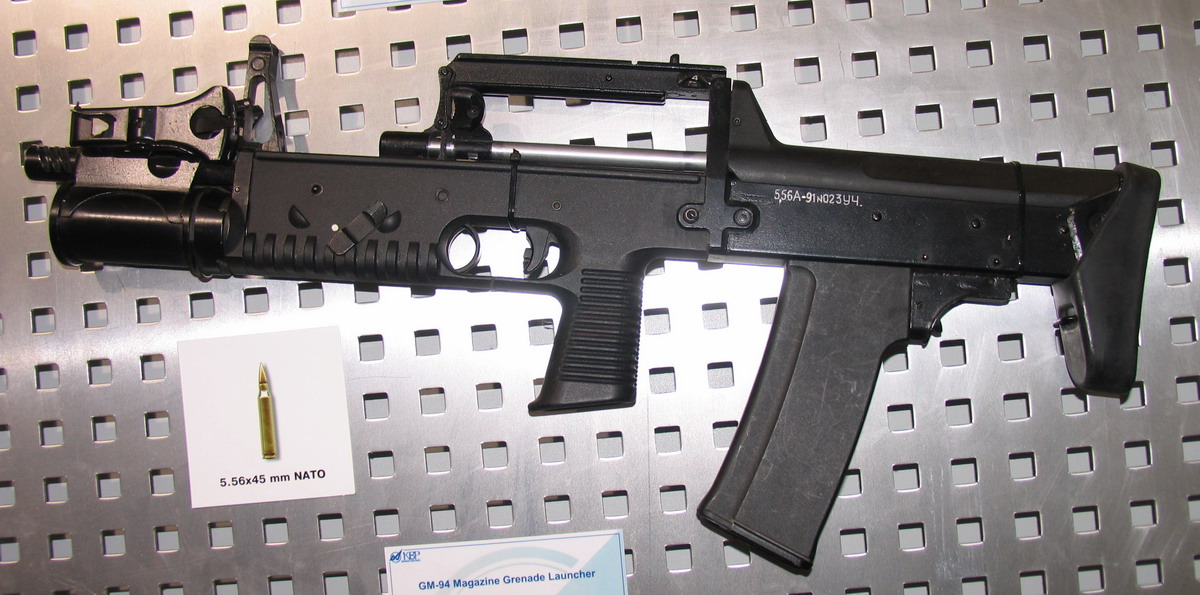
A-91
Russian bullpup assault rifle with integrated 40mm grenade launcher.

Remigiusz Wilk (REMOV) REMOV · CC BY 2.5
The A-91 is a Russian bullpup assault rifle created by the KBP Instrument Design Bureau in the 1990s. It builds on the earlier 9A-91 carbine, with a focus on being compact, dependable, and adaptable for fighting in cities. Its standout traits are a built-in 40mm grenade launcher and a bullpup layout, where the magazine sits behind the trigger, keeping the weapon short without cutting down the barrel length.
The rifle uses a gas-operated action with a rotating bolt, much like AK-pattern weapons. But unlike most Russian rifles, the bullpup design makes it easier to handle in tight spaces by keeping the overall length short while using a full-size barrel. It can fire several calibers, including the standard Russian 5.45×39mm and 7.62×39mm rounds, plus the NATO 5.56×45mm cartridge. Its cyclic rate is about 600 rounds per minute, and the muzzle velocity reaches 880 m/s. A key feature is the under-barrel grenade launcher, which fires standard 40mm grenades like the VOG-25 out to 400 meters. The rifle also has a forward-ejecting system for spent casings, so they don’t hit the shooter’s face or arms when firing left-handed.
KBP designed the A-91 as a replacement for the 9A-91, aiming it at both regular troops and special forces. The bullpup shape was chosen for its short length and ease of use in close-quarters combat. Initial production started in the 1990s, and the rifle has since been used in different roles within the Russian military.
Several variants exist, adapted for different calibers and tasks. The A-91M is the most updated version, with better materials and ergonomics, available in 5.45×39mm and 7.62×39mm.
The A-91 sees limited service with the Russian Armed Forces and some special units. Its compact size and flexibility suit urban combat and special operations, but it hasn’t been adopted as widely as more traditional Kalashnikov designs like the AK-74 and its variants.
Quick Facts
- Origin
- Soviet Union
- Is Ranged
- Yes
- Service
- 1990–present
- Designer
- KBP Instrument Design Bureau
- Design Date
- 1990
- Production Date
- 1991
- Variants
- 5,56 A-91, A-91M
- Weight
- 4.3 kg (A-91 without the grenade launcher) / 4.4 kg (5,56A-91 with the grenade launcher)
- Length
- 660 mm / 670 mm (5,56A-91)
- Part Length
- 415 mm
- Height
- 291 mm / 292 mm (5,56A-91)
- Cartridge
- 7.62×39mm / 5.45×39mm / 5.56×45mm NATO (5,56A-91) / 40 mm caseless (grenade launcher)
Facts from the source article.
Lore & Background
The A-91 was designed by the KBP Instrument Design Bureau as a successor to the 9A-91 carbine, with a focus on creating a weapon suited for both conventional and special operations forces. The bullpup design was chosen for its compact size and ease of handling in close-quarter combat (CQB). Initial production began in the 1990s, and the rifle has since been used in various roles within the Russian military.
The A-91 uses a gas-operated system with a rotating bolt, similar to the AK-47 and other Kalashnikov designs. However, unlike most Russian rifles, it adopts a bullpup layout, which reduces the overall length while maintaining a full-length barrel, improving handling in confined spaces. The rifle can be chambered in multiple calibers, including the standard Russian 5.45×39mm and 7.62×39mm rounds, as well as the NATO-standard 5.56×45mm NATO cartridge. Its rate of fire is approximately 600 rounds per minute, with a muzzle velocity of 880 m/s.
One of the most notable features of the A-91 is its integrated under-barrel grenade launcher, designed to fire standard 40mm grenades such as the VOG-25. The launcher has a range of up to 400 meters. The rifle also has a spent-case ejection system that ejects casings forward, preventing interference with the user's face or arms when firing from the left shoulder.
Reader's Guide
The A-91 represents a notable departure from traditional Russian rifle design through its bullpup configuration, which prioritizes compactness for urban and close-quarters combat without compromising barrel length. Its integrated 40mm grenade launcher adds versatility, allowing a single soldier to engage both point targets and area targets. Despite these innovations, the A-91 has seen limited service with the Russian Armed Forces and various special forces units, and has not achieved widespread adoption compared to more traditional Kalashnikov designs like the AK-74 and its variants. The rifle's development by KBP Instrument Design Bureau during the 1990s positioned it as a specialized tool for special operations and urban warfare, rather than a general-issue infantry weapon. The existence of variants such as the A-91M, which features updated materials and improved ergonomics, indicates ongoing refinement. Its forward-ejecting spent-case system is a practical solution for left-handed firing, a common challenge in bullpup designs. Overall, the A-91 occupies a niche role within Russian military small arms, valued for its compactness and integrated firepower in specific operational contexts.
Did You Know?
- The A-91 is an evolution of the earlier 9A-91 carbine.
- Its spent-case ejection system ejects casings forward to allow left-shoulder firing.
- The integrated 40mm grenade launcher can fire VOG-25 grenades out to 400 meters.
- The A-91 can be chambered in 5.45×39mm, 7.62×39mm, or 5.56×45mm NATO.
The Five Pillars of Classification
An assault rifle is not simply a powerful gun with a detachable magazine. To earn the designation under strict definition, a firearm must satisfy five requirements simultaneously. It must function as an individual weapon rather than a crew-served system. It must offer selective fire, meaning the operator can toggle between semi-automatic and burst or fully automatic modes. Its cartridge must occupy the intermediate power band—more energetic than a pistol round yet less powerful than full rifle or battle rifle ammunition. Ammunition must be fed through a detachable box magazine rather than a fixed internal one. Finally, the weapon must deliver effective performance at a minimum of 300 metres. Every single condition is mandatory. A rifle that meets four out of five criteria is, by strict definition, not an assault rifle, no matter how commonly it is labeled as one in casual conversation or marketing materials.
Rifles That Miss the Mark
Despite widespread casual usage, numerous select-fire firearms are routinely misidentified as assault rifles when they actually fail one or more of the defining criteria. The Amogh carbine, for instance, offers selective fire but tops out at roughly 200 yards of effective range, falling well short of the 300-metre threshold. The FN FAL, a legendary select-fire weapon, fires full-powered rifle cartridges, which places it firmly in the battle rifle category rather than the intermediate-power class. The Joint Venture Protective Carbine suffers from the opposite problem—its cartridge is simply too weak to qualify. The M231 Firing Port Weapon is locked into fully automatic fire only, lacking the select-fire capability entirely. Meanwhile, the Cei-Rigotti, though select-fire, uses a fixed magazine instead of a detachable box magazine. Each of these rifles satisfies most criteria but stumbles on at least one, disqualifying them under the strict definition.
A Place in the Modern Arsenal
Assault rifles have become the default service rifle across most modern militaries worldwide, a position of dominance that reflects their balance of power, portability, and versatility. They occupy a specific niche in the broader family of military firearms, sitting between pistols and full battle rifles in terms of cartridge energy. The intermediate-power cartridge they chamber is more energetic than a pistol round yet less powerful than the ammunition used in standard or battle rifles. This middle-ground positioning makes them suitable for individual soldiers who need reliable performance at moderate ranges without the extreme recoil of full-power rounds. The category also intersects with other firearm families—carbines, battle rifles, semi-automatic rifles, and machine guns all occupy adjacent but distinct roles. Understanding where an assault rifle fits in this spectrum helps clarify why certain weapons are grouped together while others, despite superficial similarities, belong elsewhere in the taxonomy.
The Semi-Automatic Shadow
One of the most common sources of confusion in the assault rifle category is the existence of semi-automatic variants of weapons whose select-fire counterparts do qualify. The AR-15 is a prime example: the original ArmaLite AR-15, with its select-fire capability, meets the assault rifle criteria, yet the semi-automatic models that flood civilian markets do not, because they lack the ability to switch to burst or fully automatic fire. This same pattern repeats across the category—several rifles listed as assault rifles also produce non-assault-rifle variants that fire only in semi-automatic mode. These variants fulfill every other requirement of the definition, from intermediate cartridge to detachable magazine to effective range, but the absence of selective fire alone strips them of the designation. The distinction matters both legally and technically, as it separates a weapon capable of sustained automatic fire from one limited to single shots per trigger pull.
Gallery

Frequently Asked Questions
What is the A-91?
The A-91 is a Russian bullpup assault rifle that the KBP Instrument Design Bureau developed in the 1990s as a successor to the 9A-91 carbine. It was purpose-built for close-quarters and urban fighting, keeping the overall length short while preserving a full-length barrel for accuracy.
What makes the A-91 different from a standard AK-pattern rifle?
Its two headline features are the bullpup layout and a built-in 40mm grenade launcher that can lob VOG-25 rounds to roughly 400 meters. No conventional long-stocked AK offers that combination of compact size and integrated grenade capability out of the box.
What calibers can the A-91 be chambered in?
It has been produced in 5.45×39mm, 7.62×39mm, and 5.56×45mm NATO, giving operators flexibility depending on their ammunition supply. Every variant runs the same gas-operated, rotating-bolt mechanism.
What are the A-91's key firing specs?
The rifle cycles at about 600 rounds per minute and pushes its bullet to roughly 880 m/s at the muzzle. Those numbers hold across the standard calibers and reflect a moderate, manageable rate for sustained fire.
Why did KBP go with a bullpup design instead of a traditional layout?
By tucking the magazine and action behind the trigger guard, the weapon stays short enough to swing quickly in doorways and stairwells without losing barrel length or muzzle energy. That trade-off is the core reason the A-91 exists as a dedicated urban-combat platform.
More in Assault Rifles 1-24
Spotted an error? Know more?
Reader corrections go straight into our review queue. Suggest an edit · How this site is sourced