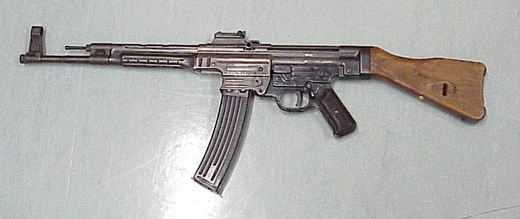
Type 88 assault rifle
North Korean AK-74 derivative with multiple specialized variants.

The Type 88 (Korean: 88식자동보총) is a North Korean assault rifle derived from the AK-74. It entered production in 1988 as the standard-issue rifle of the Korean People's Army, with resemblance to the Chinese equivalent. The Type 88 has been observed in multiple variants, including models with folding stocks, helical magazines, and a bullpup configuration.
Quick Facts
- Origin
- North Korea
- Is Ranged
- Yes
- Designer
- Mikhail Kalashnikov
- Production Date
- 1988 (presumed) - present
- Cartridge
- 5.45×39mm
- Action
- Gas-operated, long-stroke piston, closed rotating bolt
- Feed
- 30-round detachable box magazine, helical magazines
- Sights
- Adjustable iron sights, front post and rear notch on a scaled tangent
Facts from the source article.
Lore & Background
The Type 88 commenced production in North Korea in 1988 as the standard issue rifle of the Korean People's Army, with resemblance to the Chinese equivalent. Several Type 88s were salvaged by the Japan Coast Guard during the aftermath of the Battle of Amami-Ōshima in 2001; these captured rifles have right side-folding stocks, similar to the Chinese Type 81 assault rifle. In 2010, Type 88s with helical magazines and top folding stocks were observed in operational use with North Korean soldiers accompanying Kim Jong Un. By 2017, the Type 88 was reportedly being used by North Korean special forces units and also by the Supreme Guard Command.
The Type 88 is an AK-74 copy, with sources suggesting that it was unlicensed and made with technical assistance from China. They are given a black finish to give them a modern look. Newer Type 88s are made with plastic polymer furniture, which led to the mistake of naming them as the Type 98. The rifle uses 30-round steel magazines, but plastic versions are seen with new Type 88s manufactured; it can also use helical magazines reported to hold around 100 to 150 rounds. The Type 88 can be fitted with the GP-25 UBGL. Like its predecessors (Type 58 and 68), it has no rate reducer, and it is manufactured with AK-74-based muzzle brakes. It has a combined safety/fire selector switch for safe, semi-auto and full-auto.
Variants include the Type 88-1 (a North Korean AKS-74 copy with right-folding stocks, plastic pistol grips, and wooden handguards); the Type 88-2 (with top folding stocks, plastic handguard and grips, and a helical magazine); a carbine variant based on the Type 88 with elements borrowed from the AKS-74U and AK-105; a bullpup variant based on the Type 88-2 and ADS; a chrome variant used by honor guard soldiers or exceptional soldiers; and an OICW-type weapon based on the Type 88-2, sometimes known as the NK11, with a 20 mm bullpup bolt-action over-barrel launcher.
Reader's Guide
The Type 88 represents North Korea's adoption of the AK-74 platform, serving as the standard-issue rifle of the Korean People's Army since 1988. Its development, reportedly unlicensed and with Chinese technical assistance, reflects the country's reliance on derivative designs to equip its military. The rifle's black finish and later plastic polymer furniture were intended to give it a modern appearance, though this led to misidentification as the Type 98. The Type 88's variants demonstrate North Korea's efforts to adapt the platform for different roles: the Type 88-1 with a right-folding stock, the Type 88-2 with a top-folding stock and helical magazine, a compact carbine for special forces, a bullpup configuration, and even an OICW-type weapon with an airburst grenade launcher. The helical magazine, reported to hold 100 to 150 rounds, is a distinctive feature that appeared in 2010. The Type 88 has been observed in use by North Korean special forces, the Supreme Guard Command, and the Worker-Peasant Red Guards, replacing older Type 58s and 68s. Its capture by the Japan Coast Guard in 2001 and its appearance in parades and exercises have provided external glimpses of North Korean small arms development.
Did You Know?
- The Type 88 is sometimes misidentified as the Type 98 due to its plastic polymer furniture.
- The Type 88-2 variant features a top-folding stock and a helical magazine that reportedly holds 100 to 150 rounds.
- An OICW-type variant of the Type 88, known as the NK11, includes a 20 mm bullpup bolt-action over-barrel launcher.
More in Assault Rifles 1-24
Spotted an error? Know more?
Reader corrections go straight into our review queue. Suggest an edit · How this site is sourced