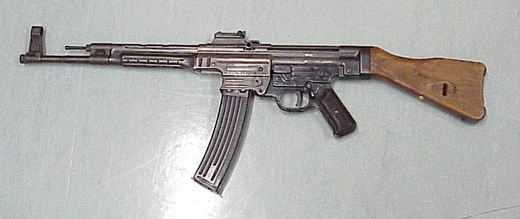
TKB-0146
Stechkin's innovative bullpup competed in the Abakan trials.

The TKB-0146 (ТКБ-0146) is a prototype bullpup assault rifle created by Igor Yakovlevich Stechkin at the TsKIB SOO. It was entered into the Russian Army's Project Abakan trials. Alongside the design by Nikonov (which later became the AN-94), Stechkin's rifle was one of just two entries in the final round that offered genuinely new mechanisms; the other six finalists relied on more conventional layouts. Stechkin's gun could fire two-round bursts at 2000 rounds per minute or sustain automatic fire at 600 rounds per minute. Although it proved slightly more accurate than Nikonov's rifle, it was less reliable, mainly because it accumulated fouling more quickly. Switching between semi-automatic and fully automatic fire involved a secondary trigger positioned behind the main trigger. A light squeeze of the main trigger fired a single shot; pulling it all the way back so it contacted the secondary trigger enabled full-auto. A separate lever selected the two-round burst mode. Two examples are on display at the Tula arms museum, one of which is an early prototype configured for three-round bursts rather than the two-round option found on later models.
Quick Facts
- Origin
- Soviet Union
- Is Ranged
- YES
- Designer
- Igor Yakovlevich Stechkin
- Weight
- 3.8kg
- Length
- 794mm
- Part Length
- 420mm
- Cartridge
- 5.45×39mm
- Caliber
- 5.45mm
- Rate
- 600 rpm (sustained) / 2000 rpm (two-round burst)
- Velocity
- 920m/s
- Feed
- 30-round AK-74 compatible box magazine
- Sights
- Iron sights
Facts from the source article.
Lore & Background
The TKB-0146 was developed by Igor Yakovlevich Stechkin at the TsKIB SOO for the Russian Army's Project Abakan assault rifle trials. Alongside Nikonov's AS[M], it was one of only two truly innovative designs that made it to the final testing round; the other six competitors were based on more conventional designs. The rifle could fire two-round bursts at 2000 rpm or sustained fire at 600 rpm. Switching from semi-automatic to fully automatic fire was accomplished by a secondary trigger located behind the main trigger: squeezing the main trigger slightly fired a single round, while pulling it back fully pressed the secondary trigger and enabled fully automatic fire. The two-round burst mode was selected by operating a different lever. Two examples are held in the Tula arms museum; one is an early prototype configured for three-round bursts rather than the two-round burst option of later models.
Reader's Guide
The TKB-0146's significance lies in its role as one of the two truly innovative finalists in the Project Abakan trials, a competition that sought a new standard-issue assault rifle for the Russian Army. Stechkin's design was slightly more accurate than Nikonov's winning AS[M] (which became the AN-94), but it proved less reliable, primarily due to accumulating more fouling. Its unique trigger mechanism—a secondary trigger for selecting fully automatic fire—and its two-round burst capability at 2000 rpm represented a novel approach to fire control in a bullpup configuration. Although it lost the competition, the TKB-0146 remains a notable example of late-Soviet experimental firearms engineering, preserved in the Tula arms museum alongside a variant configured for three-round bursts. Its legacy is that of a technically ambitious design that pushed the boundaries of bullpup and burst-fire concepts, even if it ultimately fell short in reliability.
Did You Know?
- The TKB-0146 was designed by Igor Yakovlevich Stechkin at the TsKIB SOO.
- It was one of only two truly innovative designs to reach the final round of the Abakan trials.
- The rifle used a secondary trigger behind the main trigger to switch from semi-automatic to fully automatic fire.
- An early prototype in the Tula arms museum is configured for three-round bursts instead of two.
More in Assault Rifles 1-24
Spotted an error? Know more?
Reader corrections go straight into our review queue. Suggest an edit · How this site is sourced