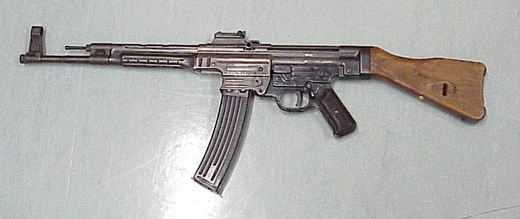
AK-74
Soviet assault rifle chambered for the 5.45×39mm cartridge.

The AK-74 is an assault rifle created by Mikhail Kalashnikov in 1974, intended to replace the earlier AKM. It fires the 5.45×39mm cartridge, a smaller round than the 7.62×39mm used in previous Kalashnikov designs for the Soviet military. The weapon entered combat with Soviet troops during the Soviet–Afghan War starting in 1979. According to the head of the Afghan bureau of Pakistan’s Inter-Services Intelligence, the CIA paid $5,000 for the first AK-74 captured by Afghan mujahideen in that conflict. As of 2026, most former Soviet states still use the rifle, and licensed copies have been made in Bulgaria (AK-74, AKS-74, AKS-74U) and the former East Germany (MPi-AK-74N, MPi-AKS-74N, MPi-AKS-74NK).
The design was led by A. D. Kryakushin’s team under Kalashnikov’s supervision. It is an adaptation of the 7.62×39mm AKM, with key improvements driven by switching to the high-velocity 5.45×39mm cartridge. Some early models were reportedly converted AKMs fitted with new 5.45mm barrels. Compared to the AKM, the AK-74 offers better effective range, accuracy (a primary goal), and reliability. Roughly half of its parts—such as pins, springs, and screws—are interchangeable with the AKM.
The firing and reloading mechanism works the same as the AKM. After the primer ignites the propellant, expanding gases enter the gas cylinder through a vent near the muzzle. These gases push the long-stroke piston and bolt carrier rearward. A cam guide on the bolt carrier’s underside, along with an ejector spur, rotates the bolt about 35 degrees to unlock it from the barrel extension. The moving assembly has about 5.5 mm of free travel, creating a delay that lets gas pressures drop safely before the bolt unlocks. Like earlier Kalashnikov rifles, the AK-74 has no gas valve; excess gas escapes through radial ports in the cylinder. Because the system lacks primary extraction during bolt rotation, the 5.45mm AK-74 uses a larger extractor claw than the 7.62mm AKM for better reliability. Other minor changes were made to the bolt and carrier assembly.
The AK-74 has a new chrome-lined barrel with four right-hand grooves and a 200 mm (1:7.87 inch) twist rate. The front sight base and gas block were redesigned. The gas block has a gas channel set at a 90-degree angle to the bore to reduce bullet shear at the port.
Quick Facts
- Service
- 1974–present · 1991–present (AK-74M)
- Designer
- Mikhail Kalashnikov
- Number
- 5,000,000+
- Length
- AK-74: 943 mm / AKS-74 (stock extended): 943 mm / AKS-74 (stock folded): 690 mm / AK-74M (stock extended): 943 mm / AK-74M (stock folded): 700 mm
- Height
- AK-74M: 195 mm
- Action
- Gas-operated, long-stroke piston, closed rotating bolt
- Origin
- Soviet Union
- Is Ranged
- Yes
- Design Date
- AK-74: 1974 / AK-74M: 1991
- Manufacturer
- Kalashnikov Concern / (formerly Izhmash)
- Production Date
- AK-74: 1974–1991 / AK-74M: 1991–present
- Weight
- AK-74: 3.07 kg / AKS-74: 2.97 kg / AK-74M: 3.4 kg / without magazine / 30-round magazine: 0.23 kg / 6H5 bayonet: 0.32 kg
Facts from the source article.
Lore & Background
The AK-74 was designed by A. D. Kryakushin's group under the design supervision of Mikhail Kalashnikov. It is an adaptation of the 7.62×39mm AKM assault rifle and features several important design improvements, primarily the result of converting the rifle to the intermediate-calibre high velocity 5.45×39mm cartridge. Some early models are reported to have been converted AKMs, re-barreled to 5.45×39mm. Compared with the preceding AKM, the AK-74 has better effective firing range, accuracy (a main development goal), and reliability. About 50% of the parts in the AK-74 and AKM are the same, including pins, springs and screws.
The rifle's operation during firing and reloading is identical to that of the AKM. The AK-74 does not have a gas valve; excess gases are ventilated through a series of radial ports in the gas cylinder. The bolt has a larger extractor claw than the 7.62×39mm AKM for increased extraction reliability. The barrel is chrome-lined with 4 right-hand grooves at a 200 mm (1:7.87 in) rifling twist rate. The standard-issue muzzle brake features a large expansion chamber, two symmetrical vertical cuts, and three non-symmetrical vent holes to counteract muzzle rise and climb as well as lateral shift to the right. The muzzle brake prevents backblast from reaching the firer, though it is reported to be harsh on bystanders.
The AK-74 uses an adjustable notched rear tangent iron sight calibrated in 100 m increments from 100 to 1,000 m. The front sight is a post adjustable for elevation in the field. The 'point-blank range' battle zero setting 'П' corresponds to a 400 m zero. For the AK-74 combined with the 7N6 or 7N10 service cartridges, the 400 m battle zero setting limits the apparent bullet rise within approximately −5 to +38 cm under the line of sight. Various magnified and non-magnified optical sights are available for designated marksmen and other special purpose troops, including the East German Zeiss ZFK 4×25, USP-1 (1P29), Belorussian BelOMO PO 3.5×21P, PO 4×24P, 1P78 Kashtan, and the newest 1P87 Valdai dedicated side rail mounted optical sights.
Reader's Guide
The AK-74 represents a significant evolution in the Kalashnikov rifle line, adapting the proven AKM design to a smaller, higher-velocity cartridge. Its introduction marked a shift in Soviet small arms philosophy toward intermediate-calibre ammunition, and the rifle saw its combat debut in the Soviet–Afghan War from 1979. The head of the Afghan bureau of the Inter-Services Intelligence (ISI) claimed that the American Central Intelligence Agency (CIA) paid $5,000 for the first AK-74 captured by the Afghan mujahideen during that war. As of 2026, most countries of the former Soviet Union use the rifle, and licensed copies have been produced in Bulgaria and the former East Germany. The design's reliability and accuracy improvements over the AKM, combined with its widespread adoption, have made it a standard infantry weapon across much of the post-Soviet sphere. Its operating mechanism remains essentially the same as the AKM, ensuring familiarity for users of earlier Kalashnikov models. The availability of various optical sights, including the 1P29 and 1P78 Kashtan, extends its utility for designated marksmen and special purpose troops.
Frequently Asked Questions
Who is AK-74?
AK-74 is a Soviet assault rifle designed by Mikhail Kalashnikov in 1974 to succeed the AKM in the Red Army's small-arms lineup. It is chambered for the 5.45×39mm cartridge and represents the next major generation of the Kalashnikov platform.
What are AK-74's powers/role?
Its defining trait is the shift to the smaller 5.45×39mm round, a deliberate step down from the 7.62×39mm cartridge that powered earlier Kalashnikovs. This gave Soviet infantry a lighter, more manageable round while preserving effective stopping power at standard engagement distances.
How does AK-74's story begin?
It entered real-world combat with Soviet forces during the Soviet–Afghan War starting in 1979. A memorable early chapter involved Afghan mujahideen capturing one, which the CIA allegedly purchased for $5,000 as a prized intelligence trophy.
Why is AK-74 important?
As of 2026, the majority of former Soviet states still field the rifle, and licensed production variants have been manufactured in several other countries. It cemented the 5.45mm round as the standard Soviet small-arms caliber and kept the Kalashnikov lineage at the forefront of military service well into the twenty-first century.
What cartridge does AK-74 use and why switch from 7.62?
It fires the 5.45×39mm round, chosen specifically to replace the heavier 7.62×39mm cartridge of the AKM. The smaller projectile reduced overall weapon weight and made sustained fire more practical for troops in the field without sacrificing terminal effectiveness at typical combat ranges.
More in Assault Rifles 1-24
Spotted an error? Know more?
Reader corrections go straight into our review queue. Suggest an edit · How this site is sourced