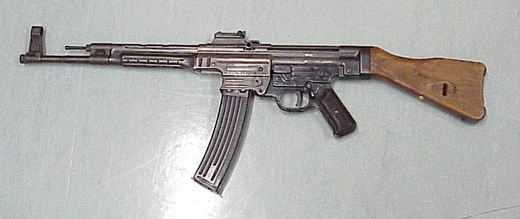
FB Tantal
Polish 5.45mm assault rifle with a resetting three-round burst.

The FB Tantal, officially designated the karabinek wzór 1988 (Carbine Model 1988), is a 5.45×39mm assault rifle designed and produced in Poland in the late 1980s. It was developed by the Ośrodek Badawczo-Rozwojowy (OBR) in Radom and manufactured by the Łucznik Arms Factory in Radom. The Tantal is notable for its three-round burst fire mode, which resets the burst count when the trigger is released mid-burst, and for its multifunction muzzle brake capable of launching rifle grenades.
Quick Facts
- Origin
- Poland
- Is Ranged
- Yes
- Service
- 1991–present (Middle East)
- Wars
- Kurdish–Turkish conflict / Kosovo War / UNDOF / Iraqi insurgency / Russo-Ukrainian War
- Designer
- OBR Radom
- Design Date
- 1981–1988
- Manufacturer
- FB Radom
- Production Date
- 1989–1994
- Number
- ~25,000
- Variants
- Kbkg wz. 1974, skbk wz. 1989 Onyks
- Weight
- 3.69 kg
- Length
- 943 mm stock extended / 748 mm stock folded
Facts from the source article.
Lore & Background
Design work on the Tantal began in 1984 at the Ośrodek Badawczo-Rozwojowy in Radom, following earlier studies of a 5.45mm weapon since late 1980. Early prototypes, designated wz. 1981, were based on the Soviet 7.62mm AKM and featured a wire stock copied from the East German MPi-KMS-72, a multifunction muzzle device, and a mechanically limited burst fire mode borrowed from the AKMS wz. 1980 prototype. By the end of 1987, the rifle was overhauled with components interchangeable with the AK-74, including the bolt carrier, bolt, and magazines, and the burst mode was refined. After evaluations in 1988 and 1989, a pre-production batch was ordered in 1989, and the rifle was introduced into Polish service in 1991 as the kbk wz. 88.
The Tantal is a gas-operated, selective-fire weapon with a right-rotating bolt. Its fire selector, on the left side of the receiver, offers semi-automatic, fully automatic, and three-round burst modes. The burst mechanism uses a ratcheting device on the left side of the receiver that interacts with the trigger group; releasing the trigger mid-burst resets the ratchet, ensuring the next trigger pull starts a fresh three-round burst. The safety lever, located on the right side, disables the trigger bar and limits bolt carrier movement. The rifle feeds from 30-round box magazines made of bakelite or stamped metal.
The cold hammer-forged barrel has a chrome-plated bore with four right-hand grooves and a 200 mm twist rate. The multifunction muzzle brake can launch rifle grenades. The side-folding wire stock folds to the right, and the rifle can also accept fixed wooden or synthetic AKM/AK-74 stocks. Handguards and pistol grip are bakelite, with some black polymer parts produced; most handguards from the later wz. 1996 Beryl are compatible. The iron sights are mechanically adjustable, with a rear tangent sight graduated from 100 to 1,000 meters and a fixed 'S' setting equivalent to 400 meters, plus a radium gas illuminated vial for low-light use.
Reader's Guide
The Tantal represents Poland's adoption of the 5.45×39mm intermediate cartridge, aligning with Warsaw Pact standardization while incorporating unique design features. Its development at OBR Radom, under B. Szpaderski, produced a rifle that combined elements from the Soviet AKM and AK-74 with Polish innovations, particularly the three-round burst mechanism that resets on trigger release—a distinction from the M16A2's burst system. The rifle was produced exclusively with a folding wire stock, though it could accept other stock types. The Tantal served as the basis for the Onyks carbine, a grenade launcher combination, and a night-vision variant. A prototype chambered in 5.56×45mm NATO, the Kbk wz. 1990, was rejected due to lack of Polish Army interest. The Tantal saw export to Iraq (10,000 units in 2005/2006) and was donated to Ukraine in 2022. By 2005, the Polish Army had partially withdrawn the Tantal from service, with some units kept in storage. The rifle's design influenced the later wz. 1996 Beryl, with which it shares handguard compatibility.
Did You Know?
- The Tantal's burst fire mode resets the ratchet when the trigger is released mid-burst, so the next trigger pull always starts a fresh three-round burst.
- The wire stock on the Tantal is a copy of the stock used on the East German MPi-KMS-72 rifle.
- The Tantal was designed to launch rifle grenades via its multifunction muzzle brake.
More in Assault Rifles 1-24
Spotted an error? Know more?
Reader corrections go straight into our review queue. Suggest an edit · How this site is sourced