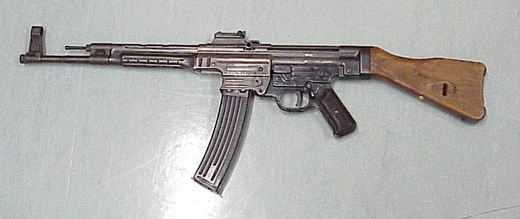
AL-7
Soviet assault rifle with balanced automatics, never adopted.

The AL-7 is a Soviet assault rifle designed in the early 1970s by Izhmash engineer Yury Aleksandrov. Its key feature is the Balanced Automatics Recoil System (BARS), an operating mechanism first developed by Pyotr Tkachyov of TsNIITochMash in the mid-1960s and originally used on the AO-38 assault rifle. Instead of the standard Kalashnikov gas piston system, BARS reduces recoil and makes automatic fire more effective by moving mass toward the muzzle as the bolt and bolt carrier travel rearward.
The Soviet Army never adopted the AL-7 or its BARS system. The project lost out to the AK-74, mainly due to cost. Over time, advances in manufacturing technology made the AL-7 concept financially practical, leading to the later AK-107 and AK-108 rifles. Other firearms using the balanced automatics system include the AEK-971, AO-38, SA-006, AKB, and AKB-1.
Quick Facts
- Origin
- Soviet Union
- Is Ranged
- YES
- Designer
- Yury Aleksandrov
- Manufacturer
- Izhmash
- Cartridge
- 5.45×39mm
- Action
- Gas operated, rotating bolt
- Feed
- 30 round box magazine
- Sights
- Iron
Facts from the source article.
Lore & Background
The AL-7 was designed by Izhmash engineer Yury Aleksandrov in the early 1970s. Its operating system, the Balanced Automatics Recoil System (BARS), was developed by Pyotr Tkachyov of TsNIITochMash in the mid-1960s and first used on the AO-38 assault rifle. BARS replaces the traditional Kalashnikov gas piston system by shifting mass toward the muzzle as the bolt and bolt carrier recoil rearward, reducing recoil effects and enabling more efficient automatic fire.
The AL-7 and its BARS system were never adopted by the Soviet Army. The project was overshadowed by the acceptance of the AK-74 due to cost considerations. Other rifles that use the balanced automatics system include the AEK-971, AO-38, SA-006, AKB, and AKB-1.
Reader's Guide
The AL-7's significance lies in its innovative Balanced Automatics Recoil System (BARS), which addressed recoil issues in automatic fire by shifting mass toward the muzzle during the recoil cycle. Although the AL-7 itself was not adopted by the Soviet Army—overshadowed by the AK-74 due to cost—the concept did not disappear. The passage of time allowed manufacturing technology to advance, making the AL-7 concept economically viable. This eventually presented itself in the form of the AK-107 and AK-108 rifles. The AL-7 thus represents a technological precursor whose core operating principle was later realized in production firearms. Its legacy is also reflected in other rifles using the same balanced automatics system, such as the AEK-971, AO-38, SA-006, AKB, and AKB-1, indicating that the design philosophy influenced multiple development lines within Soviet and Russian small arms.
Did You Know?
- The AL-7 was never adopted by the Soviet Army due to cost considerations favoring the AK-74.
- The AL-7 concept later became economically viable, leading to the AK-107 and AK-108 rifles.
More in Assault Rifles 1-24
Spotted an error? Know more?
Reader corrections go straight into our review queue. Suggest an edit · How this site is sourced