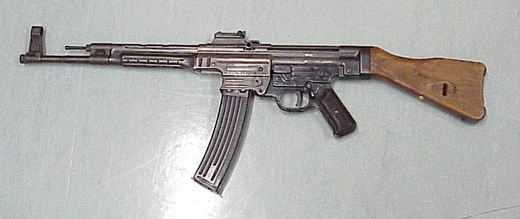
AKS-74U
Compact carbine variant of the Soviet AK-74 rifle.

The AKS-74U is the compact carbine variant of the Soviet AK-74 rifle. It fulfills the same role as similarly sized submachine guns, bridging the tactical deployment gap between a submachine gun and an assault rifle.
Quick Facts
- Origin
- Soviet Union
- Is Ranged
- Yes
- Service
- 1979–present
- Designer
- Mikhail Kalashnikov
- Design Date
- 1970s
- Manufacturer
- Tula Arms Plant
- Developed From
- AK-74
- Weight
- 2.7 kg
- Length
- 730 mm (stock extended) / 490 mm (stock folded)
- Part Length
- 206.5 mm
- Cartridge
- 5.45×39mm
- Action
- Gas-operated, long-stroke piston, closed rotating bolt
Facts from the source article.
Lore & Background
The AKS-74U was developed from a design competition codenamed "Modern" that began in 1973. Soviet planners drew from the unsolicited AO-46 design built in 1969 by Peter Andreevich Tkachev. The competition included designs by Mikhail Kalashnikov, Igor Stechkin, S. G. Simonov, A. S. Konstantinov, and Yevgeny Dragunov. In 1977, the GRAU adopted Kalashnikov's model, which was largely a shortened AKS-74, due to its performance and production cost savings. The AKS-74U was officially adopted in 1979, with production stopping in 1993. The majority were manufactured at the Tula Arms Factory rather than Izhmash.
The AKS-74U's compact dimensions were achieved by using a short 206.5 mm barrel, which forced designers to reduce the gas piston operating rod. The cyclic rate rose to around 700 rounds per minute. The barrel's twist rate was increased to 160 mm to adapt for muzzle velocities of 720 m/s and higher. A new gas block with a muzzle booster was installed, which features an internal expansion chamber and a conical end that acts as a nozzle. The muzzle blast is extremely large and visible. The front sight was integrated into the gas block.
The AKS-74U has a different rear sight composed of a U-shaped flip sight on the top cover, with settings for 350 m and 400–500 m. The sight height above the bore axis is approximately 3 mm higher than the AK-74. The top cover hinges from a barrel trunnion, pivoting forward when opened. Both the gas tube and handguard are wider and shorter than those on the AKS-74.
Reader's Guide
The AKS-74U was intended for use mainly with special forces, airborne infantry, rear-echelon support units, helicopter and armored vehicle crews. It has been augmented and replaced by various submachine guns and the less compact AK-105 carbine in Russian military service. It is commonly used by law enforcement; for example, each urban police foot patrol is issued at least one. The AKS-74U cannot mount a bayonet or standard under-barrel grenade launcher, but a suppressed 30 mm BS-1 grenade launcher was developed specifically for it. The rifle utilizes a proprietary 25 mm wide sling. It was used as the basis for the bullpup OTs-14 Groza specialist carbine and the Gepard series of multi-caliber submachine guns. In the United States, the AKS-74U is sometimes called a "Krinkov"; the origin of this term is uncertain. Research suggests the name is a Pashtun invention. US journalist C. J. Chivers reported that the gun was nicknamed "the Osama" in jihadist circles after Osama bin Laden was photographed next to an AKS-74U.
Did You Know?
- The AKS-74U is approximately 3 oz lighter than its NATO equivalent, the XM177.
- In the United States, the AKS-74U is sometimes called a 'Krinkov', though the origin of the term is uncertain.
More in Assault Rifles 1-24
Spotted an error? Know more?
Reader corrections go straight into our review queue. Suggest an edit · How this site is sourced