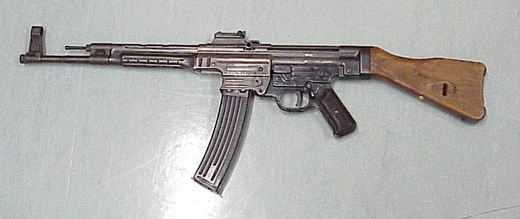
AK-107
Russian assault rifle with balanced recoil system for enhanced accuracy.

The AK-107 is a Russian 5.45×39mm assault rifle developed from the AK-100 series. It is notable for its 'balanced' operating system, similar to that used in the AEK-971, which virtually eliminates felt recoil and muzzle rise. The designation AK in this case does not indicate Avtomat Kalashnikova but Alexandrov/Kalashnikov, reflecting the incorporation of a new gas system designed by Youriy Alexandrov for Kalashnikov-pattern rifles.
Quick Facts
- Service
- 2010–present
- Designer
- Yuriy K. Alexandrov
- Length
- 943 mm stock extended / 700 mm stock folded
- Action
- Gas-operated, rotating bolt, BARS system
- Origin
- Russia
- Is Ranged
- Yes
- Design Date
- 1990s
- Manufacturer
- Kalashnikov Concern
- Production Date
- 1994–present
- Variants
- AK-108
- Weight
- 3.8 kg
- Part Length
- 415 mm
Facts from the source article.
Lore & Background
The AK-107's operating system derives from the AL-7 experimental rifle of the early 1970s. The AL-7 utilized an innovative balanced gas operating system known as the Balanced Automatics Recoil System (BARS), developed by Peter Andreevich Tkachev of TsNIITochMash, first used on the AO-38 assault rifle of 1965. This system essentially eliminated felt recoil and muzzle rise. The system was modified by Alexandrov, then a junior engineer at Izhmash, and prototypes were produced under the designation AL-7. The AL-7 was considered too expensive for production at the time, and the Soviet Army selected the AK-74 instead. No further development occurred until the mid-1990s when Alexandrov, by then a senior engineer, was directed to update his design for production as a less expensive alternative to the AN-94. The AK-107 differs only slightly from the original AL-7: the receiver is not fluted, and a three-round burst feature has been added.
The AK-107 and AK-108 represent a significant change to the Kalashnikov operating system. The system uses a recoil-reducing countermass mechanism with two operating rods that move in opposite directions. One operating rod has a gas piston facing forward, while the lower also has a gas piston. The gas tube is double-ended to accommodate the two rods. When fired, gas drives the bolt carrier to the rear and the counter-recoil upper rail forward. A star-shaped sprocket links and synchronizes both components, causing them to reach their maximum extension at the same instant, eliminating felt recoil. The travel distance of the reciprocating parts is less than other Kalashnikov designs, resulting in a higher cyclic rate of 850–900 rounds/min. External differences include a modified ejection port, a thicker operating rod cover, a rotating latch for the receiver cover, a rear sight attached to the receiver cover, and a four-position selector. The AK-108 is a version chambered in 5.56×45mm NATO. The AK-100 series use synthetic materials such as black fiberglass-reinforced polymer for the pistol grip and heat shield.
In March 2013, Izhmash debuted a civilian version of the AK-107/AK-108 designated the Saiga MK-107. The MK-107 features improvements including a rounded ergonomic charging handle, a button-style safety above the trigger guard, AR-15-style pistol grip and stock, and a full-length top Picatinny rail. The AK-107 is used by Kazakhstan and is being tested by the Russian military with new features including an enhanced stock, top and side-mounted accessory rails, high-capacity Izhmash 60-round quad-stack magazine, and holographic sight.
Reader's Guide
The AK-107 represents a notable departure from the traditional Kalashnikov operating system, incorporating a balanced recoil mechanism that virtually eliminates felt recoil and muzzle rise. This design, originally developed for the AL-7 experimental rifle, was revived in the mid-1990s as a less expensive alternative to the AN-94. The system's use of two reciprocating rods synchronized by a star-shaped sprocket allows for enhanced accuracy, particularly during burst and fully automatic fire, despite a higher cyclic rate of 850–900 rounds per minute. The AK-107's three-round burst mode resets each time the trigger is released, even if only one or two rounds were fired. Externally, the rifle differs from earlier Kalashnikov models in several ways, including a modified ejection port, thicker operating rod cover, rotating latch for the receiver cover, and a four-position selector. The AK-108 variant is chambered in 5.56×45mm NATO. The AK-107 is in service with Kazakhstan and is undergoing testing by the Russian military with additional features. A civilian version, the Saiga MK-107, was introduced in March 2013 with ergonomic and accessory rail improvements. The AK-107's balanced system, while not widely adopted, demonstrates an alternative approach to recoil management in assault rifles, building on earlier work by Peter Andreevich Tkachev and Youriy Alexandrov.
Did You Know?
- The AK-107's designation does not indicate Avtomat Kalashnikova but Alexandrov/Kalashnikov.
- The AK-107 has a cyclic rate of 850–900 rounds per minute, higher than the 600 rounds per minute of other AK rifles.
- A civilian version, the Saiga MK-107, was debuted in March 2013 with AR-15-style furniture and a Picatinny rail.
More in Assault Rifles 1-24
Spotted an error? Know more?
Reader corrections go straight into our review queue. Suggest an edit · How this site is sourced