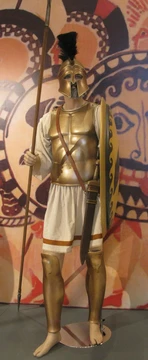
Xyston
Long Macedonian cavalry spear with a single spearhead and a butt spike.

The xyston was a type of long thrusting spear used in ancient Greece, measuring about 3.5 to 4.25 meters (11 to 14 feet) in length. It had a wooden shaft and a single spearhead at one end, while the butt end was often fitted with a spike (sauroter) for counterbalance or planting in the ground. The xyston is usually mentioned in context with the hetairoi, the cavalry forces of ancient Macedon. After Alexander the Great's death, the term xystophoroi ('spear-bearers') was used in the Hellenistic period for certain cavalry units, but the hetairoi continued to be called hetairoi in many contexts.
- type
- Thrusting spear
- length
- 3.5–4.25 m (11–14 ft)
- material
- Cornel wood (Cornus mas)
- wood_density
- 51.5 lb/ft³ (825 kg/m³)
- associated_force
- Hetairoi (Macedonian cavalry)
- also_known_as
- Kontos (later slang term)
Lore & Background
The xyston was wielded either underarm or overarm, presumably as a matter of personal preference. Its wooden shaft was made of cornel wood (Cornus mas), which was chosen for its elasticity and hardness, making it very durable and a good material for spears, javelins, and bows. The wood was tough enough to not need thickness to balance the weight of its length, while still maintaining its elasticity.
Cornus mas, also known as the Cornelian cherry, was common in the wood mountains that surround Macedonia, ranging from areas in the Balkans and into Syria, with specific locations including Mt. Olympus, Phthiotis, Aetolia, Arcadia, and Laconis. The xyston was also known, especially later, as the kontos, meaning literally 'barge-pole,' a name that possibly originated as a slang term for the weapon.
The butt spike (sauroter) served as a counterweight and could be used to plant the spear in the ground or as a secondary weapon if the shaft broke. In his Greek-written Bellum Judaicum, the Jewish historian Flavius Josephus uses the term xyston to describe the Roman throwing javelin, the pilum.
Reader's Guide
The xyston was a specialized weapon of the Macedonian hetairoi cavalry, reflecting the tactical emphasis on shock combat in Hellenistic warfare. Its great length allowed cavalrymen to strike infantry or other cavalry from a distance, while the double-ended design provided a counterweight and a backup point if the shaft broke. The use of cornel wood, noted for its elasticity and hardness, enabled the spear to be long yet light enough for two-handed use. After Alexander the Great's death, the hetairoi were renamed xystophoroi, indicating the weapon's iconic status. The later adoption of the term kontos suggests the weapon's continued evolution or slang usage. Flavius Josephus's application of xyston to the Roman pilum shows the term's flexibility in ancient literature. The xyston's design and material choices illustrate the practical engineering of ancient weaponry, balancing length, weight, and durability for cavalry effectiveness.
Did You Know?
- The xyston measured about 3.5 to 4.25 meters (11 to 14 feet) long.
- It had a single spearhead, with the butt end fitted with a spike (sauroter) for counterbalance or planting in the ground.
- The wood used was cornel wood (Cornus mas), known for its elasticity and hardness.
- Flavius Josephus used the term xyston to describe the Roman pilum.
More in Ancient Greek military equipment 1-24
Spotted an error? Know more?
This is a living reference — every entry is fact-audited, and reader corrections feed straight into our audit queue. Suggest an edit · See this site's audit record