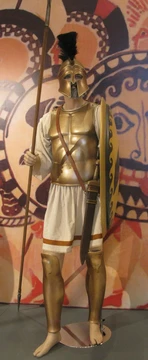
Attic helmet
A Greek helmet type popular in Italy and later Roman art.

The Attic helmet was a type of helmet that originated in Classical Greece and was widely used in Italy and the Hellenistic world until well into the Roman Empire. Its name is a modern historiographic convention, used in archaeology for convenience to denote a particular type of helmet and not to imply its origin. The Attic helmet was similar to the Chalcidian helmet but lacked a nose guard.
- origin
- Classical Greece
- type
- Helmet
- key feature
- Similar to Chalcidian helmet but lacked a nose guard
- primary region of use
- Italy and the Hellenistic world
- notable archaeological context
- Prominent in Samnite and Lucanian burials and associated art
Lore & Background
The Attic helmet, though originating in Classical Greece, was not as widespread in Greece itself as the Corinthian or Phrygian types. Instead, it became very popular in Italy, where most examples have been found. Many Italian peoples used variations of the Attic helmet, but archaeologically it has been especially prominent in Samnite and Lucanian burials and their associated art, such as frescos.
Reader's Guide
As an artistic motif, variations of the Attic helmet long outlasted other contemporary helmet types, being used to impart an archaic look to depictions of generals, emperors and Praetorians throughout the Hellenistic and Roman periods. A form of Attic helmet has become part of the popular image of a Roman officer, as found in art from the Renaissance onwards or in earlier Hollywood productions. However, no archaeological remains of this type of helmet have been found to date. The closest surviving Imperial Roman helmet to the type illustrated in relief sculpture dates to the 2nd century AD and was found in Bavaria. It has been classified as a 'pseudo-Attic' helmet by some scholars. It is of tinned bronze and is very elaborately decorated with an integral crest raised from the skull incorporating an eagle.
Did You Know?
- The name 'Attic helmet' is a modern historiographic convention, not an ancient designation.
- The Attic helmet was similar to the Chalcidian helmet but lacked a nose guard.
- Most archaeological examples of the Attic helmet have been found in Italy, especially in Samnite and Lucanian burials.
- No archaeological remains of the Attic helmet as depicted in Roman relief sculpture have been found to date.
Design & Functional Philosophy
The Boeotian helmet drew its silhouette from the petasos, a felt sun hat familiar throughout Greek daily life, specifically a folded-down variant of that headwear. Rather than enclosing the head like a Corinthian, it was an open construction: a domed skull encircled by a wide, flaring brim that sloped downward in every direction. At the rear the brim extended to shield the nape of the neck; at the front it projected over the brow. The sides featured an intricate arrangement of downward-pointing folds that offered partial lateral coverage for the face. A long, falling plume could be affixed to the crown for additional visual presence. The open architecture was not incidental—it granted the wearer unobstructed peripheral sight and clear hearing, qualities that proved essential for cavalrymen who needed to track movement and hear commands while riding at speed. This functional priority over full facial protection made the Boeotian a purpose-built piece of mounted-warfare equipment rather than a general-purpose head defense.
Manufacturing & Material Craft
Craftsmen produced the Boeotian helmet by beating a single sheet of bronze over a helmet-shaped former, a mould that guided the metal into its distinctive profile. One such former, carved from limestone, has survived to the present day, offering a rare glimpse into the workshop processes of the classical era. The finished product was a seamless, one-piece construction that combined the domed crown with the elaborate brim and its lateral folds in a single continuous form. Among the most remarkable surviving examples is a helmet recovered from the Tigris River in modern-day Iraq; its excellent state of preservation suggests it may have belonged to a cavalryman serving under Alexander the Great. This piece now resides in the Ashmolean Museum. Over time the basic silhouette shifted: by the late Hellenistic period the skull had grown taller and more conical, while the brim was often reduced in size, signalling a gradual evolution of the design even as its fundamental open-brimmed character persisted.
Cavalry Adoption & Military Service
The Boeotian helmet found its most prominent role in the mounted forces of the ancient Mediterranean world. The Athenian writer and military theorist Xenophon explicitly endorsed it for cavalry, praising its ability to protect everything above the cuirass while leaving the rider's field of vision completely free. Alexander the Great heeded this counsel and outfitted his horsemen with the type, a fact corroborated by both the Alexander Sarcophagus and the famous Alexander Mosaic, each depicting Macedonian cavalry wearing the distinctive brimmed helmet. After Alexander's death his successor kingdoms continued the tradition, and the helmet became especially visible in the Greco-Bactrian and Indo-Greek realms, where rulers chose to depict themselves wearing a variant on their coinage—an extraordinary departure from the norm, since most Hellenistic monarchs displayed only a royal diadem. The type also crossed into Roman military practice, appearing on Republican citizen cavalry, as seen on the altar of Gnaeus Domitius Ahenobarbus, where a horseman wears the later conical-skull version topped with a horsehair plume.
Naming, Identity & Cultural Distinction
Unlike most labels in the typology of ancient Greek helmets, which were coined by modern scholars, the name "Boeotian helmet" traces back to contemporary usage. Xenophon himself employed the term, anchoring the type to the Greek region of Boeotia and giving it an identity rooted in the ancient world rather than in later academic convention. This regional association echoes a broader pattern: Boeotia is also linked to a specific shield type, though no physical examples of that shield have survived, and its connection to the region rests largely on images struck on local coinage. The Boeotian helmet's cultural footprint extends further still. In an era when Hellenistic kings typically presented only a diadem on their currency, the Greco-Bactrian and Indo-Greek rulers who chose to show themselves in the brimmed helmet made a deliberate statement of martial identity and regional heritage. This unusual numismatic choice elevated a piece of cavalry equipment into a symbol of kingship and cultural pride, distinguishing these kingdoms from their more conventionally adorned predecessors.
Frequently Asked Questions
What is an Attic helmet?
It is a Greek helmet type that emerged during the Classical period and went on to see broad adoption across Italy and the Hellenistic world, persisting into Roman-era contexts.
How does the Attic helmet differ from the Chalcidian helmet?
The two share a very similar overall silhouette, but the Attic version omits the nose guard that the Chalcidian retains, leaving a more open facial opening.
Why is it called 'Attic' if it didn't actually come from Attica?
The name is a modern archaeological label applied by scholars as a convenient shorthand for this particular helmet form; it carries no implication of genuine Athenian origin.
Where do we see the Attic helmet most often in the archaeological record?
It is especially prominent in Samnite and Lucanian burial assemblages in southern Italy, and it also appears in the decorative arts associated with those regional cultures.
How long did the Attic helmet remain in practical use?
From its Classical Greek origins it stayed in circulation through the Hellenistic period and well into the Roman Empire, making it one of the longer-lived single helmet designs in the ancient Mediterranean.
More in Ancient Greek military equipment 1-24
Spotted an error? Know more?
This is a living reference — every entry is fact-audited, and reader corrections feed straight into our audit queue. Suggest an edit · See this site's audit record