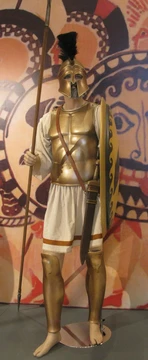
Greave
Armor protecting the shin from attack.

A greave (from the Old French greve 'shin, shin armor') or jambeau is a piece of armor that protects the leg. Its primary purpose is to protect the tibia from attack, as the shinbone is very close to the skin and extremely vulnerable; a successful attack on the shin can render the leg useless. Greaves usually consisted of a metal exterior with an inner padding of felt, which was important to prevent blows from transferring directly from the metal to the shin.
- type
- Armor
- period
- Bronze Age to medieval and feudal Japan
- cultures
- Mycenaean Greeks, Urnfield culture, Ancient Greece, Rome, Medieval Europe, Feudal Japan
- materials
- Metal (bronze, iron, steel), felt, leather, cloth, mail
- variants
- Schynbalds, closed greaves, suneate (shino-suneate, tsutsu-suneate)
Lore & Background
Greaves were used in Bronze Age Europe by the Mycenaean Greeks and the Central European Urnfield culture. In classical antiquity, they are referenced in texts such as The Iliad, where Greek forces are called 'well-greaved Achaeans,' and The Odyssey, among others. Roman light infantry (hastati) used greaves, which were mass-produced using presses on sheets of metal with leather or cloth lining. While often worn in pairs, evidence from skeletons shows many wore a single greave on one leg, possibly as a status symbol.
Reader's Guide
Greaves represent a fundamental piece of leg armor across multiple cultures and time periods, highlighting the universal recognition of the shin's vulnerability in combat. Their design evolved from simple bronze plates to complex closed greaves with hinges and buckles, and in Japan to splinted suneate with mail. The inclusion of padding—felt in Europe, leather in Japan—underscores the practical need to absorb impact. The fact that some individuals wore only a single greave, as seen in burials of gladiators and soldiers, suggests that greaves could serve as markers of status rather than purely functional gear. Their mention in major literary works like the Iliad and Odyssey indicates their cultural significance beyond mere battlefield utility. The disappearance and later reappearance of greaves in medieval Europe around the 13th century shows how armor fashions and technologies could fluctuate. Overall, greaves illustrate how armorers addressed a specific anatomical weakness, leading to innovations that spread across continents and centuries.
Did You Know?
- The word 'greave' comes from the Old French greve, meaning 'shin, shin armor'.
- In the Iliad, Greek forces are called 'well-greaved Achaeans'.
- Some skeletons have been found buried with only a single greave, including gladiators and soldiers.
- Japanese greaves (suneate) were first introduced during the 11th century in the late Heian period.
The Phalanx and Its Primary Armament
The backbone of ancient Greek infantry combat was the phalanx, a tightly packed shield-wall formation that demanded specific equipment from every soldier. The central weapon of this system was the doru, a spear measuring roughly two to three meters in length. Its leaf-shaped blade sat at the front while a shorter spike called the sauroter—literally 'lizard killer'—anchored the rear. That rear spike likely served a dual purpose: finishing off fallen enemies as the line advanced, or acting as a makeshift spearhead if the main blade snapped. Soldiers wielded the doru one-handed, bracing the other hand on their shield. Mounted cavalry, by contrast, favored a slimmer or exceptionally long lance known as the xyston to gain a reach advantage over foot soldiers. Under Philip II of Macedon, the concept was pushed to its extreme: hoplites carried sarrisae stretching up to twenty-one feet. When locked in phalanx formation, these enormous spears created an almost impenetrable wall of points that shorter enemy weapons simply could not penetrate.
Social Stratification on the Battlefield
Greek warfare carried a distinctly democratic yet deeply unequal character. Because no standing peace-keeping army existed, most citizens kept weapons at home for personal self-defence, and when conflict erupted each soldier was expected to furnish his own complete panoply. This individual provisioning meant that equipment quality varied enormously from one fighter to the next, producing a remarkable diversity of arms and armor across Hellenistic forces. Wealthier citizens could afford the full hoplite kit, but the poorest members of the community simply could not. Those citizens fell into the role of psiloi or peltasts—fast, mobile skirmishers who operated on the battlefield's periphery. Their kit was deliberately minimal: a handful of light javelins and a wicker shield called a pelte, designed to deflect incoming projectiles rather than absorb the thrust of a spear. Their tactical mission was to harass and pepper enemy formations from a distance, then withdraw before close-quarters fighting could begin. In this way, economic status literally dictated a soldier's position, role, and survivability in battle.
The Materials Revolution and Strategic Consequences
The shift from copper to iron and bronze reshaped the military landscape of the ancient Greek world. Copper, once the default metal for weapon-making, proved far too soft and brittle to compete with the harder alternatives. Iron, by contrast, was abundant across the region, and its availability meant even smaller Greek poleis could outfit their citizens with blades that were simultaneously lighter and tougher than their copper predecessors. Bronze remained in use but was comparatively scarce, largely because the tin required for the alloy was difficult to source. The practical result was an arms landscape dominated by iron and copper implements, a combination that proved decisive during the Greco-Persian Wars. Even in smaller items, material choice mattered: the light javelins carried by peltasts and hoplites alike featured bronze tips specifically so that spent projectiles could be retrieved from the ground. The amentum, a throwing aid used to add spin and distance to javelin throws, further illustrates how material and technique combined to extend the reach of Greek light infantry.
Protective Gear: From Helmets to Greaves
While offensive weapons drew the most attention, the protective elements of a Greek soldier's kit were equally critical—and equally limited. For the torso, the linothorax, a layered linen cuirass, was the most widespread choice because it was inexpensive and light. Wealthier fighters might wear a bronze breastplate in the form of a bell cuirass, but beyond the torso and head, protection was sparse. Ancient art and poetry record fatal strikes to the bladder and neck, areas left entirely exposed. Hoplites and cavalry alike wore greaves to shield the lower legs, yet the arms, hands, and much of the torso remained vulnerable. Helmets evolved over time: the heavy Corinthian type, appearing around 600 BC, gave way to lighter Phrygian and Chalcidian designs that improved sight and hearing. Cavalry favored the Boeotian helmet for maximum unobstructed vision. A horsehair crest added both decoration and a thin extra layer of defense. The aspis shield, roughly a meter across and weighing about seven kilograms, completed the defensive picture for heavy infantry.
Frequently Asked Questions
What is a greave in ancient Greek warfare?
A greave is a piece of leg armor built to shield the shinbone, which sits very close to the skin and is extremely vulnerable to blade or blunt-force attacks. The word traces back to the Old French term 'greve,' meaning shin or shin armor.
Why was the shin such a critical weak point for Greek soldiers?
The tibia has almost no muscle or fat covering it, so even a moderate strike can fracture the bone and leave the entire leg useless in combat. This made dedicated shin protection a practical necessity for hoplites and other armored fighters.
What materials went into making a typical Greek greave?
A metal outer shell of bronze, iron, or steel was fitted over an inner layer of felt padding. The felt was essential because it absorbed impact so the force of a blow would not transfer directly from the hard metal onto the bare bone.
Did only ancient Greeks wear greaves, or were they used in other cultures too?
Greaves appeared across many cultures and eras, from Mycenaean Greece through Rome, Medieval Europe, and even Feudal Japan, where they took forms like suneate and shino-suneate. The basic idea of a rigid shell over soft lining was a universal solution to the same anatomical vulnerability.
What different types or variants of greaves existed?
Common variants included open schynbalds, fully enclosed closed greaves, and the Japanese suneate family (shino-suneate and tsutsu-suneate). Construction materials ranged from bronze and iron to steel, with leather, cloth, and mail sometimes incorporated as well.
More in Ancient Greek military equipment 1-24
Spotted an error? Know more?
This is a living reference — every entry is fact-audited, and reader corrections feed straight into our audit queue. Suggest an edit · See this site's audit record