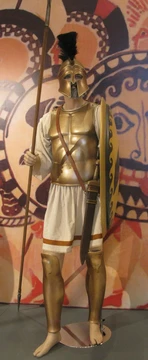
Galea (helmet)
Roman leather or felt helmet worn by legionaries and some gladiators.

The Roman galea was a helmet primarily associated with legionary heavy infantry. However, in Latin, the term 'galea' specifically referred to a leather or felt helmet, not a metal one; metal helmets were called 'cassis'. Certain gladiators, notably the murmillo, also used bronze versions that included face masks and ornamental details, such as a fish motif on the crest. Across the Republic and Principate periods, the fundamental structure remained consistent: a rounded bowl covering the skull, a neck guard that became more pronounced over time, a forehead deflector band, and hinged cheek plates for facial protection.
Roman helmet design was initially shaped by Italic influences, particularly the "Nasua" type often associated with Samnites or other Italic peoples, and later by Greek styles from the south. Evidence comes mainly from damaged or incomplete archaeological finds, supplemented by depictions in bas-relief and mosaic.
In *The Armour of Imperial Rome* (1975), H. Russell Robinson categorized heavy infantry helmets into four main types—Montefortino, Coolus, Imperial Gallic, Imperial Italic—along with a later ridge helmet shown on coins of Constantine I. He also identified thirty distinct cheek guard variants specifically for Imperial Gallic and Imperial Italic helmets. Gladiatorial helmets differed significantly from military ones.
Some legionary helmets featured crest holders. Crests were typically made of plumes or horse hair, often red but possibly also yellow, purple, black, or combinations like alternating yellow and black. Gladiators such as the samnis and hoplomachus likely wore large feathered crests. According to Vegetius and certain sculptures, legionaries mounted their crests longitudinally, while centurions wore them transversely. Centurions in the early empire may have worn crests constantly, even in battle, but legionaries—and centurions in other periods—probably used them only on occasion.
- Type
- Military helmet
- Primary users
- Roman heavy infantry (legionaries) and some gladiators (murmillo)
- Material
- Leather or felt (galea); metal (cassis) for military; bronze for some gladiators
- Period of use
- Republic era through Principate (specific types from 4th century BC to early 3rd century AD, plus ridge helmet from 4th century AD)
- Key design features
- Skull bowl, neck guard, deflector band, cheek plates
- Influences
- Italic 'Nasua' type helmets (associated with Samnites and other Italic peoples) and Greek designs from southern Italy
Lore & Background
The galea's origins were influenced by neighboring Italic peoples, who used 'Nasua' type helmets often linked to Samnites, and by Greeks in the south of Italy. The primary evidence for galeae comes from scattered archaeological finds, often damaged or incomplete, supplemented by period depictions in bas-relief sculpture and mosaic. H. Russell Robinson, in his 1975 book *The Armour of Imperial Rome*, classified four main types of heavy infantry helmets—Montefortino, Coolus, Imperial Gallic, Imperial Italic—and a later ridge helmet, along with thirty different types of cheek guards specifically for the Imperial Gallic and Imperial Italic types.
Reader's Guide
The galea is significant as the defining head protection of the Roman legionary, evolving over centuries from the 4th century BC Montefortino type to the ridge helmet of the 4th century AD. Its basic design—skull bowl, neck guard, deflector band, and cheek plates—remained consistent through the Republic and Principate, though exact form, metal, and decoration varied by time, unit, and individual craftsmanship. Pre-industrial hand production means standardization was uncertain even under the Empire. The helmet also served gladiators, notably the murmillo, whose bronze versions included face masks and fish-crest decorations. Robinson's classification system remains a key reference for understanding these variations, though the fragmentary archaeological record leaves many details unresolved.
Did You Know?
- The word 'galea' may be related to Ancient Greek γαλέη (galéē) meaning 'weasel, marten', but this etymology is uncertain and not widely accepted.
- Some gladiators, specifically the murmillo, wore bronze galeae with face masks and a fish on the crest.
- H. Russell Robinson classified four main types of heavy infantry helmets and thirty types of cheek guards specifically for Imperial Gallic and Imperial Italic helmets in his 1975 book.
- Legionary crests were usually made of plumes or horse hair, possibly in colors like red, yellow, purple, and black.
Anatomy and Origins of the Roman Helmet
The galea, the iconic metal helmet of Roman soldiers, drew its name from the Latin word pronounced roughly as GAH-leh, itself borrowed from the Ancient Greek galéē, a term that originally denoted a weasel or marten. Despite this curious etymology, the helmet's architecture followed a remarkably consistent blueprint across centuries. From the Republic era through the Principate, every Roman galea incorporated a bowl shielding the skull, a neck guard that progressively enlarged over time, a deflector band covering the forehead, and cheek plates guarding the face. Yet consistency did not mean uniformity. Because pre-industrial manufacturing relied entirely on handwork, the precise shape, metal composition, and decorative details shifted between units, between individual artisans, and across the centuries. Even under the full administrative weight of the Roman Empire, scholars cannot confirm how much standardization actually existed. The earliest Roman helmet designs were shaped by two neighboring civilizations: the Etruscans to the north, whose Nasua-type helmets left a clear imprint, and the Greek communities in the south, whose forms also bled into early Roman metalwork.
Taxonomy: Robinson's Four Types and the Cheek-Guard Problem
In 1975, H. Russell Robinson published The Armour of Imperial Rome, in which he organized the scattered archaeological record into a coherent taxonomy. He identified four principal helmet types worn by heavy legionary infantry, each with lettered subcategories, and catalogued thirty distinct varieties of cheek guards. The Montefortino type, the earliest in his sequence, spanned from the fourth century BC all the way into the first century AD. The Coolus helmet followed, appearing in the third century BC and surviving at least until the eruption of Vesuvius in 79 AD. The Imperial Gallic helmet emerged in the late first century BC and persisted into the early second century AD, while the Imperial Italic type overlapped it, running from the late first century BC through the early third century AD. The latest form, the Ridge helmet, first appears on coins minted under the fourth-century emperor Constantine I. Robinson's framework remains the backbone of modern discussion, though the fragmentary nature of the evidence—scattered, often damaged or incomplete finds, supplemented by bas-relief sculptures and mosaics—means his categories are best understood as broad groupings rather than rigid boundaries.
Arena versus Battlefield: The Gladiatorial Galea
While the galea is most closely associated with the heavy infantry of the Roman legions, it also found a very different life in the arena. Gladiators of the murmillo type—sometimes rendered as myrmillo—wore bronze galeae that were deliberately ornamental, fitted with face masks and decorative elements, most recognizably a fish mounted atop the crest. These combat helmets were quite different in form from their military counterparts, reflecting the spectacle-driven priorities of the arena rather than the practical protection needs of a legionary on the march. The distinction between the two traditions was not merely cosmetic; the gladiatorial versions served a theatrical purpose, identifying the fighter's class to the crowd, while the legionary's galea was a functional piece of battlefield equipment. Even within the military context, the helmet's exact appearance could differ by unit type, by the era in which it was forged, and by the individual artisan who shaped it, a reminder that Roman military equipment was never the mass-produced, identical commodity that later centuries would make standard.
Plumes, Colors, and the Language of Rank
One of the most visually striking features of the Roman galea was its crest, a plume of horse hair or feathers held aloft by a dedicated crest holder on the helmet's crown. The most commonly referenced color for these plumes was red, but the evidence points to a broader palette: yellow, purple, and black all appear, and combinations such as alternating yellow and black are also attested. Beyond color, the orientation of the crest carried social and military meaning. According to the writings of Vegetius and corroborating sculptural evidence, legionaries mounted their crests longitudinally, running front to back, while centurions fixed theirs transversely, across the top of the skull. This distinction may have been a constant visual marker of rank in the early empire, with centurions wearing their transverse crests even in battle. For ordinary legionaries, however, the crest was likely a periodic rather than permanent feature, donned for specific occasions rather than every engagement. Gladiators such as the samnis and the hoplomachus also appear to have sported large feathered crests, echoing the military tradition in the arena.
Frequently Asked Questions
What is a galea helmet?
The galea is a military helmet most closely tied to Roman legionary heavy infantry. In strict Latin usage, the word referred specifically to a head covering made of leather or felt rather than metal.
Who actually wore the galea?
Roman heavy infantrymen were the primary users throughout the Republic and Principate eras. The gladiator type known as the murmillo also sported a bronze galea, often complete with a face mask and a crest decorated with a fish motif.
What are the key design features of a galea?
The core layout stayed remarkably consistent: a rounded bowl over the skull, a neck guard that grew more pronounced over the centuries, a deflector band across the forehead, and hinged cheek plates. These elements defined the helmet from the 4th century BC through the early 3rd century AD.
What's the difference between a galea and a cassis?
In Latin military vocabulary, 'galea' denoted a leather or felt helmet, while 'cassis' was the term reserved for metal ones. So a legionary's steel headgear was technically a cassis, even though casual usage often lumps both under 'galea'.
What earlier designs influenced the galea?
The galea's shape drew heavily on Italic helmet traditions, especially the so-called 'Nasua' type linked to the Samnites and other Italic peoples. Those ancestral forms set the template for the rounded bowl and cheek-plate structure that endured for centuries.
More in Ancient Greek military equipment 1-24
Spotted an error? Know more?
This is a living reference — every entry is fact-audited, and reader corrections feed straight into our audit queue. Suggest an edit · See this site's audit record