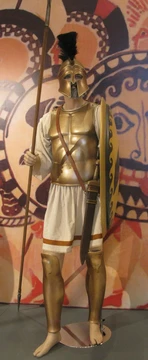
Knemides (armor)
Ancient Greek leg armor mentioned in classical texts.

Knemides (armor) is the Ancient Greek term for greaves, a piece of armor that protects the leg. The term appears in various texts of classical antiquity, including The Iliad and The Odyssey, where Greek forces are commonly referred to as 'well-greaved Achaeans.' These references, while primarily mythological, provide evidence that greaves were indeed in use in ancient warfare.
- field
- Armor
- known_for
- Protecting the tibia in ancient Greek and Roman warfare
- nationality
- Ancient Greece and Rome
Lore & Background
The reference to knēmídes exists in various texts of classical antiquity, including The Shield of Heracles, The Iliad and The Odyssey, The Bibliotheca of Pseudo-Apollodorus, and The Aeneid. In the Iliad, the Greek forces are commonly referred to as 'well-greaved Achaeans' (ἐϋκνήμιδες Ἀχαιοί). The Iliad also mentions the ἐπισφύρια (episphýria), which were either plates covering the ankle attached to the lower edge of the greaves, or more probably a clasp fastening them round the ankle, often made of silver.
There are also non-fictional testimonies of their use among Roman light infantry (or hastati) from Polybius, though Vegetius does not specifically mention hastati using greaves in the same way. These greaves are thought to have been mass-produced by the Romans using presses on sheets of metal and then attaching lining, usually leather or cloth. While it is generally assumed that greaves were always worn in pairs, there is some evidence of individuals wearing a single greave on the left or right leg, including gladiators and soldiers, possibly as a sign of status, though the claim that 'many skeletons' have been found buried with only a single greave is not supported by widely-known historical or archaeological consensus.
Reader's Guide
Knemides, or greaves, were a crucial piece of armor in ancient Greek and Roman warfare, designed to protect the tibia from attack. The tibia is very close to the skin and extremely vulnerable, and a successful attack on the shin could render a leg useless, greatly hampering maneuverability. The mention of greaves in major classical texts like The Iliad and The Odyssey, as well as in historical accounts by Polybius and Vegetius, underscores their importance in ancient military equipment.
The Romans mass-produced these greaves using presses on sheets of metal, attaching linings of leather or cloth. Interestingly, archaeological evidence shows that many soldiers and gladiators were buried with only a single greave, suggesting that wearing a pair was not always standard practice. This may have been a sign of status rather than purely practical use. The legacy of knēmides lies in their representation of ancient armor technology and their prominent place in classical literature, where they became a defining characteristic of Greek warriors.
Did You Know?
- The term 'knēmídes' appears in The Iliad, where Greek forces are called 'well-greaved Achaeans.'
- The Iliad also mentions ἐπισφύρια, which were either ankle plates or clasps, often made of silver.
- Roman light infantry (hastati) used greaves, as recorded by Polybius, though Vegetius does not specifically mention hastati using greaves in the same way.
Anatomy as Armor Design
The shinbone sits so close to the surface that virtually any strike lands directly on bone, making the tibia one of the most exposed and vulnerable parts of the human body. A single successful blow to the shin could render an entire leg useless, stripping a warrior of the ability to shift weight, pivot, or flee. Greaves were engineered precisely to neutralize this threat. Their construction followed a straightforward but critical principle: a rigid metal exterior to deflect incoming force, paired with an inner layer of felt padding. That padding was not a minor detail. Without it, every impact the metal plate absorbed would transfer straight through to the bone beneath, turning the armor into a blunt instrument against its own wearer. The felt acted as a shock absorber, dispersing energy across a broader area and sparing the tibia from the full concussive force of a sword edge or mace head. This two-layer philosophy—hard shell, soft interior—became the defining structural logic of leg protection across multiple civilizations and centuries, from Bronze Age Greece to Muromachi Japan.
Echoes in Epic and the Roman Workshop
The word knemides carries a literary weight that few pieces of military equipment can claim. Homer's Iliad repeatedly calls the Greek forces the "well-greaved Acheans," embedding leg armor so deeply into the identity of the warrior that it becomes almost a synonym for the army itself. The same term surfaces in The Odyssey, The Shield of Heracles, Pseudo-Apollodorus's Bibliotheca, and Virgil's Aeneid. The Iliad also references episphýria—small plates or clasps, often silver, that secured the lower edge of the greave around the ankle. Though these are epic or mythological texts, their consistent mention of greaves as standard kit strongly implies real-world use. Beyond poetry, practical military writers from Polybius to Vegetius document greaves among Roman light infantry, the hastati. Roman production was industrial in scale: sheets of metal were pressed into shape, then lined with leather or cloth. Perhaps most striking is the archaeological record of skeletons—soldiers and gladiators alike—buried with only a single greave, suggesting that wearing one on either the left or right leg may have served as a mark of personal status rather than a practical necessity.
A Century of Silence and a New Form
Greaves enjoyed steady use in Bronze Age Europe, particularly among Mycenaean Greeks and the Central European Urnfield culture, and continued through the classical and Roman periods. Then, for roughly three centuries, they nearly vanished from the European battlefield. By the ninth century AD, the practice had largely fallen out of favor, and the armor disappeared from common military use. The first confirmed reappearance does not arrive until the 1230s or 1250s, and even then the evidence is thin. The most notable early depiction is the figure of Goliath in the Trinity College Apocalypse manuscript, dated to around 1230. The scarcity of other surviving examples from that window suggests greaves were still uncommon and perhaps limited to specific contexts. When they did reappear, most were schynbalds—simple shin-only plates. The more ambitious closed greave, which enclosed the entire leg with two hinged outer plates and internal buckles and straps, first shows up in illustrations around 1290 and did not become widely adopted until the 1320s. This roughly century-long gap between disappearance and full revival marks one of the most dramatic interruptions in the history of European leg protection.
The Suneate: Japan's Parallel Path
Japanese leg armor developed along a trajectory that mirrors European greaves in function but diverges sharply in form and terminology. The suneate first appeared during the late Heian period, in the eleventh century, in a relatively simple configuration of three metal plates strapped over the shin. By the Kamakura period, spanning 1186 to 1333, the suneate had graduated from optional protection to a standard component of full Japanese armor. The Muromachi period, from 1334 to 1572, produced the form that became most widely recognized: a single metal splint mounted on a fabric backing, with a layer of mail woven between the splint and the cloth. This configuration, called shino-suneate, remained in active service well into the Momoyama period, which ended in 1602. Cavalry units sometimes retained the older three-plate design, known as tsutsu-suneate, perhaps for its flexibility in the saddle. As with their European counterparts, most suneate incorporated leather padding on the interior to cushion impacts and prevent chafing, confirming that the same anatomical problem demanded the same engineering solution on both sides of the world.
Frequently Asked Questions
What are Knemides in Ancient Greek warfare?
Knemides is the Greek word for greaves, the metal or leather plates that shielded a soldier's lower leg. They were a standard component of hoplite armor, covering the shin area to guard against cuts and blunt impacts on the battlefield.
Where does the term Knemides show up in classical literature?
The phrase appears throughout Homer's epics, most memorably in the epithet 'well-greaved Achaeans' used to describe the Greek army in both the Iliad and the Odyssey. These literary mentions confirm that leg armor was a recognizable and expected part of a warrior's kit in the Greek world.
Which specific bone do Knemides protect?
Knemides are designed to cover the tibia, the larger of the two bones in the lower leg. By shielding this exposed bone, the greaves reduced the risk of fractures and deep lacerations from sword slashes or spear thrusts.
Were Knemides only a mythological concept or did real soldiers wear them?
While Homer's references are set in a mythological framework, they serve as early written evidence that greaves were genuinely manufactured and fielded by Greek (and later Roman) troops. Archaeological finds of bronze and leather shin guards corroborate the literary descriptions.
Why do fans of ancient Greek history consider Knemides a notable piece of equipment?
Knemides are one of the few armor elements that received a dedicated Greek name and a recurring literary epithet, making them a cultural shorthand for the hoplite ideal. Their presence in both epic poetry and historical accounts highlights how central leg protection was to the identity of the Greek fighting man.
More in Ancient Greek military equipment 1-24
Spotted an error? Know more?
This is a living reference — every entry is fact-audited, and reader corrections feed straight into our audit queue. Suggest an edit · See this site's audit record