Javelin
A light spear thrown by hand, used in war, hunting, and sport.

A javelin is a lightweight spear made for throwing, originally serving as a ranged weapon in combat. In modern times, it is mainly used in the sport of javelin throwing. Unlike slings, bows, or crossbows, which launch projectiles using a handheld device, the javelin is almost always thrown by hand. However, tools like spear-throwers or the amentum can help the thrower achieve greater distances. A soldier who primarily fights with one or more javelins is known as a javelineer. The word "javelin" comes from Middle English, derived from Old French *javelin*, a diminutive of *javelot*, meaning spear. The term *javelot* likely originated from a Celtic language.
Evidence from archaeology shows that javelins and throwing sticks were in use by the end of the Lower Paleolithic period. In a coal mine in Schöningen, Germany, seven spear-like objects were found, made from spruce trunks and measuring between 1.83 and 2.25 meters long. Stratigraphic dating places them at around 400,000 years old. These items were crafted with the greatest thickness and weight at the front of the wooden shaft, suggesting they were used as javelins. Additionally, a fossilized horse shoulder blade with a projectile wound, dating to about 500,000 years ago, was uncovered in a gravel quarry in Boxgrove, England. Studies indicate the wound was likely caused by a javelin.
In ancient Egypt, the javelin was an offensive weapon used by the military. It was lighter than those used by other nations. The Egyptian javelin had a long, thin shaft that was sometimes just pointed but often fitted with a head—either leaf-shaped, spear-like, or four-sided, attached to the shaft by projections at the angles. A strap or tasseled head at the lower end allowed the thrower to retrieve the javelin after throwing it. Egyptian soldiers trained from a young age in special military schools, focusing on gymnastics to build strength and endurance. As they grew older, they learned to throw the javelin, along with practicing archery and using the battle-axe, before joining a specific regiment. Javelins were carried by Egyptian light infantry as a main weapon or as an alternative to a bow or spear, usually alongside a shield. They also carried a curved sword, club, or hatchet as a sidearm. Javelin-men often played a key role in battles, with their weapons described as inflicting death at every blow. War-chariots sometime
- type
- Ranged weapon
- earliest_evidence
- Lower Paleolithic, about 400,000 years ago (Schöningen, Germany) and 500,000 years ago (Boxgrove, England)
- materials
- Wooden shaft (e.g., spruce), often with a metal head; later versions included lead weights
- typical_length
- 1.83 to 2.25 metres (6.0 to 7.4 ft) for prehistoric examples; about 2 metres for the Roman pilum
- weight
- Pilum: 0.9 to 2.3 kilograms (2.0 to 5.1 lb); plumbata: lighter
- effective_range
- Pilum: 15 to 20 metres (49.2 to 65.6 ft); maximum range about 30 metres (98.4 ft)
- notable_users
- Ancient Egyptian light infantry, Greek peltasts, Roman hastati and principes, velites, late Roman infantry
Lore & Background
Archaeological evidence shows javelins were in use by the last phase of the Lower Paleolithic. Seven spear-like objects made of spruce, dated to about 400,000 years ago, were found in Schöningen, Germany. A fossilized horse shoulder blade with a projectile wound, dated to 500,000 years ago, was found in Boxgrove, England, with studies suggesting the wound was caused by a javelin. In ancient Egypt, javelins were lighter than those of other nations, with a long thin shaft and a head that was leaf-shaped, spear-like, or four-sided. Egyptian light infantry carried javelins as a main weapon, often alongside a shield and a sidearm such as a curved sword or club. Javelins were also used in hunting and sport.
Reader's Guide
The javelin was a versatile weapon across many ancient cultures, serving as a primary or secondary arm for infantry, skirmishers, and chariot crews. Its design evolved from simple wooden shafts to sophisticated weapons like the Roman pilum, which combined a heavy iron shank with a wooden shaft to penetrate shields and armor. The javelin's role in battle was often to disrupt enemy formations before close combat, as seen in Greek peltast tactics and Roman legionary drills. The weapon's effectiveness against war elephants at Zama highlights its tactical flexibility. Beyond warfare, javelins were used for hunting and in athletic competitions, including the Ancient Olympics. The word 'javelin' derives from Old French and ultimately from Celtic languages. The javelin's legacy continues in the modern Olympic sport of javelin throw, though its military use has largely been replaced by firearms. The archaeological finds at Schöningen and Boxgrove demonstrate that javelins are among the oldest known projectile weapons, with a history spanning hundreds of thousands of years.
Did You Know?
- The earliest known javelins are about 400,000 years old, found in Schöningen, Germany, made of spruce wood.
- A fossilized horse shoulder blade from Boxgrove, England, dated to 500,000 years ago, shows a wound probably caused by a javelin.
- The Roman pilum had an effective range of only 15 to 20 metres, though it could reach about 30 metres.
- The word 'javelin' comes from Old French 'javelin', a diminutive of 'javelot', which likely originated from a Celtic language.
The Citizen-Soldier and the Phalanx
Ancient Greek warfare was fundamentally a citizen affair rather than a professional army's. The dominant tactical doctrine was the phalanx, a dense wall of interlocked shields and thrusting spears that demanded heavy frontal protection and medium-range offensive tools. Because there was no standing peace-keeping force, most free citizens kept weapons at home for personal defence, and each man was expected to furnish his own full panoply. This individual provisioning made equipment costly and produced a remarkable variety of arms and armor across Hellenistic units, since no single state standard governed every soldier. Those at the bottom of the economic ladder, who simply could not afford a full kit, were pressed into service as psiloi or peltasts—light, fast skirmishers whose role was to harass the enemy before the heavy infantry closed in. The result was a battlefield layered with distinct roles: heavily armored phalangites at the core, flanked by mobile javelin-throwers and slingers who could not afford the bronze and iron of a full hoplite loadout.
The Spear and the Sword
At the heart of Greek infantry combat stood the doru, a two-to-three-meter thrusting spear tipped with a leaf-shaped blade on one end and a short spike called the sauroter on the other. Whether the spearhead was more commonly bronze or iron remains debated among scholars. The sauroter likely served to dispatch fallen enemies as the phalanx advanced or to act as a backup point if the main blade snapped. A hoplite wielded the doru one-handed while bracing his shield with the other. Cavalry, needing reach over shorter infantry spears, favored a slimmer or longer lance known as the xyston. Under Philip II of Macedon, the concept was pushed to an extreme: hoplites carried sarrisae up to twenty-one feet long, creating an almost impenetrable forest of points that denied shorter enemy weapons any chance to reach the formation. As a secondary arm, the short xiphos sword was drawn when the spear broke or close-quarters fighting became unavoidable, while mounted warriors preferred the heavier, curved kopis, a blade whose name literally meant 'chopper.'
Ranged Warfare and the Javelin
Light support troops such as the psiloi and peltasts formed the ranged arm of Greek armies, and their arsenals were diverse. The bow, used by archers called toxotai, was relatively uncommon because the simple wooden stave design limited effective range; some units even thrust arrows into rotting corpses to create a crude biological weapon. Far more popular was the javelin, or akontion: a light spear roughly a meter and a half long, fitted with a bronze head so it could be retrieved after a throw, and typically launched with the aid of an amentum, a thong that added spin and distance. Peltasts relied on javelins as their primary tool, peppering enemy ranks while avoiding the close combat they were ill-equipped for. Hoplites and cavalry also carried throwing javelins as a supplementary weapon. Slings, or sfendonai, rounded out the ranged toolkit, hurling lead pellets or loose stones; in fact, unaided hand-thrown stones were a common enough tactic to be noted alongside purpose-built projectiles.
Armor, Shields, and Helmets
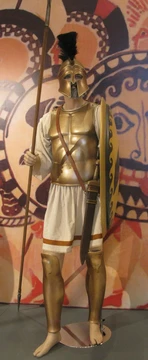
Defensive gear in ancient Greece was pragmatic rather than all-encompassing. The most widespread torso protection was the linothorax, a layered linen cuirass prized for being inexpensive and light; a bronze bell cuirass served as a costlier alternative. Cavalry wore a sleeveless chitoniskos beneath a muscle cuirass that kept the arms free for riding and fighting. Beyond the torso and head, the only other armored area was the lower leg, protected by greaves on both infantry and horsemen. The aspis, a round shield roughly a meter across and weighing about seven kilograms, was the single most critical piece of a hoplite's kit, typically built from bronze, wood, and leather. Peltasts, needing speed, carried a much lighter wicker pelte designed to stop incoming javelins rather than absorb a spear thrust. Helmets evolved from the heavy Corinthian type of around 600 BC to the lighter Phrygian and Chalcidian designs that improved sight and hearing, while cavalry favored the Boeotian helmet for maximum visibility. All left the eyes, nose, and mouth exposed, and many bore a horsehair crest for both decoration and a thin extra layer of protection.
Frequently Asked Questions
What is a javelin in ancient Greek military context?
A javelin is a lightweight throwing spear designed to be hurled by hand at an enemy, serving as a primary ranged weapon on the battlefield. Unlike projectiles fired from slings or bows, the javelin relies on the thrower's own arm strength, though accessories like an amentum could extend its range.
How did the javelin compare to other Greek ranged weapons like slings or bows?
While slings, bows, and crossbows use a handheld mechanism to launch their projectiles, the javelin is thrown directly by hand, making it more dependent on the soldier's physical strength. This simplicity made it quicker to deploy in the short window before two armies closed for a charge.
What materials were used to make a Greek javelin?
The shaft was typically carved from wood such as spruce, with a metal head fitted to the tip for penetration. Later iterations added lead weights along the shaft to improve flight stability and accuracy.
What was the effective range of a thrown javelin?
A standard javelin could reliably strike targets at roughly 15 to 20 metres, though a skilled thrower using an amentum or spear-thrower could push that distance further. The weapon was most lethal in the closing moments before two lines of infantry clashed.
What was a javelineer in the Greek army?
A javelineer was a soldier whose primary combat role revolved around carrying and throwing one or more javelins at the enemy. These troops often served as a supporting ranged element, softening opposition before heavier infantry advanced.
More in Ancient Greek military equipment 1-24
Spotted an error? Know more?
This is a living reference — every entry is fact-audited, and reader corrections feed straight into our audit queue. Suggest an edit · See this site's audit record