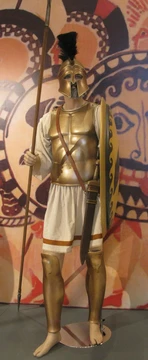
Dory (spear)
Chief spear of Ancient Greek hoplites, used in phalanx warfare.

The dory (or doru; Greek: δόρυ) was the primary spear used by hoplites, the heavy infantry of Ancient Greece. A smaller version was called a doration. The word *doru* first appears in Homeric epics, meaning both "wood" and "spear"; Homeric heroes are described carrying two *dorata*. The dory was not designed for throwing, like a javelin, but its aerodynamic shape made it possible to throw if needed. It evolved specifically for phalanx combat, and its length—about 2 to 3 meters (6'7" to 9'10")—allowed multiple ranks of a formation to strike enemies at the same time. The shaft, made of cornel or ash wood with a diameter of 5 cm (2 in), weighed between 0.91 and 1.81 kg (2.0 to 4.0 lb). The flat, leaf-shaped iron spearhead was called *aichme*, *akoke*, or *logche*. The rear of the spear was capped with an iron butt-spike known as a *sauroter* (also *ouriachos*, *styrax*, or *styrakion*). This spike served as a counterweight, allowed the spear to be stood upright, and could be used as a secondary weapon if the spearhead broke. If the shaft broke or the point was lost, the remaining portion could still function, and its full length reduced the chance of a single break making it useless. Soldiers in the back ranks of the phalanx could also use the vertical spear to dispatch fallen enemies as they marched over them. The dory was stored in a case called a *doratotheke*, *dourodotheke*, *dourotheke*, or *dorotheke* (meaning "dory case") or a rack called a *dourodoke* or *dorydoke*; Homer referred to the case as *syrigx*, meaning "pipe," due to its shape. The Persian army under Darius I and Xerxes used a shorter spear than the Greek dory during the Greco-Persian Wars. Hoplites were generally more heavily armored than their non-Greek contemporaries, and the dory was built to be effective against defenses incorporating bronze shields and helmets. The dory should not be confused with the *dorydrepanon* (from *dory* + *drepanon*, "sickle"), a type of halberd used to cut halyards in sea battles and pull down battlements during sieges. In classical antiquity, the dory was a symbol of military power, possibly more important than the sword, as seen in expressions like "Troy conquered by dory" and words such as *doryktetos* ("spear-won") and *doryalotos* ("spear-taken"). *Doriklutos* means "spear-famed," and *dorikthtos ploutos* ("spear-won wealth") refers to wealth gained thro
- length
- 2–3 meters (6'7" to 9'10")
- handle_diameter
- 5 cm (2 in)
- weight
- 0.91 to 1.81 kg (2.0 to 4.0 lb)
- materials
- Wood (cornel or ash) shaft, iron spearhead, iron butt-spike
- spearhead_type
- Flat leaf-shaped
- butt_spike
- Sauroter (also called ouriachos or styrax)
Lore & Background
The word doru is first attested in the Homeric epics with the meanings of 'wood' and 'spear'. Homeric heroes hold two dorata (plural of δόρυ). The dory was not intended for throwing, such as a dart or javelin, though its aerodynamic shape allowed it to be thrown. It evolved for combat between phalanxes and was constructed to be adequate against Greek infantry defenses, which incorporated bronze in shield and helmet construction. Hoplites were generally more heavily armored than infantry of their non-Greek contemporaries. The spear used by the Persian army under Darius I and Xerxes in their respective campaigns during the Greco-Persian Wars was shorter than that of their Greek opponents.
Reader's Guide
In classical antiquity, the dory was a symbol of military power, possibly more important than the sword, as inferred from expressions like 'Troy conquered by dory' and words such as 'doryktetos' (spear-won) and 'doryalotos' (spear-taken). The Greeks used the proverb 'Σὺν δορί, σὺν ἀσπίδι' ('with spear and shield') meaning to pursue something by every possible means. Another proverb, 'Dory kerykeion' ('a spear as a herald's wand'), described people who both urge and threaten at the same time, presenting themselves as peaceful while preparing for violence. The dory's butt-spike, the sauroter, served as a counterweight and could be used as a secondary weapon if the spearhead was broken. A dory was kept in a case called a δορατοθήκη or δουροδοθήκη. The dory should not be confused with the Dorydrepanon, a kind of halberd used for cutting halyards in sea-fights and pulling down battlements in sieges.
Did You Know?
- The dory's butt-spike, called the sauroter, could be used as a secondary weapon if the spearhead broke off.
- A small dory was called a doration (δοράτιον).
- The word doru is first attested in the Homeric epics with the meanings of 'wood' and 'spear'.
- The Persian army under Darius I and Xerxes used spears shorter than the Greek dory.
Tactical Role in the Phalanx
The dory served as the primary weapon of Greek heavy infantry, the hoplites, and its design was shaped entirely around the demands of phalanx combat. At roughly two to three meters in length, the spear allowed several ranks of a formation to thrust simultaneously, creating a wall of iron points that no single opponent could easily penetrate. This multi-rank engagement was a decisive tactical advantage over shorter weapons, such as the spears carried by Persian forces under Darius I and Xerxes during the Greco-Persian Wars. The dory was never designed as a throwing weapon in the manner of a javelin, though its aerodynamic profile made throwing possible. Instead, it evolved specifically to counter the bronze shields and helmets that armored Greek infantry, warriors who were generally more heavily protected than their non-Greek contemporaries. The spear's length and thrusting orientation made it the backbone of close-order infantry warfare in the classical Greek world.
Construction and Physical Design
A standard dory measured between two and three meters, roughly six feet seven inches to nine feet ten inches, and featured a wooden shaft with a diameter of about five centimeters. The wood was typically either cornel or ash, and the complete weapon weighed somewhere between 0.91 and 1.81 kilograms. The flat, leaf-shaped spearhead was forged from iron, and its weight was balanced by an iron butt-spike at the rear. This rear spike, known by several names including sauroter, ouriachos, and styrax, served multiple practical purposes: it acted as a counterweight for balance, allowed a hoplite to plant the spear upright on the ground, and functioned as a secondary weapon should the front head be lost in combat. Even if the shaft broke or the iron point was severed, the remaining section retained combat utility at reduced range. Hoplites stored their dory in a protective case called a dory case or dory rack, a form Homer poetically referred to as a pipe due to its shape.
Cultural Symbolism and Linguistic Legacy
The dory transcended its military function to become a powerful cultural symbol in the Greek world. In the Homeric epics, the word doru is first attested with meanings of both wood and spear, and heroes are depicted gripping two dorata simultaneously. The spear came to represent military power in a way that arguably surpassed even the sword, as evidenced by the phrase Troy conquered by dory from the Iliad. A rich vocabulary grew around the weapon: doryktetos meant spear-won, doryalotos meant spear-taken, and doriklutos conveyed spear-famed or renowned for the spear. The expression spear-won wealth described riches acquired through warfare. The Greeks also employed the dory in proverbs. With spear and shield became a saying meaning to pursue a goal by every possible means. Another, a spear as a herald's wand, described individuals who simultaneously threatened and reassured, appearing peaceful while preparing for violence, a reference to the Gephyraeans who sent a leader with a peace staff ahead of armed warriors during a migration to Tanagra.
Distinctions and Related Arms
The dory must be carefully distinguished from several related weapons that share its name or lineage. The dorydrepanon, a compound of dory and drepanon meaning sickle, was actually a type of halberd used in very different contexts: cutting halyards during naval engagements and pulling down battlements during sieges. It had nothing to do with the thrusting spear of the phalanx. The dory also differs from the longer sarissa, though the two share the iron butt-spike design principle. In terms of combat role, the dory was not a javelin or dart; while its aerodynamic shape made throwing technically possible, it was engineered for sustained thrusting engagements between opposing phalanxes. A smaller variant called the doration existed, suggesting the weapon came in different sizes for different purposes. The dory's design philosophy of long shaft, iron leaf-shaped head, and counterbalancing spike reflected a specific tactical doctrine of close-order infantry warfare that set Greek hoplites apart from the shorter-armed infantry they faced in the Greco-Persian conflicts.
Frequently Asked Questions
What was the dory in Ancient Greek warfare?
The dory was the long spear carried by hoplites, serving as their primary offensive weapon in close-quarters phalanx fighting. It was a thrusting weapon designed to keep enemy soldiers at bay within the dense infantry formation.
How long was a typical dory and why did that length matter tactically?
A standard dory measured roughly two to three meters, which meant that several rows of a phalanx could drive their points forward simultaneously. This overlapping reach gave the formation a layered wall of spear tips that was very hard for an opposing force to break through.
What materials made up a dory?
The shaft was typically carved from cornel or ash wood, fitted with a flat, leaf-shaped iron point at the front and a matching iron spike called a sauroter at the rear. The whole assembly weighed somewhere around two to four pounds.
Was the dory meant to be thrown like a javelin?
No, the dory was built as a thrusting spear for the phalanx rather than a projectile. That said, its streamlined profile meant a hoplite could hurl it in a pinch, though that was not its intended use.
What was the sauroter (butt-spike) on the back end of the dory?
The sauroter, also known as ouriachos or styrax, was an iron spike fitted to the rear of the shaft. It served as a counterweight and a secondary point that could stab an enemy if the spear was wrenched from the wielder's grip.
More in Ancient Greek military equipment 1-24
Spotted an error? Know more?
This is a living reference — every entry is fact-audited, and reader corrections feed straight into our audit queue. Suggest an edit · See this site's audit record