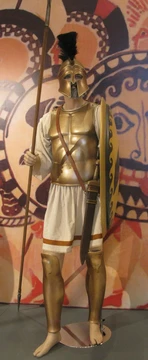
Dendra panoply
Mycenaean bronze armor from the Late Helladic IIIA period.

The Dendra panoply is a suit of full-body armor from the Mycenaean period, constructed from bronze plates. It was found in the village of Dendra in the Argolid, Greece, and is now housed in the Archaeological Museum of Nafplion. Swedish archaeologists unearthed it in May 1960, making it the oldest known example of a beaten bronze cuirass, dating to the Late Helladic IIIA period (c. 1400–1300 BC) or around 1400 BC.
The armor consists of fifteen separate bronze sheets, fastened together with leather thongs, covering the wearer from the neck to the knees. It includes a cuirass made of front and back pieces joined by a hinge on the right side, with fastening loops on the left side and shoulders. Large shoulder guards attach over the cuirass, with two triangular plates protecting the armpits when the arms are raised. A deep neck guard is also present. Three pairs of curved plates hang from the waist to shield the groin and thighs. All pieces are beaten bronze sheet backed with leather, loosely tied with ox-hide thongs to allow some movement, creating a cumbersome tubular suit. The panoply also includes lower arm-guards, along with fragments of a boars'-tusk helmet found in the same grave. Similar armor appears as an ideogram on Linear B tablets from Knossos, Pylos, and Tiryns.
Other bronze armor elements, such as body cuirass parts, shoulder guards, breast plates, and lower protection plates, have been found at Thebes, while bronze bands have been uncovered at Mycenae and Phaistos, and bronze scales at Mycenae and Troy. Greaves, often depicted in late Mycenaean art, were likely made of linen, with the few bronze examples possibly worn over them for status as much as protection, as suggested by Diane Fortenberry. The figures on the Warrior Vase from Mycenae (c. 1200 BC) wear different armor, possibly a leather corslet with a fringed apron or a bronze 'bell' corselet similar to types in central Europe and those worn by the Peoples of the Sea depicted at Medinet Habu.
The panoply has been extensively studied and experimentally tested. In 1988, Diana Wardle used a replica made by students at Bournville College of Art to make initial findings. In 2012, Barry Molloy contributed insights with a different replica. In 2018, Spyros Bakas provided information o
- type
- Bronze armor panoply
- date
- Late Helladic IIIA (c. 1400–1300 BC) or around 1400 BC
- period
- Late Helladic IIIA
- material
- Bronze sheet, leather, ox-hide thongs
- discovered
- May 1960, Dendra, Argolid, Greece
- current_location
- Archaeological Museum of Nafplion
Quick Facts
- Material
- bronze
- Created
- 15th century BC
- Discovered Place
- Mycenaean Tomb number 12 in Dendra, Greece
- Discovered Date
- 1960
- Location
- Archaeological Museum of Nafplion
- Period
- Bronze Age
- Civilization
- Mycenaean
Facts from the source article.
Lore & Background
The Dendra panoply consists of 15 separate pieces of beaten bronze sheet, held together with leather thongs, encasing the wearer from neck to knees. The cuirass has two pieces for chest and back, joined on the right side by a hinge, with fastening loops on the left side and shoulders. Large shoulder guards fit over the cuirass, with triangular plates protecting the armpits when arms are raised. A deep neck guard is present, and three pairs of curved plates hang from the waist to protect the groin and thighs. The panoply also includes lower arm-guards, all backed with leather and loosely fastened by ox-hide thongs for movement.
Reader's Guide
The Dendra panoply is significant as the only complete example of Mycenaean bronze body armor found to date, providing crucial evidence for Late Bronze Age military equipment. Its design appears as an ideogram on Linear B tablets from Knossos, Pylos, and Tiryns, indicating similar armor was known in Mycenaean administrative records. Experimental research, including a 2024 study by the University of Thessaly, demonstrated that a replica allowed armed-forces personnel to complete an 11-hour simulated combat protocol, showing the armor was suited for battle, not merely ceremonial. The panoply's construction—beaten bronze sheets backed with leather—reflects a balance between protection and mobility, though it forms a cumbersome tubular suit. Its discovery at Dendra has informed understanding of Mycenaean warfare, craftsmanship, and connections to Near Eastern armor features, such as the high bronze collar.
Did You Know?
- The Dendra panoply consists of 15 separate bronze sheets, held together with leather thongs.
- A 2024 study by Flouris et al. tested the panoply in 13 hours of simulated combat, finding it did not restrict movement or cause excessive heat stress.
Discovery & Composition
In May 1960, a team of Swedish archaeologists made a remarkable find in the village of Dendra, located in the Argolid region of Greece. Buried in a chamber tomb, they uncovered what would become the earliest known example of a beaten bronze cuirass, dating to the close of the fifteenth century BC. The assemblage, designated the Late Helladic IIIa Dendra Panoply, comprises fifteen individual sheets of bronze that, when assembled, encase a warrior from the neck down to the knees. Among the components are lower arm-guards—a feature for which this single example is the only known bronze specimen—and fragments of greaves that likely supplemented linen leg coverings. Slivers of boar's tusk recovered from the same grave indicate the warrior also wore a tusk helmet. Today the complete set is exhibited at the Archaeological Museum of Nafplion, where it remains the sole fully intact Mycenaean panoply ever recovered.
Engineering & Construction
The panoply's design reveals a sophisticated understanding of articulated protection. The torso is shielded by a two-part cuirass—one plate for the chest, one for the back—connected along the left flank by a hinge mechanism. A bronze loop on the right side of the front plate, mirrored by loops on each shoulder, allowed the garment to be secured. Oversized shoulder guards sat atop the cuirass, and two triangular plates attached to them covered the armpits specifically when the wearer raised his arms. A deep neck guard, a feature also characteristic of Near Eastern body armour, completed the upper protection. From the waist, three pairs of curved bronze plates hung down to guard the groin and upper thighs. Every element was fashioned from hammered bronze sheet, backed with leather, and loosely lashed with ox-hide thongs so the wearer retained a degree of freedom of movement. The result was a heavy, tubular suit that fully enclosed the neck, torso, and legs to the knees.
Place in the Mycenaean Armor Landscape
The Dendra find does not exist in isolation. Fragmentary body-armour elements—cuirass pieces, shoulder guards, breast plates, and lower protection plates—have surfaced at Thebes, while bronze bands appear in deposits from Mycenae and Phaistos, and bronze scales have been recovered at both Mycenae and Troy. Yet no other site has yielded a complete, assembled panoply. Written evidence corroborates the type: Linear B ideograms depicting armour with a clearly discernible neck guard appear on tablets from Knossos (Sc series), Pylos (Sh series), and Tiryns (Si series), confirming that Dendra-style protection was a recognized category across the Mycenaean world. Artistic depictions, however, present a more varied picture. The Warrior Vase from Mycenae (c. 1200 BC, now in Athens) shows warriors in body armour that differs from Dendra—possibly an embossed leather corslet with a fringed apron, reminiscent of the Sea Peoples illustrated at Ramesses III's temple at Medinet Habu, or alternatively a bell-shaped bronze corselet of a type also found in central Europe.
From Ceremonial Assumption to Proven Combat Gear
For decades after its publication in Paul Åstrom's 1977 monograph, the Dendra panoply was often treated as a prestige or ritual object rather than practical battle equipment. That assumption has been steadily eroded by experimental research. In 1988, Diana Wardle tested a replica built by students at Birmingham's Bournville College of Art and reported initial observations on how the armour functioned in motion. Barry Molloy followed in 2012 with a separate replica, focusing on the kinematics of a wearer. Spyros Bakas then produced a meticulous reconstruction in 2018, clarifying the anatomy of each component and the operational capabilities of the warrior inside. The most definitive test came in 2024, when a team at the University of Thessaly under Andreas Flouris, working with Wardle's 1980s replica, had a group of special armed-forces personnel complete an eleven-hour simulated Late Bronze Age combat protocol. Their conclusion was unambiguous: the armour was fully suited to sustained battlefield use, overturning the earlier ceremonial interpretation.
Frequently Asked Questions
What exactly is the Dendra panoply?
It is a full-body suit of bronze armor from the Mycenaean era, covering the wearer from neck to knee. The suit is assembled from fifteen individual bronze sheets lashed together with leather and ox-hide thongs.
How old is the Dendra panoply?
It dates to the Late Helladic II period, roughly 1450 to 1400 BC. That makes it the oldest surviving example of a beaten-bronze cuirass we have from the ancient world.
What materials go into the Dendra panoply?
The armor is built from bronze sheet metal, with leather and ox-hide thongs used to fasten the fifteen separate plates together. There are no metal rivets or hinges—just lashing.
Where was the Dendra panoply found, and where can I see it today?
Swedish archaeologists dug it up in May 1960 at the village of Dendra in the Argolid region of Greece. It is currently on display at the Archaeological Museum of Nafplion.
Why does the Dendra panoply matter to people who study ancient Greek warfare?
Before its discovery, the oldest known bronze cuirass was much later, so the Dendra find pushed the evidence for full-body metal armor back by several centuries. It also reshaped assumptions about Mycenaean military technology and the realism of Homeric descriptions.
More in Ancient Greek military equipment 1-24
Spotted an error? Know more?
This is a living reference — every entry is fact-audited, and reader corrections feed straight into our audit queue. Suggest an edit · See this site's audit record